

Nvidia Stock Price at $180: Discounted Entry or Warning Sign for NASDAQ:NVDA?
After a 15% drop from record highs, NASDAQ:NVDA still prints massive AI cash flows while H200 China tensions, valuation risk and Blackwell/Vera Rubin growth bets collide – is this pullback a real opportunity or a trap? | That's TradingNEWS
NASDAQ:NVDA – AI Infrastructure Leader With China As Pure Upside
NASDAQ:NVDA is trading roughly 15% below its recent high, around the mid-$180s, after a sharp repricing of three forces at once: China blocking H200 shipments, a macro scare around new tariffs that has now cooled, and a market that is only starting to understand that Nvidia is no longer “just a GPU vendor” but the core supplier of full AI factories. The current price already assumes zero H200 revenue from China, while the core AI infrastructure cycle and cash machine are still fully intact.
Macro Backdrop, Tariffs And Why It Matters For NASDAQ:NVDA
The latest macro shock came from Washington rather than Silicon Valley. The administration floated new tariffs on a group of NATO countries starting February 1 as part of the Greenland dispute, then reversed course after talks at Davos and a framework on Arctic cooperation. That U-turn immediately lifted risk assets, pushed yields down and removed the near-term risk that broader tech exports get dragged into another tariff wave.
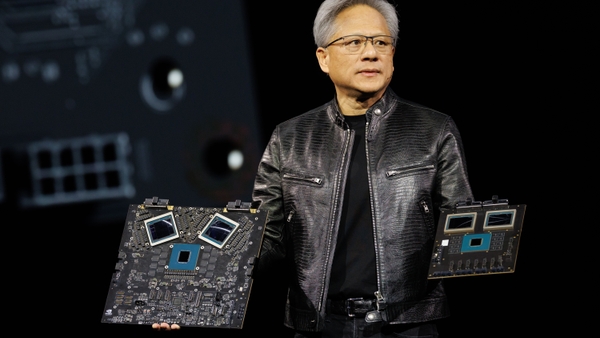
For NASDAQ:NVDA, this matters on two axes. First, it lowers the probability that non-China datacenter shipments get tangled in fresh tariff noise just as hyperscalers ramp another AI buildout leg. Second, Davos itself turned into a showcase for Nvidia’s structural story: Jensen Huang described the AI cycle as the largest infrastructure build in history and stressed that future constraints are energy, land and skilled labor, not willingness to buy compute. At the same time, natural-gas futures exploded more than 50% in two days on extreme cold, and power prices jumped in key regions. Higher structural energy costs are a headwind to AI opex, but they also increase the premium on systems that deliver more intelligence per watt and per rack. Nvidia is designing directly into that constraint set.
China, H200 And The Emerging “Boeing-Style” Political Risk
The H200 episode is the clearest illustration that NASDAQ:NVDA has become a strategic asset in the US–China rivalry. After months of negotiation, a structure was announced under which H200 accelerators for China would first enter the US, incur a 25% tariff, and only then be shipped onward to Chinese customers. Markets initially treated that as a green light for a new multi-billion-dollar demand leg.
The scale was real: Nvidia had line of sight to roughly one million H200 units for China, with a headline value around $30 billion. How much of that converts into profit depends on who ultimately eats the 25% hit. On a simplified $100 H200 sale with $40 cost of goods, Nvidia’s “clean” gross margin would be 60%. If the company absorbs the full $25 tariff, effective gross margin drops toward the mid-30s. If it passes the $25 through to the customer, revenue is preserved but demand elasticity becomes the question.
China has now blocked H200 shipments at customs altogether. That transforms the chip into a bargaining chip, similar to how the country handled Boeing’s 737 MAX: formal approvals are one thing, actual acceptance and deployment are another, and both are timed to maximize political leverage. The key difference is that Nvidia reacted quickly. Suppliers have paused H200 component production to avoid piling up inventory on an architecture that is already behind Blackwell and will be leap-frogged again when Rubin and Vera Rubin arrive. That decision limits the risk of large write-downs if the Chinese market remains shut.
The important point for investors: Nvidia’s official outlook does not rely on those H200 China revenues. The situation is painful because upside has vanished for now, but guidance and most valuation frameworks treat China as optional. If Beijing eventually allows H200 or future parts in size, it is a bonus, not the base case.
From GPUs To Full-Stack AI Factories: The Real Product Of NASDAQ:NVDA
The single biggest misunderstanding about NASDAQ:NVDA is that the competitive game is still “who has the best GPU.” That phase is over. Nvidia used the first AI wave to build a dominant GPU position; the current wave is about selling fully integrated AI systems.
The company’s product stack now runs from silicon to data center: high-end GPUs, CPUs, DPUs, NVLink interconnects, Ethernet fabrics like Spectrum-X, memory hierarchies, and a thick software and tooling layer from CUDA up to domain-specific libraries. On top of that sits Omniverse and simulation tooling that let customers train and test models in virtual environments before they touch real-world assets.
What hyperscalers and enterprises are actually buying is not “another batch of cards” but AI factories: racks and clusters pre-architected for low cost per unit of intelligence. In that context, a GPU in isolation is just a commodity compute block. The economic moat is created at system level through performance, latency, reliability, energy efficiency and software lock-in. Once workloads, models and internal tooling are tuned to Nvidia’s stack, ripping it out to plug in a rival ASIC is technically and operationally expensive.
Vera Rubin, Physical AI And Deep Ecosystem Lock-In
The next growth leg for NASDAQ:NVDA is not text-only generative AI but “physical AI” – systems that interact with the real world: robots, autonomous vehicles, industrial lines, logistics networks and power grids. Those workloads demand persistent, simulation-heavy compute rather than short-bursts chat sessions.
The Vera Rubin platform is built exactly for that world. Nvidia is co-designing GPUs, Vera CPUs, NVLink 6, DPUs, storage hierarchies and cooling as a unified product. Each rack is treated as an intelligent node in a larger AI plant. Synthetic data generation and high-fidelity digital twins inside Omniverse become standard parts of development, reducing the need to experiment on real hardware.
That co-design matters for two reasons. First, it raises the barrier for competitors. It is far harder to copy a full system that spans chips, boards, racks, networking and software than to copy one GPU spec sheet. Second, it deepens customer lock-in. When an automaker or factory operator standardizes on a Vera Rubin–class stack for physical AI, the entire toolchain – from simulation to deployment – becomes tied to Nvidia’s ecosystem. That is where the company’s long-term pricing power sits, not on this quarter’s GPU model number.
Revenue, Margins And Free Cash Flow: Quantifying The NASDAQ:NVDA Engine
The latest numbers show a company that is still in hyper-growth while already operating with “mega-cap platform” cash metrics.
Recent quarterly revenue reached roughly $57 billion, up about 63% year on year, beating expectations by close to $1.9 billion. Within that, Data Center revenue was around $51.2 billion, up roughly 25% sequentially and 66% year on year, underscoring how dominant AI infrastructure has become inside the business mix.
Non-GAAP earnings per share printed near $1.30, ahead of a roughly $1.26 consensus, and management guided the next quarter’s revenue to about $65 billion. Longer-term, the company has pointed to an AI infrastructure revenue opportunity of roughly $500 billion through this year, reflecting both GPU demand and the broader systems pull-through.
Free cash flow is where NASDAQ:NVDA separates itself from typical “high-growth tech.” In the latest quarter, free cash flow surged to around $22 billion, up about 60% versus the prior quarter. Over the past 90 days alone, the business generated roughly $3.17 of free cash flow per share, even while spending heavily on capacity.
At the model level, expectations out to 2028 have Nvidia maintaining strong revenue growth, high gross margins, cash conversion north of 70% and relatively modest CapEx as a share of operating cash flow. Under those assumptions, cumulative free cash flow is enough to push cash balances toward the $200 billion area by the late-decade timeline, all while the company carries no net debt and very limited gross leverage.
Valuation Ranges, Scenario Math And What The Market Is Actually Pricing
Valuation has cooled from the “everything AI” peak, but NASDAQ:NVDA is far from cheap in an absolute sense. The question is whether the current multiple properly reflects the growth, the moat and the China overhang.
One framework built off forward EV/EBITDA and cash-flow forecasts generates a low-end fair value near $201.54, using peer group multiples and 2027 earnings. A more central case, using 2026 earnings with similar relative valuation, lands around $243.53, roughly a third above present levels. An aggressive scenario that blends peer multiples with 2028 earnings power pushes the implied fair value near $303.20, which would represent about 65% upside from the mid-$180s zone.
Separately, a simpler earnings-multiple approach assumes roughly $7.60 in non-GAAP EPS over the next 12 months and applies a 30x multiple, leading to a target near $228. That is not a speculative multiple for a business that just grew revenue 63% and free cash flow 60% quarter-on-quarter, especially when many software names with slower growth trade at similar or higher multiples.
The key nuance is that all of these valuation bands are constructed without assuming that the H200 China backlog converts. The optimistic $303-range output effectively requires either faster-than-modeled global AI infrastructure demand, a better relative multiple, or a reopening of China at scale. The base and low cases do not.
Balance Sheet Strength, Cash Build And Capital Allocation Capacity
On the balance sheet, NASDAQ:NVDA is moving into a position that looks more like a sovereign wealth fund than a typical semiconductor company. The business carries negligible net debt against explosive EBITDA, with gross debt tiny relative to free cash generation.
With free cash flow running at more than $20 billion a quarter and likely to grow, Nvidia has several levers: it can fund aggressive R&D across GPUs, CPUs, networking and software; it can expand system-level manufacturing and datacenter partnerships; it can continue disciplined share repurchases; and it can selectively pursue acquisitions that reinforce the stack.
The core risk in this profile is not solvency or liquidity; it is capital allocation discipline. With projected cash approaching $200 billion by 2028 under reasonable scenarios, the main concern is whether management channels that pool into high-return projects rather than empire-building. So far, the focus on reinforcing the AI stack rather than diversifying into unrelated categories is a positive signal.
Read More
-
Reddit Stock Price Forecast - RDDT at $212: Hyper-Growth, 91% Margins And A Path Toward $300–$400
22.01.2026 · TradingNEWS ArchiveStocks
-
XRP Price Forecast: XRP USD Holds Around $1.94 After 19% Slide From January Highs
22.01.2026 · TradingNEWS ArchiveCrypto
-
Natural Gas Futures Forecast - Price Rocket 75% to 2022 Highs on Arctic Blast and Storage Shock
22.01.2026 · TradingNEWS ArchiveCommodities
-
Stock Market Today: Dow Jones 49,321 and Nasdaq 23,353 Rally After Trump Scraps Greenland Tariffs
22.01.2026 · TradingNEWS ArchiveMarkets
-
USD/JPY Price Forecast - Pairs Charges Toward ¥159.45 as BoJ Risk and US Data Fuel Bullish Momentum
22.01.2026 · TradingNEWS ArchiveForex
Technical Structure: 15% Pullback, Key Levels Around 170–195
Technically, the chart has finally given bears something to point at. After an extraordinary run, NASDAQ:NVDA has slid about 15% from its all-time high, underperforming the S&P 500 in the recent risk wobble.
The daily pattern resembles a potential head-and-shoulders structure, with the neckline sitting around $170, roughly aligned with the rising 200-day moving average. A clean break and sustained trade below that area would confirm the topping pattern and raise the risk of a more pronounced correction. Longer-term support sits near $153, which marked the range highs in 2024.
On the upside, a decisive move back above roughly $195 would go a long way toward negating the head-and-shoulders setup and reasserting the long-term uptrend. Options markets are currently pricing a modest single-digit percentage move for the next earnings release, suggesting that implied volatility is not especially elevated despite the macro noise.
In other words, the chart is fragile but not broken. Long-term investors should treat $170 as a key risk reference and $195 as the first confirmation level that the recent sell-off was a healthy reset rather than the start of a cyclical top.
Risk Map: Competition, Regulation, Energy Costs And China Stalemate
The obvious headline risk is China. If the H200 impasse morphs into a broader, multi-year block on high-end Nvidia systems while rivals gain share in that market, the “optional upside” narrative becomes a structural cap. That would not derail the global AI story but would limit one of the biggest incremental demand pools.
Competition is intensifying. Large cloud providers are deploying their own accelerators, and traditional rivals are closing the gap on raw GPU performance. That will pressure stand-alone chip pricing over time. Nvidia’s defense is the full-stack system and software lock-in; if it ever loses that advantage, the margin and growth profile re-rates lower.
Regulatory pressure is another line of risk. Dominance in AI infrastructure invites antitrust scrutiny and national-security oversight. Export controls, forced divestitures or heavy-handed interoperability mandates could weaken the moat.
Finally, the energy and power-grid angle cannot be ignored. AI factories are enormous electricity sinks. If power prices stay structurally higher, or if regulators impose caps on data-center expansion, customers will become even more sensitive to energy efficiency and total cost of ownership. Nvidia’s strategy of designing for lower cost per unit of intelligence suits that environment, but it must keep executing at the system-level to stay ahead.
Buy, Sell Or Hold NASDAQ:NVDA? A Clear Verdict
Pull everything together and the picture is straightforward. At current levels, NASDAQ:NVDA offers:
A business growing revenue more than 60% year on year and printing around $22 billion in quarterly free cash flow.
A full-stack AI infrastructure moat that competitors cannot replicate quickly, reinforced by Vera Rubin and the physical-AI push.
A balance sheet on track toward $200 billion in cash by 2028 with no net debt.
A valuation where reasonable base-case targets cluster in the $225–$245 band, with upside scenarios stretching toward $300+, and downside technically anchored around $170 support unless macro or regulatory shocks arrive.
China has moved from “promising growth driver” to “political wild card,” but the stock is not priced as if that pipeline will be realized. That makes any eventual thaw a positive surprise rather than something required for the thesis.
On that basis, the appropriate stance is Buy. The stock is not cheap, and volatility around tariffs, China, energy and regulation will be high. But the combination of structural position in AI infrastructure, cash generation, system-level moat and a current price that already bakes in a lot of China bad news still tilts the risk–reward in favor of owning NASDAQ:NVDA on a multi-year view rather than trading around the latest headline.