


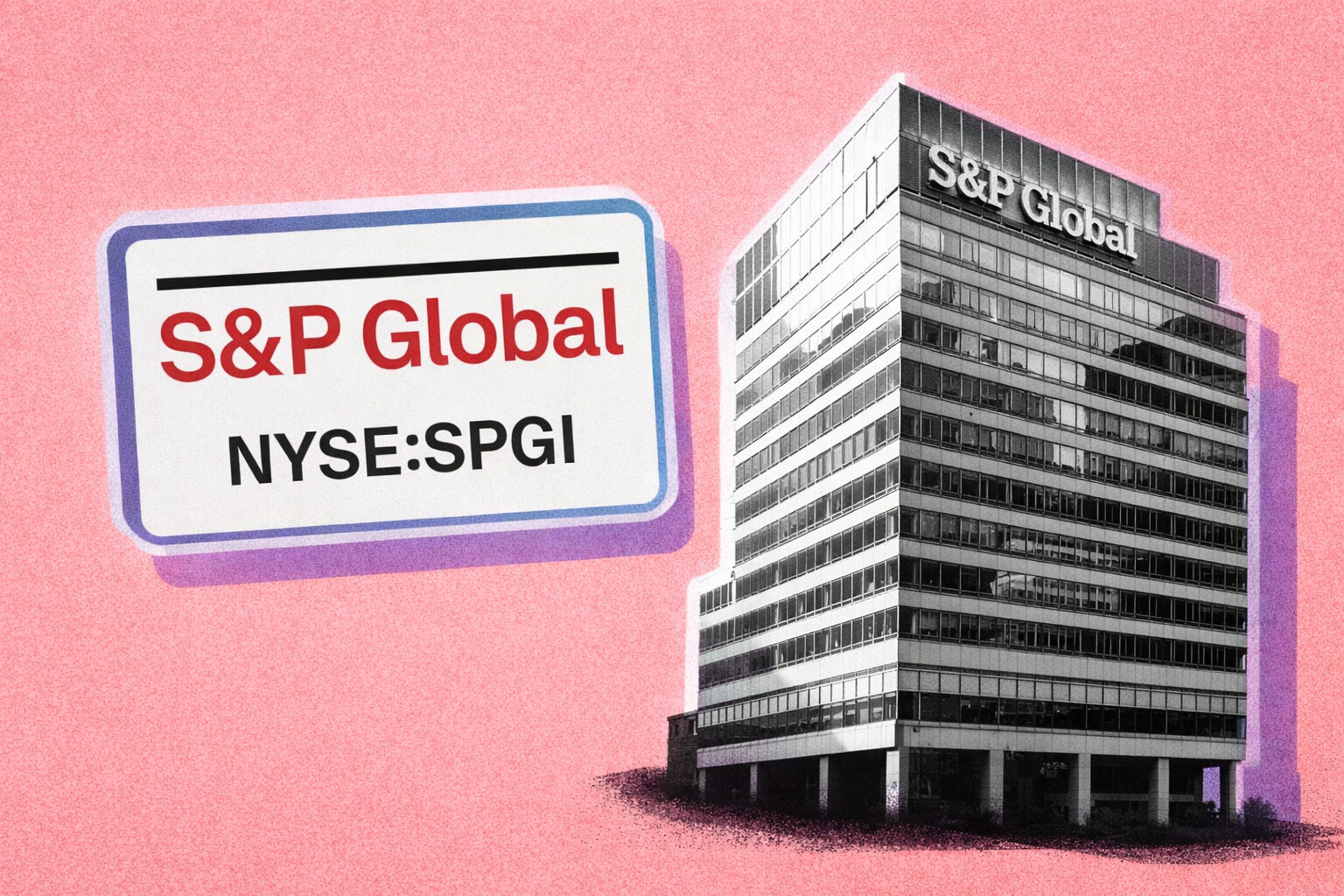
S&P Global Stock Price Forecast - SPGI at $527.79 – Can S&P Global’s Data Empire Run to $800–$900 Next?
With ratings and index margins above 60%, a post-spin margin lift, a $2.5B repurchase plan and EPS rising from ~$18 toward $28+ by 2029, S&P Global (SPGI) still looks built for long-term upside | That's TradingNEWS
NYSE:SPGI – Long-Term Compounding At A Premium Price
S&P Global Inc NYSE:SPGI trades around $527.79 per share, with a market cap near $159.8 billion, a trailing P/E of roughly 38.4x and a forward multiple closer to 29–30x on 2025–2026 earnings, against a dividend yield of about 0.74%. Live pricing and intraday moves are on the NYSE:SPGI real-time chart. The stock is not cheap on headline metrics, but the entire case rests on whether you believe this is a 10%-plus EPS compounding machine with durable oligopoly economics in ratings, indices and proprietary data.
Business Mix And Moats Support Premium For NYSE:SPGI
NYSE:SPGI is effectively three high-quality franchises wrapped into one: global credit ratings, index licensing (S&P Dow Jones Indices) and the Market Intelligence / data platforms. Ratings and indices carry operating margins in the 60–70% range, with ratings margins around the mid-60s and index margins above 70%. Market Intelligence sits lower, around the low-30s on an adjusted basis, but is still a highly profitable, mostly recurring subscription business. Revenue growth over the last decade averaged about 11% per year, with EPS compounding even faster due to margin expansion and buybacks. Over the past five years, revenue still grew in the mid-teens, while reported EPS growth moderated as the IHS Markit integration and portfolio reshaping worked through the P&L. Today roughly 95% of group revenue is proprietary data or IP-driven services, and Market Intelligence has about 96% recurring revenue. That mix is exactly what justifies a structurally higher multiple than a typical financial stock and explains why the stock holds a premium valuation even when the cycle in debt issuance is not at its peak.
Growth Math For NYSE:SPGI – From $17.85 EPS Toward $53–54
The core long-run case for NYSE:SPGI is straightforward: take today’s earnings power, assume the company continues to compound in line with its own targets, and ask what that implies for returns if the multiple merely normalizes around its historical average. Management is targeting 7–9% organic revenue growth in constant currency, plus 50–75 basis points of margin expansion per year, with double-digit adjusted EPS growth over the next 3–5 years. Using a base EPS around $17.85 and assuming ~12% annual EPS growth to 2028, then 10% per year through 2036, you get to roughly $53.75 of EPS in a decade. That trajectory implies an earnings yield north of 10% if the stock did not move at all from here. The historical forward P/E for NYSE:SPGI sits close to 30x; current 2026 forward P/E around 26.7x is actually below that long-term average and represents some margin of safety for a franchise of this quality. If the market is still willing to pay about 25x earnings in 2036 for a mature but still growing information utility, $53.75 of EPS at 25x points to a share price around $1,343 – about 152% upside over 10 years. Broken down, that is roughly 9.9% annual total return before dividends, and that figure can be higher if execution beats the 10–12% EPS growth band or the multiple stays closer to 28–30x instead of compressing to 25x.
Private Markets Strategy – NYSE:SPGI As Infrastructure Layer
A key structural leg for NYSE:SPGI now is its push into private markets infrastructure. Global private assets are around $21 trillion, and that ecosystem still suffers from a basic transparency and standardization gap. By integrating With Intelligence’s allocator-sourced dataset—covering more than 30,000 LPs and GPs—with iLEVEL’s portfolio monitoring tools—used by 700+ clients tracking over 16 billion data points—S&P Global is positioning itself as the interoperability layer for private capital. The strategic goal is not to simply sell more data licences; it is to create the de facto reporting standard for private equity and private credit, in the same way GICS and S&P’s ratings taxonomy dominate public markets. If GPs have to report in NYSE:SPGI-defined formats because LPs demand comparable data across funds, the result is a self-reinforcing network: more clients drive better benchmarks, better benchmarks force more clients onto the platform. That structure shifts private-market products from a “nice-to-have” data spend towards a quasi-infrastructure spend that is very difficult to cut in a downturn. Over time, that supports higher pricing power in Market Intelligence and Ratings, decouples growth from pure issuance cycles, and justifies a valuation closer to a mission-critical data utility than a cyclical financial.
Market Intelligence, AI Risk And The Seat-Based Model At NYSE:SPGI
The main forward risk to NYSE:SPGI is not whether clients still want data; it is how they consume it. Market Intelligence generates roughly 36% of group revenue, heavily skewed to high-margin desktop and advisory products sold on per-seat licences. Those licences can easily run into the tens of thousands of dollars per user per year. The risk is that large banks, asset managers and hedge funds increasingly deploy autonomous AI agents that pull data directly via APIs and internal models, rather than through human analysts living inside a GUI like Capital IQ Pro. If a firm replaces 500 junior seats at, for example, $20,000+ per year with one large enterprise feed used by AI agents, NYSE:SPGI preserves volume but compresses revenue per unit of consumption. The company estimates around 12% of Market Intelligence revenue is tied to undifferentiated content such as public filings and transcripts. In an LLM world, that slice is most vulnerable to commoditization as agents can scrape, reconstruct and contextualize public information at near-zero marginal cost. The defence is that roughly 95% of group revenue is now proprietary IP: structured credit data, private markets datasets, bespoke analytics, ratings and methodologies that cannot legally or practically be replicated by scraping. The strategic response is to shift from pure workstation licences to LLM-ready, machine-to-machine APIs and embed S&P’s content deep inside clients’ AI workflows. If that migration is managed aggressively and pricing is adapted, the mix shift from GUI to headless consumption will hit unit economics but should not destroy the long-term growth story. The risk is margin drag if the model changes faster than cost structures or pricing strategies adjust.
Ratings, Indices And The $8.2 Trillion Refinancing Wall For NYSE:SPGI
The Ratings and Indices businesses remain the backbone of NYSE:SPGI’s economics. Ratings is an oligopoly: alongside a small number of global peers, S&P’s ratings are effectively mandatory for most institutional debt investors. Across corporate, sovereign and structured markets, the firm faces an $8.2 trillion “maturity wall” through 2028—debt that must be refinanced, repriced or restructured. That wall is the pipeline for billed issuance: management is looking for mid-to-high-teens growth in billed issuance in Q4 2025, using that refinancing flow as the main driver. Ratings margins in the low-to-mid-60s magnify that volume into very high incremental profit when issuance is strong, but they also make Ratings appear cyclical whenever issuance pauses. Indices is a smaller piece of revenue at about 13% of the group but is arguably one of the most attractive businesses S&P owns. S&P Dow Jones Indices is deeply embedded across ETFs, index-tracking funds and derivatives. As global AUM tracks equity markets and more products get wrapped around the indices, fee revenue grows almost organically. High-margin licensing revenue scales with market levels and fund inflows without incremental capital requirement. In an environment where passive and factor products keep gaining share, indices support secular growth in the mid-single to high-single digits with operating margins over 70%. Together, Ratings and Indices give NYSE:SPGI a combination of cyclical upside (issuance cycles) and secular fee growth that is very hard to replicate.
Read More
-
Starbucks Stock Price Forecast - SBUX Near $92: Is NYSE:SBUX Still Just A Hold After Q1 FY26?
31.01.2026 · TradingNEWS ArchiveStocks
-
XRP Price Forecast – XRP-USD Slides to 90-Day Lows Near $1.60
31.01.2026 · TradingNEWS ArchiveCrypto
-
Oil Price Forecast: WTI Near $65 and Brent Around $69 as Geopolitics Collide with US Weather Shock
31.01.2026 · TradingNEWS ArchiveCommodities
-
Stock Market Today – Dow, S&P 500 and Nasdaq Slide as Gold Crashes; AAPL, XOM, DECK in Focus
31.01.2026 · TradingNEWS ArchiveMarkets
-
GBP/USD Price Forecast: Sterling Defends 1.37 Pivot Before NFP and BoE
31.01.2026 · TradingNEWS ArchiveForex
Mobility Spin-Off, Margin Uplift And Re-Rating Potential For NYSE:SPGI
The planned spin-off of the Mobility division is central to how the market should think about the valuation of NYSE:SPGI over the next cycle. Mobility contributes around 11.5% of consolidated revenue at an adjusted operating margin of roughly 39.5–40%, materially lower than Ratings and Indices and somewhat below the rest of the information stack. After separation, the “New S&P Global” will be more tightly focused on high-margin, high-recurrence data and analytics with a consolidated recurring proprietary revenue share above 95%. Using 2025 guidance, and stripping out roughly 9.5% of the bottom line attributed to Mobility, you get to an adjusted EPS base of about $16.15 for the remaining operations. Apply a conservative 15% annual EPS growth rate (lower than the historical ~17% and slightly above management’s medium-term double-digit target), and you get an estimated $28.25 of EPS in 2029 for the post-spin entity. If the market awards that cleaner, higher-margin, more recurring mix a forward P/E of 30.75x—essentially a reversion towards the five-year forward average for NYSE:SPGI—the implied 2029 price is around $869 per share. From about $528, that is more than 60% upside over four years, before dividends. The logic is that the spin removes a lower-margin, more cyclical asset, lifts group margins, and clarifies the profile: an information utility with dominant franchises, not a mixed financial services conglomerate.
Balance Sheet, Capital Returns And Insider Signals At NYSE:SPGI
Capital allocation remains disciplined and supports the long-term compounding story for NYSE:SPGI. The company has authorized a $2.5 billion share repurchase program for Q4, which provides direct support under the stock during periods of volatility. At the current price around $527.79, that envelope alone can retire roughly 4–5% of the share count if fully executed at similar levels. The dividend yield around 0.74% looks modest, but the payout ratio is deliberately low to keep cash available for buybacks, bolt-on deals and organic investment in new data sets and technology.
Valuation View And Verdict On NYSE:SPGI – Buy, Sell Or Hold
At roughly $527.79, NYSE:SPGI trades on a trailing multiple near 38x and a forward multiple in the high-20s, against a medium-term EPS growth runway of 10–15% and structural advantages that are extremely difficult to replicate. Two different long-term lenses—one projecting EPS from $17.85 to about $53.75 by 2036, the other taking a post-Mobility base EPS of $16.15 to about $28.25 by 2029—both point to high-single to low-double-digit annualized returns if the market maintains anything close to a 25–31x earnings multiple. On the risk side, agentic AI could compress per-seat economics in Market Intelligence faster than S&P Global can re-price its data feeds and adjust its cost base, and regulation can always cap pricing power in ratings or benchmarks. But the counterweight is an increasingly proprietary revenue mix, recurring contracts in the mid-90s as a percentage of sales, an $8.2 trillion refinancing wall feeding ratings volume, and a growing role as infrastructure for both public and private capital markets. On balance, for a long-term investor who is comfortable paying a quality premium, the risk–reward remains attractive. With the current valuation slightly below the historical forward P/E average and multiple structural growth drivers intact, NYSE:SPGI is a Buy, with the caveat that position sizing should respect the high absolute price and the potential for short-term drawdowns if macro or AI headlines temporarily hit high-multiple data and analytics names.