


Starbucks Stock Price Forecast - SBUX Near $92: Is NYSE:SBUX Still Just A Hold After Q1 FY26?
Traffic and comps are finally rebounding, but NYSE:SBUX margins, free cash flow, the Boyu China deal and a 2.7% yield now decide whether this $75–$117 range stock breaks higher or stays a valuation trap | That's TradingNEWS
NYSE:SBUX – Turnaround Traffic Is Back, Profitability Still On Trial
NYSE:SBUX – Price, Range And Market Context
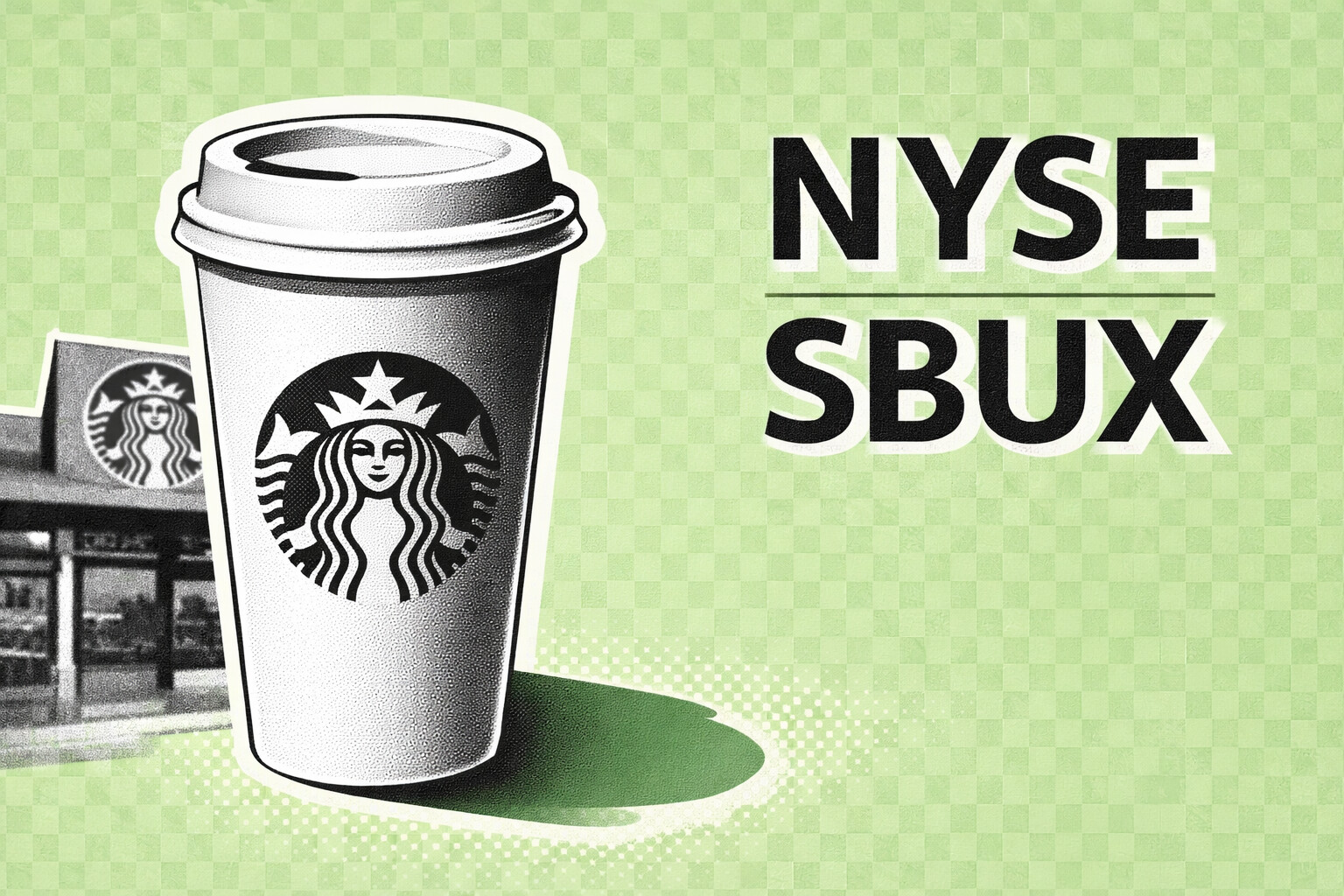
NYSE:SBUX last closed around $91.95 with after-hours trading near $91.82, down about 2.1% on the day. The stock traded between $91.00 and $93.21 intraday, versus a 52-week range of $75.50–$117.46, which puts it in the lower half of its yearly band. Market capitalization is roughly $104.8B. The trailing P/E sits near 76.6x, while the forward multiple implied by FY26 guidance is about 40x, and the current dividend yield is around 2.7%. At these levels the market is clearly treating Starbucks as a premium, global consumer franchise in the middle of a multi-year reset, not as a cheap recovery trade. Anyone looking at the name must understand that a significant part of the margin repair story is already reflected in the price. For live price action and liquidity context, the stock can be tracked via the NYSE:SBUX real_time_chart.
NYSE:SBUX – Q1 FY26 Numbers: Strong Sales, Weak Earnings
In Q1 FY26, Starbucks reported revenue of $9.92B, up roughly 5.5–6.0% year over year and ahead of consensus by about $260M, even beating the top end of Wall Street revenue estimates around $9.79B. That top-line beat did not translate into earnings strength. Non-GAAP EPS was $0.56, down about 19% versus the prior year and $0.03 below Street expectations. GAAP net income dropped to $293.3M, a severe 62.4% decline, pulling net margin down to 2.96%, a compression of more than 64% year over year. On the operating side, margins remain the key pressure point. Adjusted operating margin is running near 10.1%, roughly 180 basis points lower than a year ago, and trailing-twelve-month operating margin has slipped to around 9.5%. In North America, which is still the economic engine, the hit is harsher: segment operating margin fell from 16.7% to 11.9%, a deterioration of 480 basis points, even as sales recovered. The quarter proves demand is healing, but the profit and loss statement still reflects the cost of the reset.
Read More
-
S&P Global Stock Price Forecast - SPGI at $527.79 – Can S&P Global’s Data Empire Run to $800–$900 Next?
31.01.2026 · TradingNEWS ArchiveStocks
-
XRP Price Forecast – XRP-USD Slides to 90-Day Lows Near $1.60
31.01.2026 · TradingNEWS ArchiveCrypto
-
Oil Price Forecast: WTI Near $65 and Brent Around $69 as Geopolitics Collide with US Weather Shock
31.01.2026 · TradingNEWS ArchiveCommodities
-
Stock Market Today – Dow, S&P 500 and Nasdaq Slide as Gold Crashes; AAPL, XOM, DECK in Focus
31.01.2026 · TradingNEWS ArchiveMarkets
-
GBP/USD Price Forecast: Sterling Defends 1.37 Pivot Before NFP and BoE
31.01.2026 · TradingNEWS ArchiveForex
NYSE:SBUX – Back To Starbucks Strategy And Traffic Recovery
The Back to Starbucks strategy is built around one critical objective: get customers back into the stores consistently. The Q1 numbers show that this is working. Global comparable store sales grew 4%, marking the first meaningful positive comp after two years of weakness. The quality of that comp is important. Transactions rose 3% globally, meaning most of the comp came from higher traffic, not just pricing. In North America, the shift is even more notable. The region posted 4% comp growth after a prior year period that saw a 4% decline and an 8% drop in transactions. Transaction growth has swung by about 1,100 basis points from -8% to +3%, a clear sign that consumers are responding to the new service model. International markets also contributed, with around 10% revenue growth and 5% comp growth, supported by better traffic. The pattern is consistent: more visits per store and healthier like-for-like sales, driven by operational changes rather than simple price increases. That is exactly what you want to see when judging whether a service-led turnaround is real.
NYSE:SBUX – China, Boyu Capital Joint Venture And International Expansion
China was a drag on the story a year ago; now it is turning into a controlled growth lever. In the latest quarter, China comparable sales increased about 7%, with transactions up 5%, showing that the brand is regaining traction despite intense local competition. The strategic shift is the pending transaction with Boyu Capital, in which Starbucks will sell 60% of its China operations at a deal value of roughly $4B, implying about $2.4B in cash proceeds to Starbucks. That move has two functions: it frees capital to support the global turnaround and dividend while reducing direct exposure to the volatility and pricing battles in China, but keeps upside through the retained stake and brand control. Outside China, the international expansion agenda remains aggressive. Management’s FY28 framework calls for a run-rate of around 2,000 new store openings per year, including approximately 400 new US company-operated stores. With more than 41,000 stores globally already, that planned build-out shows management is not just defending the current footprint; it is betting that there is still significant whitespace demand for the Starbucks format.
NYSE:SBUX – Service-Led Reset, Throughput And Cost Structure
The core of the Back to Starbucks reset is service and throughput, not cost cutting. Management is deliberately spending into the P&L to fix the experience. That means more partners on the floor at peak times, next-generation espresso and cold beverage equipment designed to speed up drink production, improved order-sequencing technology, and better integration between in-store, mobile, drive-through and delivery so they work as one system instead of competing lanes. These changes are measurable in the +3% global transaction growth and the rebound of North American traffic. They are also visible in margins. While reported operating expense in the quarter was $1.17B, down around 4.5% year over year on the headline figure, the mix has shifted toward labor and store-level investments that suppress operating margin today. There is no free lunch here: Starbucks is consciously accepting lower short-term profitability in exchange for restoring throughput and service quality, with the expectation that higher traffic and better in-store economics will support a margin rebuild over the next several years.
NYSE:SBUX – Margin Compression, FY26 Guidance And FY28 Targets
Margin compression is still the biggest question mark around NYSE:SBUX. Consolidated adjusted operating margin near 10.1% is well below both historical levels and management’s medium-term target. Net margin at 2.96% and net income down 62% year over year underline how acute the profit squeeze has become. Several drivers are converging: wage inflation and higher staffing, store-level investments tied to the turnaround, and the recent period of elevated coffee costs driven by tariffs. The tariff impact should fade as the November 2025 removal rolls fully through the cost base during FY26. Management’s guidance for FY26 is conservative but directional. Global and US comparable sales are expected to grow at 3% or higher, with total revenue set to grow at a similar low-single-digit pace. Non-GAAP operating margin is guided to improve modestly from FY25’s ~9.9%, and non-GAAP EPS is guided between $2.15 and $2.40, with the midpoint $2.28, implying roughly 7% growth after a 36% EPS collapse in FY25. The longer-term FY28 framework calls for sales growth above 5% annually, driven by around 3% comps and 2–3% from new stores, and an operating margin band of 13.5–15%, above today’s roughly 10% but still below the 16.1% peak achieved in FY23. These numbers effectively say that FY25–FY26 is the margin trough, FY27–FY28 is the rebuild phase, and Starbucks is targeting a structurally lower but still attractive profitability profile anchored by higher traffic and a larger global base.
NYSE:SBUX – Cash Flow, Dividend Sustainability And Balance Sheet
The free-cash-flow picture is what forced management to pause buybacks and raised investor anxiety about the dividend. Trailing-twelve-month free cash flow is around -$2.29B, a sharp reversal from historic positive FCF. Cash from operations over the last twelve months is about $1.60B, down nearly 23% year over year, while dividends on a trailing basis exceed free cash flow by roughly $0.5B, creating a visible funding gap. At the same time, the company generated a positive net change in cash of about $193.6M, as cash from investing and financing was tightly managed. Cash and short-term investments stand near $3.60B, about 9% lower year over year, but still a comfortable buffer. Total assets are about $32.23B, total liabilities about $40.61B, leaving reported equity negative at -$8.38B and a stated price-to-book ratio of roughly -12.8x. That negative equity is mainly the result of past buybacks and lease accounting, not an imminent solvency threat. The correct read today: buybacks are on hold until free cash flow turns, but the ~2.7% dividend yield looks defendable when you combine existing cash with the expected $2.4B proceeds from the Boyu China deal, as long as the turnaround continues to translate into better operating profit. For a granular view of management and insider behavior, monitoring SBUX insider_transactions and the broader SBUX stock_profile is essential; a credible margin recovery should, over time, be confirmed by either insider accumulation or at least the absence of heavy insider selling.
NYSE:SBUX – Competitive, Macro And Execution Risks
The risk set around NYSE:SBUX is not exotic, but it is real. Competition is intense across all segments: global chains, regional players and local independents. In markets like China, aggressive discounting and constant format innovation can erode unit economics and force heavier promotional spend. At the same time, Starbucks is heavily exposed to discretionary consumer spending. With net margin already near 3% and operating leverage high, a slowdown in US or international demand, particularly in premium beverages, would hit earnings disproportionately. Input cost volatility remains a structural vulnerability; the recent coffee tariff cycle showed how quickly commodity and policy shocks can compress margins. Consumer preferences are also evolving, with health and wellness trends putting pressure on sugary beverages and forcing constant menu innovation. On top of that, the entire equity story depends on flawless execution of the Back to Starbucks strategy. If comp growth slips back below 3%, if transaction growth stalls, or if operating margins fail to progress toward the 13–15% band outlined for FY28, the market will likely compress the multiple and reassess the premium narrative around the brand.
NYSE:SBUX – Final Rating For Investors Watching NYSE:SBUX
At around $92 per share, NYSE:SBUX trades essentially in line with a reasonable fair-value band of roughly $90–100 based on FY26–FY28 assumptions: revenue growing in the mid-single digits, operating margin recovering from about 10% toward the 13.5–15% range, free cash flow turning positive as investment intensity peaks and tariffs roll off, and the dividend maintained with buybacks still paused. The brand is strong, the traffic recovery is genuine, and the service-led reset under Brian Niccol is the right strategic choice, but the stock already embeds a high probability that this turnaround succeeds. On the data in front of you now, the clean call is that NYSE:SBUX is a HOLD. Long-term investors with a multi-year horizon can stay in the name and let the margin story play out, but an aggressive new entry would be more attractive on a pullback into the high-$70s or low-$80s, or after hard evidence that operating margins are moving decisively toward the mid-teens faster than the current guidance implies.