



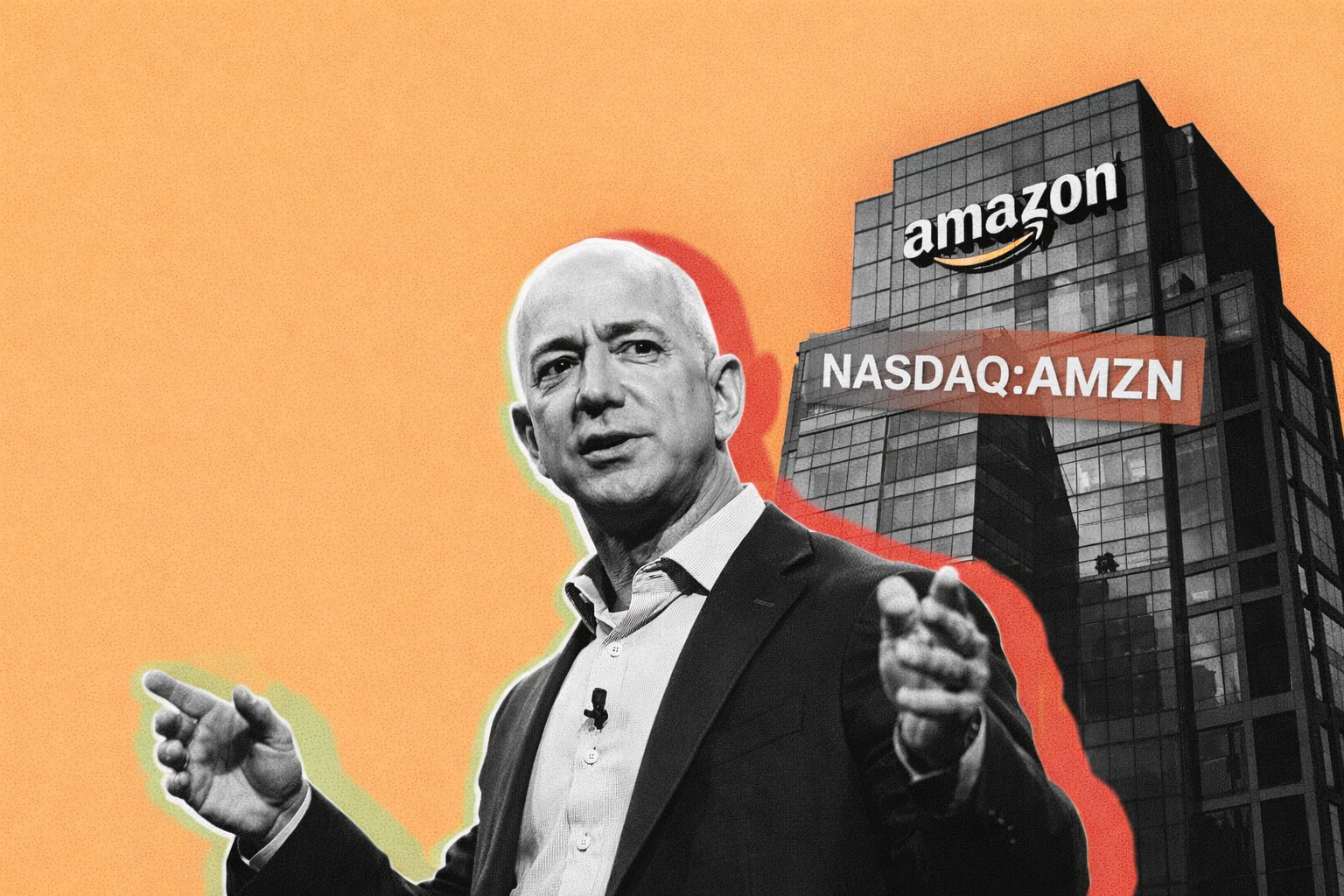
Amazon Stock Price Forecast - AMZN Stock; AI Capex, AWS Acceleration And The Road To $300
Amazon stock hovers around $231, below its $258.60 high, while Q3 2025 revenue hits $180.2B, net income jumps 38% to $21.2B | That's TradingNEWS
NASDAQ:AMZN – Repricing A $2.4 Trillion AI–Retail Hybrid
Macro Backdrop: K-Shaped Economy And What It Really Means For NASDAQ:AMZN
The U.S. consumer landscape is split. Lower-income households are cutting discretionary spend and prioritizing essentials, while higher-income cohorts continue to spend at a healthy pace. Tariff-driven inflation is still moving through the system with a lag as old inventories clear and new, higher-cost stock flows in. That is exactly the environment where online comparison shopping and value hunting accelerate. For NASDAQ:AMZN, with roughly 73% of revenue tied to retail and ads and around 60% from online stores plus third-party services, the macro pressure pushes users toward its marketplace instead of away from it.
At the same time, equity risk is elevated. Consumer confidence has rolled over, recession chatter is louder, and broad indices are trading at rich cyclically adjusted multiples. NASDAQ:AMZN carries a beta approaching 2, so any broad risk-off episode will hit the stock harder than the S&P 500 in the short term even if fundamentals hold. The set-up is therefore asymmetric: short-term volatility risk is high, but the behavioural shift – more online, more price sensitivity, more delivery – feeds directly into Amazon’s core.
Retail Engine: E-Commerce, Third-Party Sellers And Perishables Supporting NASDAQ:AMZN
Retail still dominates the top line. In Q3 2025, NASDAQ:AMZN reported revenue of $180.17B, up 13.4% year-on-year. North America generated $106.27B, up 11%, and international markets delivered $40.90B, up 12%. Online stores and 3P services remain the backbone of those figures. In a softer economy, that mix tilts toward value categories and marketplace offers rather than high-margin discretionary, but the volume migration stays inside Amazon’s ecosystem.
Perishable grocery delivery is strategically critical. Amazon has extended sub-5-hour perishable delivery to more than 1,000 cities. That moves NASDAQ:AMZN deeper into recurring, non-discretionary spend: food and weekly household baskets. In a world of expensive fuel and time, a frictionless grocery solution is a direct substitute for brick-and-mortar trips. Short term, this network is capex- and opex-heavy and weighs on segment EBIT. Over time, as route density improves and more automation is deployed in fulfilment centres, each incremental grocery order drops through at higher margin. The key point: the company is deliberately trading near-term retail margin for durable share in essential categories.
AI Shopping Assistant And Ads: Margin Machines Under The Surface For NASDAQ:AMZN
The retail surface is being re-wired by AI and advertising. Rufus, Amazon’s AI shopping assistant, has reached about 250M users and is tracking toward roughly $10B in annualized sales influence. It steers customers faster to relevant products, increases conversion and basket size, and does it without linear headcount growth. That gives NASDAQ:AMZN real operational leverage inside retail.
Advertising is the silent profit engine. Since 2019, ads have grown from around 4.5% of revenue to roughly 9.35%, with expectations to move into double digits in 2026. In Q3 2025, the ad segment grew 24% year-on-year, the fastest of the major lines. Because Amazon monetizes traffic already on its properties, traffic acquisition costs are structurally low. As brands face margin pressure and cut wasteful marketing, they gravitate to channels that tie spend directly to purchase intent. Amazon offers that at scale. For NASDAQ:AMZN, this means that even if pure retail growth moderates, mix shift toward high-margin ads and AI-driven merchandising supports continued expansion in gross and operating margins.
AWS, Trainium And Agentic AI: The Real Multiple Driver Behind NASDAQ:AMZN
The valuation story for NASDAQ:AMZN is increasingly anchored in AWS and its AI stack rather than retail. AWS is running near a $132B revenue run-rate with growth re-accelerating above 20% year-on-year in Q3 2025 and a backlog around $200B. The strategic shift is from being a generic cloud host for gen-AI to being the base infrastructure for agentic AI – systems that run continuous Thought–Action–Observation loops and handle autonomous enterprise tasks.
Enterprise agents such as Manus have already reached about a $90M revenue run-rate within months, built on Amazon’s AgentCore framework. That framework standardizes orchestration of agents across workflows, making AWS the operating environment for autonomous labour. Monetization here is different: instead of billing just for compute and storage, AWS charges for outcomes and continuous automation.
Silicon sovereignty amplifies this. Trainium3, built on a 3nm process, and the NVLink-integrated Trainium4 architecture are designed to deliver roughly 30–40% better price-performance versus legacy GPU configurations on the workloads that matter. Project Rainier – about 500,000 Trainium2 chips deployed for Anthropic – demonstrates that frontier models can be optimized for Amazon’s own silicon at industrial scale. As more agents run on Trainium, enterprises get lower unit costs and better integration, while NASDAQ:AMZN locks in long-duration, high-margin demand tied directly to its proprietary hardware.
This combination – custom silicon, model infrastructure (Bedrock / Nova) and agent orchestration (AgentCore) – turns AWS into a closed economic loop. Data generated by agents stays in S3 and Kinesis, model hosting stays on AWS, and the cost and complexity of moving those workloads elsewhere becomes prohibitive. That is the foundation for multiple expansion in the AWS component of NASDAQ:AMZN over the next cycle.
P&L Snapshot: Profitability Inflection Already Visible At NASDAQ:AMZN
The Q3 2025 income statement shows a company past the worst phase of this capex build-out. Revenue of $180.18B rose 13% year-on-year. Advertising services grew 24%, AWS 20%, and third-party services 12%. North America and international both posted double-digit growth.
Cost of revenue increased 10% to $88.67B, but gross profit rose 17% to $91.50B, pushing gross margin to 50.78%. Operating expenses jumped 22% to $74.09B, driven mainly by technology and content spend up 30% to $28.96B as AI, data centres and logistics investments ramped. Operating income held roughly flat at $17.42B, delivering an EBIT margin of 9.67%.
Below operating income, pre-tax profit surged 56% to $28.17B, with a $10.75B gain tied largely to the Anthropic investment. Income tax expense rose 158%, but net income still climbed 38% to $21.19B. EPS printed at $1.95, beating consensus by $0.39. Net margin reached about 11.8%, up more than 20% year-on-year. For a business deploying over $100B of capex annually, holding EBIT steady and lifting net margin and EPS at this rate signals that high-margin segments are more than offsetting the near-term drag from infrastructure build-out.
Read More
-
XAR ETF: Defense-Tech ETF Riding Trump’s $1.5 Trillion Military Super-Cycle
21.01.2026 · TradingNEWS ArchiveStocks
-
XRP ETFs Bleed $53M While XRP-USD Clings to $1.90: Can XRPI and XRPR Avoid a Deeper Slide?
21.01.2026 · TradingNEWS ArchiveCrypto
-
Natural Gas Price Skyrockets Toward $5: NG=F Short Squeeze Meets Deep Freeze
21.01.2026 · TradingNEWS ArchiveCommodities
-
GBP/USD Price Forecast - Pound Tests 1.3450 as Sticky UK Inflation and Trump’s Greenland Tariffs Hit the Dollar
21.01.2026 · TradingNEWS ArchiveForex
Cash Flow, Capex And The Depreciation Bomb Risk For NASDAQ:AMZN
On a trailing twelve-month view, net income is about $76.48B, up 53%. Operating cash flow is roughly $130.69B, up 16%. Capex, however, has surged 72% to around $120.13B, which pushed free cash flow down 75% to only $10.56B. On the latest quarter snapshot, operating cash flow was $35.53B, up 36.8%, but free cash flow was just $3.12B, down more than 60%, as cash from investing stood at negative $26.07B.
This is deliberate. NASDAQ:AMZN is in the middle of an AI and logistics capex super-cycle, at a run-rate of roughly $120–125B per year. It has also extended the accounting useful life of servers from 5 years to 6 years, which boosted reported operating income by billions – about $3.2B of benefit in 2024 and close to $0.9B in 2025.
The underlying economic risk is simple: high-end AI clusters go obsolete faster than traditional compute. If the real economic life of AI hardware is closer to 3 years while depreciation is booked over 6, the company builds up a deferred expense that will eventually need to be recognized via write-downs or accelerated replacement. If revenue and margin from Agentic AI and AWS scale quickly, they absorb that hit. If monetization lags, NASDAQ:AMZN could end up in a period of strong reported earnings but chronically weak free cash flow – a “profitless prosperity” phase that would justify multiple compression. This capex–depreciation divergence is the main structural risk to the bull case.
Balance Sheet Strength And Capital Structure Cushion At NASDAQ:AMZN
The balance sheet gives the company room to make these bets. Cash and short-term investments are around $94.20B, up nearly 7% year-on-year. Total assets stand near $727.92B, up 24.5%, with property, plant and equipment at about $324.4B, up 36%, reflecting data centres and fulfilment investments. Total liabilities are around $358.29B, up 10.1%, while total equity is roughly $369.63B, up 34%.
Long-term debt has actually been reduced by about 8% to $50.7B, leaving NASDAQ:AMZN with a debt-to-equity ratio near 0.15. Return on assets is roughly 7.1%, return on capital close to 9.7%. There is no dividend; the entire financial model is built around reinvestment. But the important point is that the AI and logistics expansion is not being financed with excessive leverage. Equity can absorb valuation swings and capex noise without triggering balance sheet stress.
Valuation Framework: Where NASDAQ:AMZN Trades Versus Its Components
On headline metrics, NASDAQ:AMZN is not obviously cheap or expensive: a P/E around 32.1 on trailing earnings, price-to-book near 6.7 on equity of roughly $369.6B, and a forward EV/EBITDA multiple in the low teens – well below its five-year average around 21x. The market has reset the price-to-cash-flow multiple to a band near 20x. Among the big IaaS names, Amazon now trades at the lowest forward price-to-cash-flow, reflecting perceived cyclicality and workforce risk.
A more accurate picture comes from a sum-of-the-parts view for 2026. Reasonable segment assumptions are: AWS and Agentic AI generating about $158B in revenue on a 20%+ growth path, valued at 10x sales for roughly $1.58T of enterprise value; advertising at around $86.4B of revenue on a 22% growth path, at 8x sales for about $691B; retail (online, stores, 3P) at roughly $510.5B revenue on 10.5% growth, at 1.3x sales for about $664B; and subscriptions (Prime) at around $56.2B, at 7x sales for roughly $393B.
That structure implies a total enterprise value close to $3.33T. After subtracting net debt of around $66.24B, equity value is around $3.26T. On approximately 10.80B diluted shares, that points to about $302 per share – roughly 22% upside from a mid-$240 reference and significantly above the current ~$231 range. If AWS growth climbs to 25% and the market is willing to pay 11x sales on that segment, fair value rises toward $324 per share, implying about 30% upside.
Technically, the stock has been trading in an ascending channel from mid-2024 through 2025, consolidating under its all-time high near $258. Fibonacci extensions on that structure point to a mid-2026 target around $309 (161.8% extension) and a late-2026 target near $350 (211.8% extension), assuming no major breakdown of the trend. Stochastic and RSI readings in the neutral–bullish zone suggest there is room for another leg up without immediate overbought stress.
Risk Matrix And Final Stance On NASDAQ:AMZN – Buy, Sell Or Hold?
The key risks for NASDAQ:AMZN are clear. A broad equity drawdown driven by stretched valuations and macro shock will hit a high-beta name hard. A genuine U.S. recession would initially reduce retail volumes before the recession-hedge benefits of online value shopping fully show up, raising the probability of short-term revenue and EPS misses. The AI infrastructure build-out carries execution and obsolescence risk: if Trainium and AgentCore fail to capture enough agentic workloads, the capex–depreciation divergence will translate into weak free cash flow and potential write-downs. Regulatory and antitrust scrutiny around retail dominance, advertising power and labour conditions is a persistent background risk.
Against that, the numbers are decisive. Q3 2025 revenue up 13.4% to $180.17B; net income up 38.2% to $21.19B; EPS at $1.95; net margin near 11.8%; trailing net income about $76.48B; operating cash flow around $130.69B; and a balance sheet with roughly $94.20B in cash and short-term investments and only $50.7B of long-term debt. AWS is re-accelerating above 20% growth, ads are compounding at 20%+ with high margins, retail is expanding into perishables and logistics at scale, and the stock is trading on multiples below its own recent history and at a discount to key cloud peers on cash-flow metrics.
On that basis, the data supports a clear stance. With the stock near $231 inside a 52-week range of $161.43–$258.60 and fair-value estimates clustering in the low-$300s under reasonable assumptions, NASDAQ:AMZN is a Buy with a bullish bias for 2026, provided an investor is prepared to tolerate volatility from macro shocks and capex headlines while the AI and agentic infrastructure thesis plays out.