




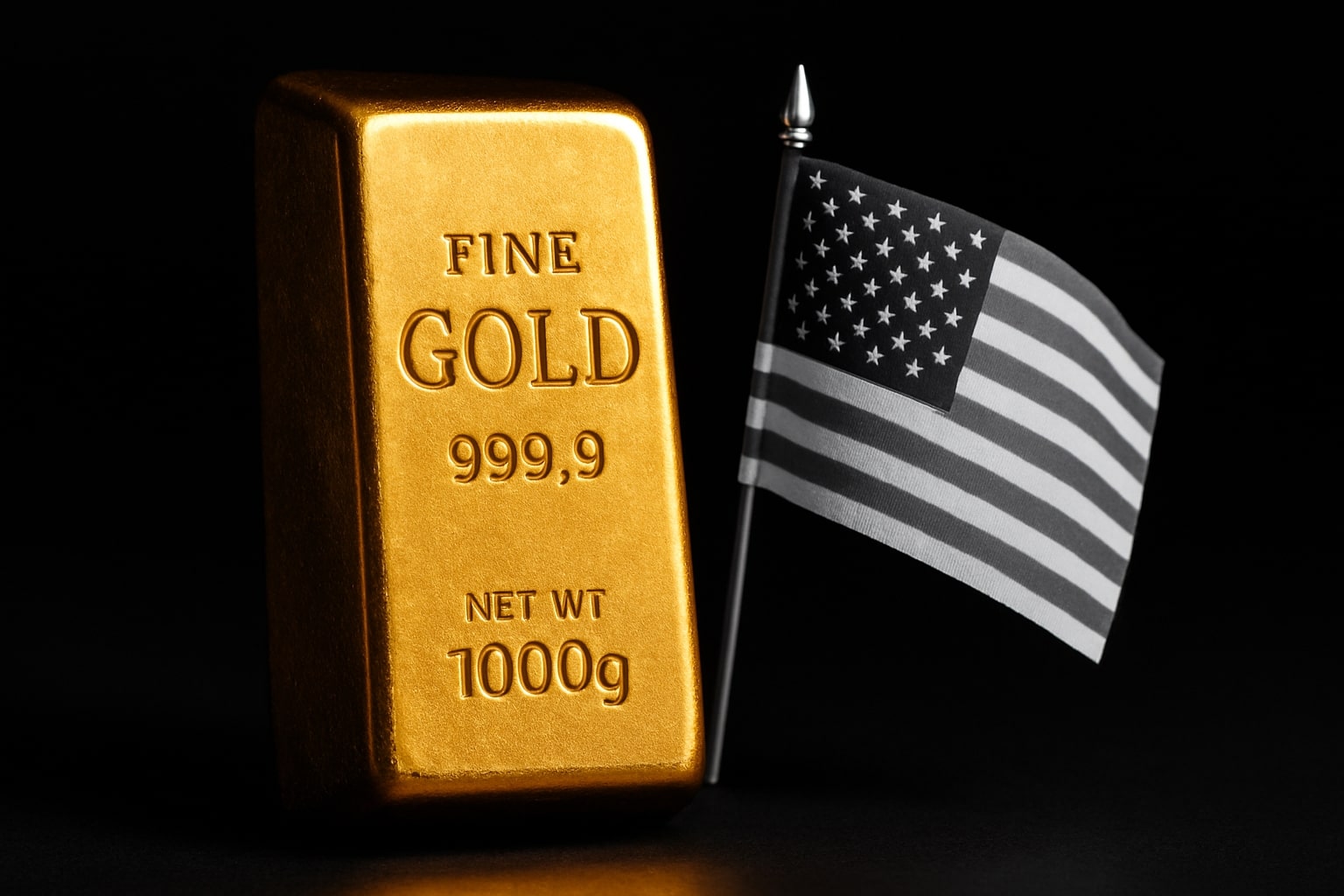
Gold Price Forecast: Central-Bank Buying Drive Momentum Toward $4,800, XAU/USD Holds $4,200
XAU/USD steadies near $4,208 amid 90% odds of Fed easing, China lifts gold reserves for a 13th month, and technicals point to a breakout above $4,300 toward $4,800 in 2026 | That's TradingNEWS
Gold Price Forecast: XAU/USD Consolidates Above $4,200 As Fed Cut Bets, Central Bank Buying, and Dollar Weakness Align for a Multi-Year Bull Cycle
Xau/Usd Holds Above $4,200 As Traders Anticipate the Fed’s Final Decision of 2025
Gold (XAU/USD) is trading near $4,208.40 per ounce, maintaining record-high territory as markets await the Federal Reserve’s final rate decision of the year. The metal has now delivered nine straight quarterly gains, one of the longest sustained rallies in modern market history. The latest surge above $4,200 was fueled by rising expectations of monetary easing, ongoing central-bank accumulation, and persistent dollar weakness. The CME FedWatch Tool assigns an 89% probability to a 25-basis-point rate cut, up from 66% in November. Lower yields continue to reduce the opportunity cost of holding non-yielding gold, while institutional traders rotate capital from equities toward commodities. U.S. gold futures (GC=F) opened the week at $4,228.10, slightly below Friday’s $4,243, with strong technical support between $4,146 and $4,056. The dollar index (DX-Y.NYB) trades near $99.11, down 0.25%, magnifying demand for dollar-priced metals. Every one-point drop in the DXY has historically added $25–$40 to spot gold, reinforcing the short-term bullish setup.
Global Liquidity Shift And Fed Policy Drive Structural Repricing In Gold
The current rally in XAU/USD reflects a deep structural repricing of global liquidity, not speculative enthusiasm. Analysts expect cumulative cuts of 75 basis points in 2026, with the Fed funds rate projected to decline from 3.75–4.00% to 3.00–3.25% by mid-year. Historically, similar easing cycles triggered major gold surges—2019’s triple cut drove a 17% yearly gain, while the 2008 post-crisis pivot ignited a 140% rally. Inflation remains at 2.8% PCE, real yields are negative, and the U.S. fiscal deficit surpasses $2.1 trillion, a backdrop favoring hard assets. ETF inflows into physical gold jumped 6.2% month-on-month and 61.4% year-on-year, showing institutional rotation into tangible stores of value as cash yields compress.
Central Bank Accumulation Reaches Record Highs Led By China And Emerging Economies
China’s central bank has increased its reserves for 13 consecutive months, now holding 74.12 million ounces, the longest accumulation streak on record. Emerging economies—India, Turkey, and Kazakhstan—collectively added more than 195 tonnes of gold in H2 2025, primarily to diversify reserves away from the dollar and hedge geopolitical exposure. Central-bank purchases now account for 25% of total mined supply, restricting global availability and amplifying price elasticity. The World Gold Council attributes a 23.4% average price gain in 2025 to this tightening effect. Deutsche Bank raised its 2026 gold forecast from $4,000 to $4,450 per ounce, expecting a $3,950–$4,950 range, while Ventura Securities projects $4,600–$4,800. The broad institutional consensus remains decisively bullish into 2026.
Technical Framework: Consolidation Above $4,200 Sets Stage For Next Breakout
Gold’s chart structure remains firmly bullish. The metal trades above all key averages—the 20-day EMA at $4,146 and 50-day EMA at $4,031—forming a tight compression channel beneath $4,300. The absence of heavy liquidation signals accumulation, not exhaustion. Momentum indicators confirm underlying strength: RSI at 58 shows controlled buying pressure, ADX at 32 indicates trend health. A breakout above $4,226 could expose $4,381–$4,441, while sustained closes over $4,300 may target $4,480–$4,600. Support sits at $4,056 and $3,950, both zones repeatedly defended by institutional buyers. The current nine-quarter winning streak echoes the 1979–1980 and 2002–2008 bull markets, both of which produced multi-year rallies exceeding 250%.
Global Macro Dynamics Reinforce Safe-Haven Flow Into Gold
The macro backdrop remains the strongest tailwind for XAU/USD. The IMF now projects global GDP growth of only 2.5% for 2026, the weakest pace since 2019. Worldwide sovereign debt has surpassed $315 trillion, pushing interest costs to a 40-year high and forcing capital rotation toward assets that preserve value amid fiscal erosion. Geopolitical risks—ongoing war in Eastern Europe, trade tensions, and budget deterioration across G7 nations—continue to support defensive positioning. Gold’s resilience while equity benchmarks trade near record highs highlights its transformation from crisis hedge to structural reserve asset.
Bond Market Dynamics And Dollar Feedback Loop
U.S. 10-year Treasury yields have fallen from 4.45% to 3.81%, compressing real yields and supporting gold. The DX-Y.NYB index’s decline from 101.4 to 99.1 magnifies this trend. Historically, for every 0.5% decline in real yields, gold has gained roughly 3.1%, implying a fair-value projection near $4,450 if yields reach 3.5%. ETF demand confirms the trend: global gold ETF holdings increased by 1.8 million ounces in November, reversing half a year of outflows. Asset managers now cite “yield compression” and “deficit overhang” as key drivers for sustained long positioning in gold.
Regional Divergences: India’s Premium And Asia’s Physical Demand
India remains structurally bullish. Domestic prices trade 15% above Dubai levels, a premium driven by high import duties and rupee depreciation. The MCX February 2026 contract hit ₹1,30,407 per 10 grams (≈$4,240 per ounce), while silver rose 1.44% to ₹1,80,700 per kg, confirming broad metals strength. China’s physical demand also expanded, with household and industrial buyers accumulating aggressively amid property-market instability, reinforcing steady consumption even as prices approach record territory.
Sentiment Indicators Confirm Structural Bull Market
Positioning data highlights conviction rather than speculation. The COT report shows managed-money net longs at 314,000 contracts, only 8% below the five-year high. COMEX open interest hit $193 billion, while the GVZ volatility index dropped to 13.8, signaling confidence and stable trend participation. This combination—rising price, increasing open interest, falling volatility—suggests sustainable institutional accumulation. Historically, such setups precede 25–35% follow-through rallies before cycle peaks.
Read More
-
PFFA ETF: 9%+ Preferred Income ETF Holding Its Ground Near $22
24.01.2026 · TradingNEWS ArchiveStocks
-
XRP ETFs XRPI and XRPR Suffer First $40M Red Week as XRP Drops Back Toward $1.91
24.01.2026 · TradingNEWS ArchiveCrypto
-
Natural Gas Price Forecast - NG=F Jumps 70% To Five-Year High As Winter Storm Fern Slams US
24.01.2026 · TradingNEWS ArchiveCommodities
-
USD/JPY Price Forecast - USDJPY=X Crashes Below 157 as Intervention Risk and BoJ 0.75% Hit the Dollar
24.01.2026 · TradingNEWS ArchiveForex
Long-Term Projections And Extended Scenarios
Ventura Securities forecasts an average price of $4,700 for 2026, Deutsche Bank expects $4,950, and Morgan Stanley targets $4,500 by mid-2026. Quantitative models tied to real yields indicate that if 10-year inflation-adjusted rates remain below 1%, fair value expands between $4,600–$5,200, implying up to 12% upside from current prices.
Portfolio Strategy And Institutional Positioning
HDFC Securities advises investors to hold 5–10% of portfolios in gold and silver, increasing exposure during easing cycles. Correlation between gold and global equities has turned negative (–0.38 on a 90-day basis), enhancing portfolio stability. Sovereign wealth funds across Asia and the Gulf added $45 billion in gold holdings in 2025, up 27% year-over-year, showing broad institutional conviction. Hedge funds continue to run long gold versus short Treasuries or the dollar index, sustaining bullish momentum even through consolidation.
Volatility Triggers And Downside Risks
A hawkish interpretation of the Fed’s cut could spark a pullback toward $4,100–$4,050, though real-yield dynamics remain favorable. A sudden inflation reacceleration could briefly lift nominal yields, but such corrections are likely to attract fresh institutional buying given the macro imbalance and persistent central-bank demand.
Market Psychology And Sentiment Transition
The psychological profile of the gold market has shifted from tactical to structural optimism. Investors are treating gold not merely as an inflation hedge but as a reserve-quality asset in a system of overextended fiscal regimes. The U.S. dollar’s share of global reserves has declined from 58% in 2021 to 52% in 2025, accelerating diversification toward gold. This behavioral realignment mirrors early-2000s dynamics, but with deeper liquidity, broader ETF integration, and diversified demand sources—creating a more sustainable and less volatile bull structure.
Verdict — XAU/USD: BUY
Current Price: ~$4,208 per ounce Near-Term Range: $4,056–$4,441 Medium-Term Target: $4,600–$4,800 Long-Term Target (2027): $5,150
Gold’s macro, technical, and structural alignment confirms a durable bull market. As long as XAU/USD holds above $4,146, momentum remains constructive. A confirmed close above $4,300 would target $4,600, while dips below $4,050 are viewed as buying opportunities within the long-term uptrend. Rating: BUY — bullish momentum intact, supported by monetary easing, institutional accumulation, and strong macro tailwinds.