

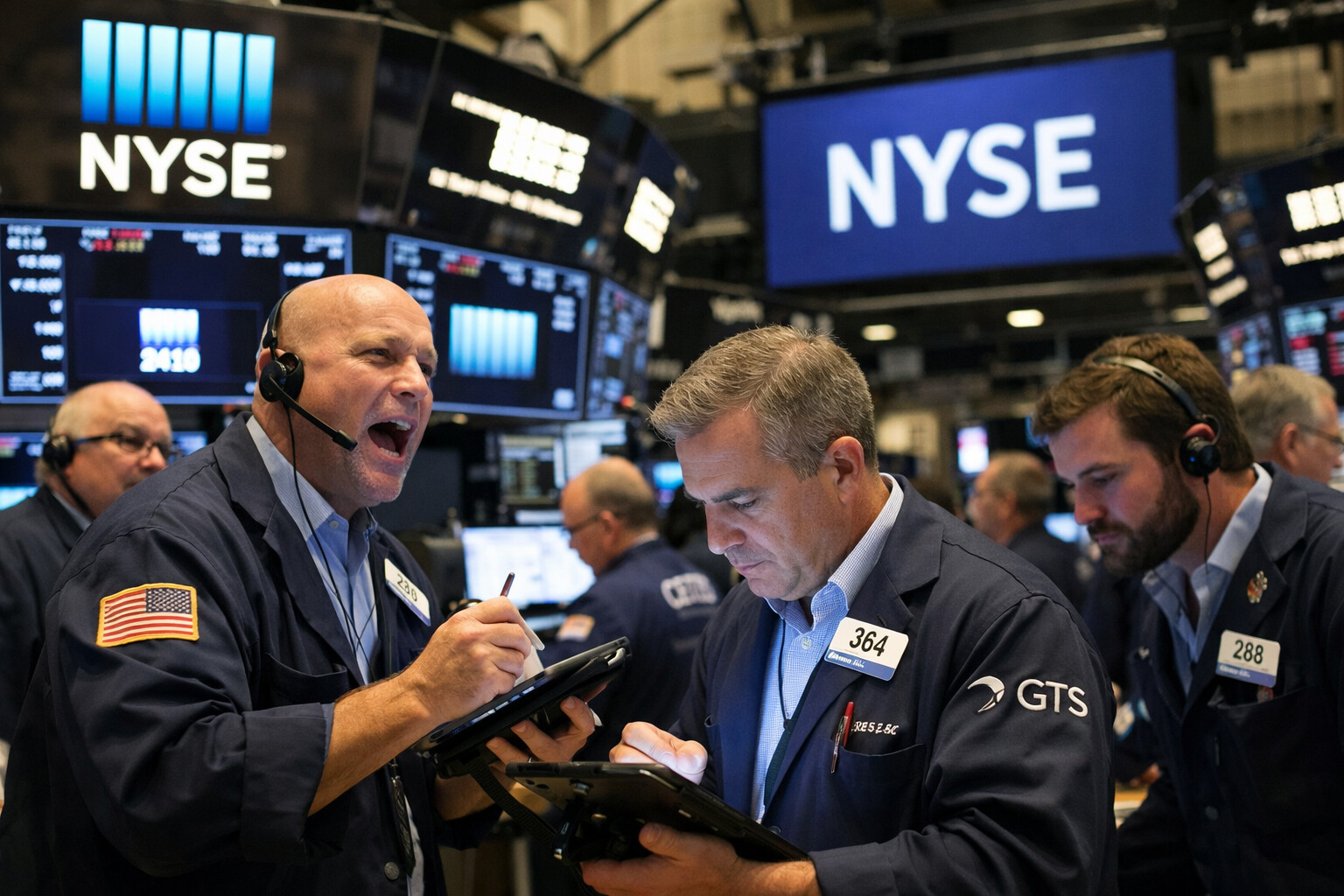
Stock Market Today - Dow Jones, S&P 500 and Nasdaq Tumble as Greenland Tariffs Trigger ‘Sell America’
Stocks drop over 1%, volatility spikes above 20 and gold rockets past $4,750 while silver nears $100 and BTC trades around $90,700 as new U.S.–Europe tariff threats hit risk appetite | That's TradingNEWS
Stock Market Today: Tariff Shock Slams U.S. Indices
Tariff escalation tied to Greenland turned today’s Trading News session into a broad “sell America” day across equities, bonds and the dollar. The Dow Jones Industrial Average sits near 48,703, down about 656 points (-1.33%). The S&P 500 trades around 6,840, off 99 points (-1.43%), while the Nasdaq Composite is the weakest, near 23,119, down 396 points (-1.68%). Futures set the tone overnight: E-Mini Dow (YM00) at 48,945 (-1.22%), E-Mini S&P 500 (ES00) at 6,878.75 (-1.40%) and E-Mini Nasdaq-100 (NQ00) at 25,294.25 (-1.54%) signaled heavy risk-off before the cash open.
The catalyst is clear: the White House threatened 10% U.S. import tariffs from February 1 on eight European allies, rising to 25% from June 1 if they continue to oppose a U.S. takeover of Greenland. On top of that, there is a separate threat of 200% tariffs on French wines and champagne, turning a long-running geopolitical idea into a full-blown trade confrontation. Betting markets put the probability of these Greenland-linked tariffs near 40%, high enough that funds are de-risking rather than waiting for details.
Greenland Tariffs, Retaliation Risk and ‘Sell America’ Flows
The tariff schedule matters because it is both large and staged: 10% on February 1, moving to 25% on June 1, targeting imports from Denmark, Norway, Sweden, France, Germany, the UK, the Netherlands and Finland. European officials have already labeled the measures “unacceptable” and are openly discussing counter-measures. France is pushing to use the EU’s Anti-Coercion Instrument, essentially a maximum-strength response mechanism.
This is not just a bilateral spat. The structure screams prolonged trade war risk, with clear room for escalation and tit-for-tat tariffs on U.S. exports. After last year’s “Liberation Day” shock tariffs and partial rollback, markets are not giving the benefit of the doubt. The combination of new tariffs, potential European retaliation and an upcoming Trump speech at Davos has investors pricing a higher probability of sustained policy uncertainty rather than a one-off headline.
Major Indices: SPX, DJIA, COMP, RUT, SPY Under Pressure
Beyond point moves, breadth and cross-asset behavior confirm genuine de-risking. The S&P 500 is down roughly 1.4%, the Nasdaq Composite about 1.6–1.7%, and the Dow around 1.3–1.5%, with earlier prints showing the Dow off as much as 700+ points intraday. The SPDR S&P 500 ETF (SPY) tracks this move with futures down about 1.4–1.5%.
Small caps are less damaged but not immune: the Russell 2000 trades near 2,650, down about 0.1%, showing that the selloff is not purely about global megacaps but also not yet a full capitulation in domestic cyclicals. Global benchmarks echo the stress: Stoxx Europe 600 is down about 1.3%, Germany’s DAX off 1.2%, France’s main index (FR40) down around 1.8%, and the FTSE 100 near 10,112 (-0.86%). In Asia, the Nikkei 225 drops roughly 2.4% to about 52,315, signalling the shock is global, not just transatlantic.
Volatility, Bonds and Currencies: VIX Surges, 10-Year Near 4.30%, Dollar Breaks
Wall Street’s volatility gauge is finally awake. The Cboe Volatility Index (VIX) jumps to around 20.3, up 4.44 points (+27.99%), the highest level of the year. The futures curve is firm: February VXG26 trades near 18.38, March VXH26 around 19.22, indicating demand for protection extends beyond the next few days.
In rates, the U.S. 10-year Treasury yield pushes to roughly 4.28–4.30%, up 5–6 basis points on the day, with strategists warning that a re-pricing toward 4.50% is “unquestionably possible” if the tariff path escalates. The 20-year U.S. yield jumps toward 4.88%, while long European yields grind higher as well: the 10-year Bund around 2.88%, 20-year near 3.42% and 30-year around 3.52%. Japan’s 40-year JGB yield hits a record high as investors start to question fiscal sustainability after talk of tax cuts.
The striking element is FX. Typically, risk-off flows support the dollar. Today the U.S. Dollar Index (DXY) falls to about 98.55 (-0.85% to -0.9%), dropping below 99. EUR/USD trades near 1.1722, up roughly 0.64%, and CHF/USD sits around 1.2541, up about 0.70%. That mix—U.S. stocks down, Treasuries down in price (yields up), and the dollar weaker—fits a clear “reduce U.S. exposure” pattern rather than the usual dash into dollar assets.
Gold, Silver and Crypto: Record Highs for Metals, BTC-USD Lags
Precious metals are the clean winners. Spot gold and front contracts blast through prior highs, with the gold continuous contract near $4,746.60, up about $151 (+3.29%) on the day; other prints show levels above $4,750. Silver follows, trading around $95–$95.75 an ounce and setting its own records. This pushes investors into metals proxies: Newmont (NEM) is up nearly 3% to around $117.39, marking a new high as well and confirming equity appetite for gold exposure.
Crypto is not acting like a clean haven. Bitcoin (BTC-USD) trades around $90,700, down from overnight levels near $93,300. Crypto-linked equities amplify the move lower: MicroStrategy (MSTR) slides to about $163, down $10.71 (-6.17%), and crypto exchange peers track similar declines. The message is straightforward: the market is favoring hard, non-credit-linked assets like gold and silver over high-beta digital proxies when geopolitical risk turns into tariff mechanics.
Big Tech and AI Complex: NVDA, GOOGL, AMZN, META, TSLA, AMD, AVGO Lead the Selloff
The growth engine that drove much of 2025’s gains is at the core of today’s drawdown. Large-cap tech and AI beneficiaries are under systematic selling as higher yields, trade risk and stretched positioning collide. Shares of Nvidia (NVDA), Alphabet (GOOGL), Amazon (AMZN), Meta Platforms (META) and Tesla (TSLA) are each down roughly 2–3% in early trade. The move is broad rather than stock-specific, consistent with de-risking by quant and macro funds rather than idiosyncratic news.
Chipmakers extend the pressure. Advanced Micro Devices (AMD) and Broadcom (AVGO) trade lower alongside NVDA, while the sector ETF Technology Select Sector SPDR (XLK) drops about 2.2%, reflecting a sector-wide de-rating.
There are stock-specific stories inside the tech complex as well. Micron (MU) falls around 1.5% after signing a $1.8 billion cash letter of intent to buy a Powerchip fab in Taiwan, a strategically important but capital-intensive move that temporarily weighs on the balance sheet. AppLovin (APP) drops roughly 5% toward $539.89, after questions around alleged money-laundering by primary shareholders. None of these headlines help sentiment in a market already primed to sell anything with elevated multiples and cyclicality to global capex.
Transport and logistics names feel the demand side of the story. J.B. Hunt Transport Services (JBHT) falls more than 2% after its final-mile revenue of $206 million misses the roughly $213 million expectation, down 10% year-on-year amid “general soft demand” in many end markets. That aligns with a market now worried that tariff escalation will further pressure global trade volumes into mid-2026.
Earnings and Corporate Moves: NFLX, WBD, PSKY, FAST, MMM, RAPT, GSK
While macro dominates, single-name earnings and M&A still move tape. Netflix (NFLX) is one of the rare gainers among large caps ahead of its report after the close. The stock trades around $89.66, up about 1.9% intraday, with options markets pricing roughly a 7% move on earnings. Risk is elevated after a 34% drawdown from its late-June record high, driven in part by skepticism over its aggressive deal to acquire Warner Bros. Discovery (WBD).
That deal sharpened today: WBD’s board approved a revised $27.75 all-cash offer from NFLX, replacing the earlier cash-and-stock structure. WBD trades near $28.09, down about 1.7%, while potential rival bidder Paramount Skydance (PSKY) is off roughly 1.5% as the market assumes the hostile bid has lower odds of success. The message from the streaming space is consolidation at premium prices into a slowing macro, with equity markets skeptical but not pricing disaster.
Industrial earnings paint a more cautious picture. Fastenal (FAST) reports Q4 net sales just under $2.03 billion, up 11% year-on-year, but fractionally below consensus that looked for a bit above $2.03 billion. Operating margin lands at 19.0%, short of the 19.4% expectation, even though EPS holds at $0.26, matching estimates. Shares drop about 6–6.5% in premarket trade despite the stock having gained roughly 15% over the last year. The takeaway: the market is punishing even modest margin slippage when valuations already price a tight execution story.
3M (MMM) also trades roughly 5% lower after its update, adding to concerns that industrial bellwethers will struggle to expand margins if tariffs compound input-cost and demand volatility. These moves feed back into the Dow, where both MMM and FAST carry weight.
On the M&A front, RAPT Therapeutics (RAPT) is the standout. The stock jumps nearly 64% to around $57.55, as GSK (GSK) agrees to acquire the company for $58 per share, a 65% premium to the prior close at $35.10. The deal values RAPT at roughly $2.2 billion, with about $1.9 billion as upfront consideration, and gives GSK rights to food-allergy drug candidate ozureprubart in most global markets. RAPT shares were already up about 265% over the last year, so today’s move caps a massive re-rating. For new money, the risk-reward at $58 with deal risk attached is much less attractive than the path that got the stock here.
Read More
-
DraftKings Stock Forecast – Is DKNG Stock Undervalued at $32 With a $60 Target?
20.01.2026 · TradingNEWS ArchiveStocks
-
Ripple XRP price Forecast – XRP-USD battles to defend $1.90 after tariff shock and liquidation cascade
20.01.2026 · TradingNEWS ArchiveCrypto
-
Oil Price Outlook: Brent Holds $64, WTI $60 While Greenland Tariff Fight Heats Up
20.01.2026 · TradingNEWS ArchiveCommodities
-
PPA ETF Rallies Toward $180 On $1.5T US Defense-Spending Supercycle
19.01.2026 · TradingNEWS ArchiveMarkets
-
GBP/USD Price Forecast – Can the Pound Hold 1.35 as Tariffs Crush the Dollar?
20.01.2026 · TradingNEWS ArchiveForex
Sector and Single-Stock Standouts: NEM, SMCI, MU, MRNA, GEV, PWR, CEG, VST, AMCR, WST, ALB, SOLS
Outside the headline names, dispersion is wide. On the upside:
– Super Micro Computer (SMCI) rallies about 10.9% to roughly $32.64, extending its reputation as a high-beta AI server proxy that benefits when investors look for second-line plays beyond megacaps.
– Micron (MU), despite the Taiwan fab concerns mentioned earlier, appears in another snapshot up 7.76% to about $362.75, underlining how volatile readings can be across the day for high-beta semis.
– Moderna (MRNA) adds around 6.3% to $41.83 as investors rotate into selective health-care growth after the RAPT/GSK headline.
– GE Vernova (GEV) gains about 6.1% to $681.55, and Quanta Services (PWR) climbs roughly 4.3% to $466.75, reflecting steady demand for infrastructure and grid-related plays even in risk-off tape.
On the downside:
– Constellation Energy (CEG) drops almost 9.8% to about $307.71.
– Vistra (VST) falls about 7.5% to $166.60.
– Amcor (AMCR) loses about 7.3% to $40.94.
– West Pharmaceutical Services (WST) is down roughly 7.0% to $259.79.
– Albemarle (ALB), a bellwether in lithium and battery chemicals, slides about 6.2% to $163.04, underscoring how higher yields and macro uncertainty pressure long-duration growth stories across materials.
In chemicals, Solstice Advanced Materials (SOLS) gets a fundamental vote of confidence. A major bank upgrades the stock to an outperform-style rating and lifts its price target from $50 to $75, implying roughly 23% upside from Friday’s close. The call leans on Solstice’s growth in next-generation refrigerants (HFOs) and a structurally advantaged position versus peers. The stock trades near $60.02, down about 1.4% intraday as macro headwinds overwhelm the upgrade—but the medium-term message skew remains positive.
European Equities, Champagne and Global Fixed Income: LVMH, REMYY, DAX, STOXX 600
The European read-across from Greenland tariffs is immediate. The pan-European Stoxx 600 is down around 0.7–1.3%, with autos and luxury goods weakest. In France, LVMH—owner of Moët & Chandon, Dom Pérignon and Veuve Clicquot—trades about 1.7% lower. Rémy Cointreau (REMYY) loses roughly 2% as traders price in the risk of 200% U.S. tariffs on French wine and champagne if diplomacy fails.
German equities feel the manufacturing and export angle: the DAX falls about 1.2%, and broader European sentiment is sour as officials prepare counter-measures. The key point for U.S. investors is that this is not a localized move; European equities, European sovereign bonds and the euro are all being repriced together around a trade-war narrative that directly targets high-value exports and long-term alliances.
In the UK, wage growth at roughly 4.7% and unemployment sitting around 5.1%, the highest since 2021, add another layer of complexity for global fixed income. Persistent wage pressure keeps inflation risks alive even as growth slows, which complicates rate-cut paths on both sides of the Atlantic. That is one reason long-dated yields are rising in tandem in the U.S., Europe and Japan rather than providing an offset to equity losses.
Macro Cross-Currents: Housing Speech, Supreme Court Risk and Capital Flows
Macro event risk does not stop with tariffs. The President is expected to use his Wednesday speech at the World Economic Forum in Davos to roll out “aggressive” plans on housing affordability, with potential implications for mortgage finance, agency spreads and homebuilder earnings. At the same time, markets are watching the U.S. Supreme Court for a ruling on the legality of the prior “Liberation Day” tariffs, which could either constrain or implicitly validate further trade actions.
Prominent investors are already talking about the risk of “capital wars” as foreign holders reduce U.S. asset exposure. That narrative aligns with today’s tape: equities down, Treasuries sold, the dollar weaker, and alternative stores of value—especially gold and silver—making fresh highs. The combination signals concern not just about cyclical growth but about the policy reliability of the U.S. in the eyes of global capital.
Trading Stance: SPY, QQQ, DIA, GLD, SLV, Key Names – Buy, Sell or Hold?
Given the data, the market message is not subtle: tariff risk is real, capital is rotating out of U.S. assets, and volatility is back. That said, the move is not yet a full-scale liquidation.
For broad U.S. equities via SPDR S&P 500 ETF (SPY), the combination of a 1.4% drop today, VIX above 20, and 10-year yields near 4.30% argues for a Hold stance with a bearish short-term bias rather than an outright Buy. The risk/reward does not justify chasing this dip while tariff paths, Supreme Court rulings and Davos rhetoric are unresolved.
The tech-heavy Nasdaq 100 / QQQ looks more vulnerable. With NVDA, GOOGL, AMZN, META, TSLA, AMD and AVGO each sliding 2–3% and XLK down 2.2%, position crowding and duration sensitivity to higher yields are obvious. The stance here leans toward lightening exposure (Sell/Trim on strength) rather than adding, until yields stabilize and the tariff trajectory is clearer.
The Dow / DIA is under pressure from MMM, FAST and other industrials, but valuation is less extended than big-cap tech. Given the roughly 1.3–1.5% drawdown and earnings-driven hits that are specific rather than systemic, DIA also sits in Hold territory, with downside risk if trade tensions spill further into global manufacturing.
On the defensive side, the tape is far more constructive. Physical gold at $4,746–4,750 and silver near $95–$95.75 confirm a strong bid for metal exposure. For gold proxies such as GLD and leading miner NEM (up nearly 3% to a record around $117.39), the stance is Buy with a bullish bias, accepting elevated volatility as the cost of owning the cleanest hedge against tariff-driven capital flight. For silver proxies like SLV, the view is Buy for high-risk capital, recognizing that moves around $95 can cut both ways quickly.
In single names, RAPT at roughly $57–58 after a 65% cash-deal premium and a 265% one-year run is a Hold / take-profits zone, not a fresh Buy; upside is now capped by deal terms while downside is tied to any closing risk. GSK takes on integration and execution risk but gains a differentiated food-allergy asset; with the stock reaction muted, the stance is Hold pending more detail on the development path.
Crypto-linked MSTR down 6.17% and other digital plays look structurally weaker than the metal complex on a day like this. With BTC-USD stuck near $90,700 while gold explodes higher, the relative-value signal favors reducing MSTR-style beta (Sell/Trim) and prioritizing exposure to metals and high-quality miners.
Overall, today’s session is bearish near-term for U.S. risk assets, constructive for gold and silver, and neutral-to-cautious for broad indices. Until the tariff schedule and European response are clarified, rallies in SPY and QQQ look more like opportunities to rebalance risk than invitations to re-leverage.