


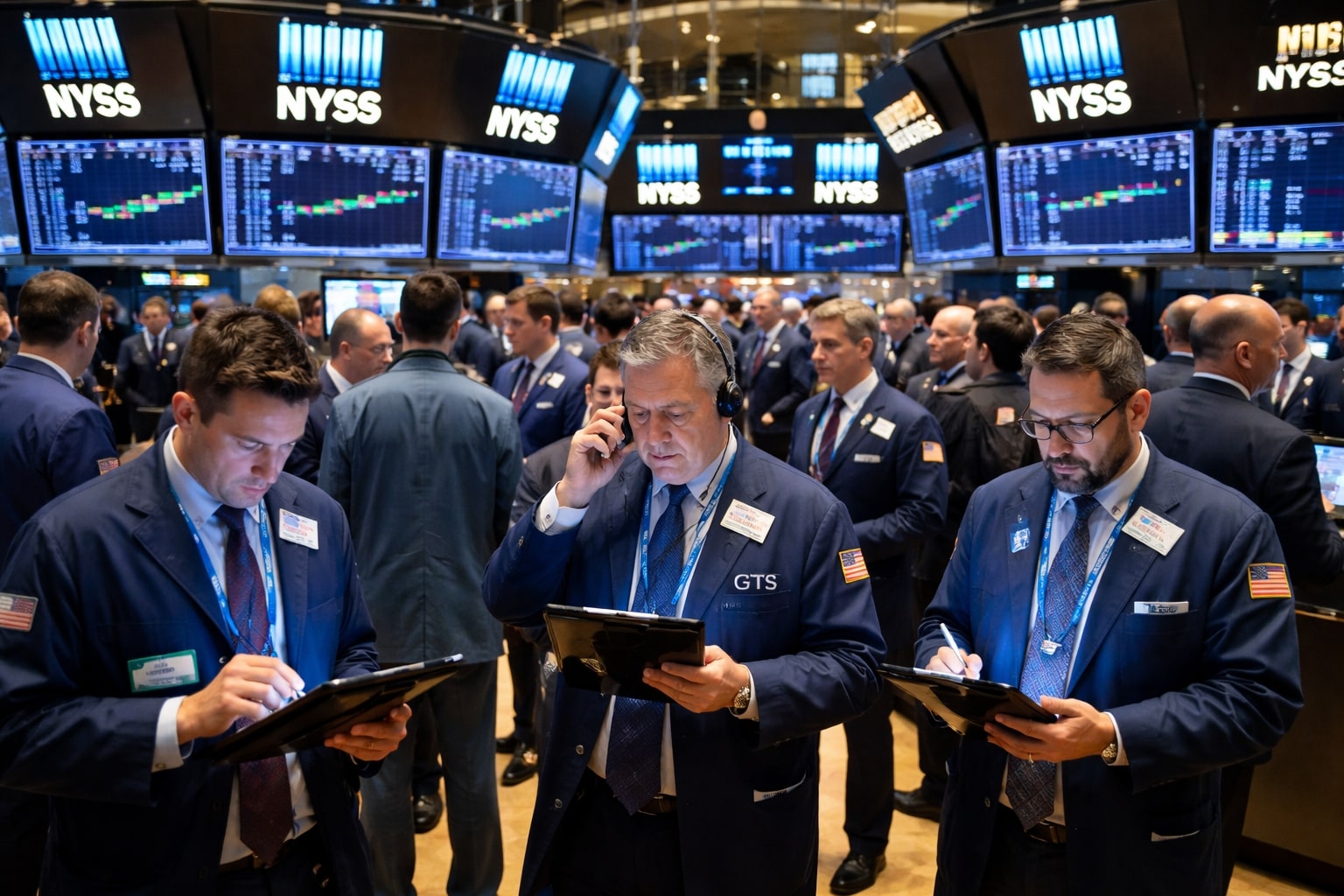
Stock Market Today - Dow Slides to 48,977 as BAC, WFC Sink and Gold Blasts to $4,621
S&P 500 falls to 6,904 and Nasdaq to 23,389 as BAC and WFC sell off, NVDA weakens, gold and silver hit record highs and Brent hovers above $66 on rising Iran and Fed risks | That's TradingNEWS
Stock Market Today - Wall Street snapshot: indices pull back from record highs
Macro pulse: inflation, retail strength and the Fed path
US equities are giving back more ground, extending Tuesday’s reversal from all-time highs. The S&P 500 (^GSPC) trades around 6,900, down roughly 0.8%. The Nasdaq Composite (^IXIC) is weaker, off about 1.3% near 23,400, as megacap tech and software re-rate lower. The Dow Jones Industrial Average (^DJI) sits just below 49,000, down around 0.4%, while the Russell 2000 (^RUT) slips a milder ~0.2%, showing only modest small-cap damage. The KBW Nasdaq Bank Index (BKX) underperforms with a drop of about 1.5%, reflecting pressure across BAC, WFC, JPM and C. Volatility is rebuilding: the VIX has moved into the mid-to-high teens, signaling a shift from one-way momentum to more two-sided trading.
On the macro side, the key message is “resilient demand, sticky disinflation.” November Producer Price Index (PPI) rose 0.2% month-on-month versus 0.3% expected, after 0.1% in October. On a 12-month basis, headline PPI runs around 3.0%, above the roughly 2.7% consensus, and the PPI measure excluding food, energy and trade services is up about 3.5%, the fastest since early 2025 and materially above the Fed’s 2% goal. Retail data point the other way: US retail and food services sales reached about $735.9 billion in November, up 0.6% from October and 3.3% year-on-year, beating a 0.4% monthly forecast. Over the September–November window, sales gained 3.6% versus the prior year, with autos driving much of the upside.
The 10-year Treasury yield has eased slightly to roughly 4.15%–4.16%, a few basis points below Tuesday’s close above 4.18% but still high enough to keep the equity risk premium compressed. In practice, the data justify the Fed’s “slow and cautious” approach: a consumer that keeps spending and pipeline inflation that hasn’t fully broken means rate cuts are likely later and shallower than markets wanted in December.
Fed credibility, Powell probe and policy risk premium
Beyond the numbers, policy risk is now a core driver of cross-asset pricing. The Justice Department’s criminal probe into Fed Chair Jerome Powell and the administration’s sustained pressure for faster rate cuts have put central-bank independence under direct political stress. Next week’s Supreme Court case on President Trump’s effort to fire Fed Governor Lisa Cook is the next inflection point: if the Court sides with the White House, it will effectively open the door to attempts to remove Powell as well, reshaping the institution in real time.
At the same time, regional Fed voices such as Philadelphia Fed President Anna Paulson are signaling that “modest” cuts later this year remain likely if inflation continues to drift lower, GDP holds near 2% and the labor market cools without a spike in unemployment. This combination—solid nominal growth, inflation still above target, and direct political attacks on the Fed—explains why defensive assets like gold and silver are ripping to all-time highs even while the S&P 500, Nasdaq and Dow trade just off record levels. For equities overall, the macro verdict is a cautious Hold: earnings still have support, but the policy premium is moving against multiples.
Big US banks: BAC, WFC, C, JPM – beats on paper, derating in price
The money-center banks are at the center of today’s underperformance. Bank of America (BAC) delivered a superficially strong quarter: Q4 EPS of about $0.98 versus roughly $0.96 expected, total revenue around $28.5 billion against $27.9 billion consensus, and net interest income (NII) near $12.3 billion, marginally ahead of estimates. Equities trading revenue surged 23% to about $2.02 billion as tariff volatility and higher rates drove client repositioning. Despite this, BAC is down roughly 4%–4.5% today. Markets are discounting a flatter curve, potential caps on credit-card APRs and rising political risk to bank profitability; they are treating the beat as late-cycle rather than a new earnings trend.
Wells Fargo (WFC) is taking the largest hit. Q4 net income rose 6% year-on-year to approximately $5.36 billion, but EPS landed at $1.62, missing expectations near $1.66. Revenue came in around $21.29 billion versus ~ $21.65 billion forecast, with NII again slightly light at ~$12.3 billion vs $12.4 billion consensus. The core issue is cost discipline: WFC booked a $612 million severance charge while cutting roughly 5,600 jobs, pushing quarterly expenses to about $13.7 billion versus $13.6 billion expected. The stock trades lower by around 5%, and the message is simple—investors are demanding cleaner cost control and more precise capital allocation now that the Fed’s asset cap is gone.
Citigroup (C) presents a different picture. Q4 profit dropped 13% to roughly $2.47 billion, or $1.19 per share, but that includes a $1.2 billion loss—around $0.62 per share—from exiting its remaining Russia operations. Revenue rose 2% to about $19.9 billion, trading income slipped just 1% to around $4.54 billion, and investment-banking fees climbed 35% to roughly $1.29 billion as dealmaking stabilized. The market is treating C more constructively: strategic cleanup combined with revenue stabilization is acceptable, even if near-term EPS looks messy.
JPMorgan (JPM), which kicked off bank earnings with a mixed report and a drop of more than 4% yesterday, remains a drag on the KBW Bank Index, underlining that even the “fortress” name is not immune when the market thinks you are at or past peak profitability. Taken together, the money-center group screens as Hold / Underweight here: valuation support exists, but regulatory, political and macro headwinds justify a discount versus the broad S&P 500.
Card networks and homebuilders: V, MA, DHI, LEN, KBH, PHM under scrutiny
Financials are also absorbing a regulatory overhang outside the big banks. Over the weekend, the administration floated the idea of capping credit-card interest rates at 10%. That headline alone triggered a sharp de-rating in payment networks: Visa (V) and Mastercard (MA) both dropped roughly 4%–5% yesterday and are trading roughly flat today as the market waits for clarity. If the cap moves from rhetoric to legislation, the impact on unsecured lending margins would be material and would likely compress ROE across card portfolios. For now, these names shift from pure “quality compounder” status toward “regulated financials with policy risk,” pushing them into Hold rather than clear Buy territory at current multiples.
In housing, comments from Federal Housing Finance Agency Director Bill Pulte about reviewing homebuilder stock buybacks hit sentiment. D.R. Horton (DHI) fell more than 2% pre-market, while Lennar (LEN), KB Home (KBH) and PulteGroup (PHM) all slipped around 1%–2%. With mortgage rates still elevated and regulators openly questioning whether builders should be returning so much cash to shareholders, the sector faces a cross-current: structurally tight housing supply supports earnings, but headline risk around buybacks and affordability caps upside. Housing equities screen as Hold, with a bias to Buy only on larger pullbacks.
**Metals leadership: record GC=F, parabolic SI=F, strong HG=F
The clearest winners in today’s cross-asset move are metals. Gold futures (GC=F) are trading around $4,630–$4,650 an ounce, marking yet another all-time high after a ~65% surge last year. Silver (SI=F) has broken decisively through $90, trading close to $91 with intraday highs near $92, after almost 150% gains in 2025 and nearly 30% more in the first two weeks of 2026. Copper (HG=F) and tin contracts are also at or near record levels.
The drivers are aligned: investors are rotating into hard assets as protection against three overlapping risks—fiscal deterioration, politicized monetary policy and geopolitical escalation. Expectations for two to three Fed cuts later this year reduce the carry disadvantage of non-yielding metals, while a softer Dollar Index in the high-90s makes dollar-priced commodities easier to accumulate globally. At the same time, booming AI-related manufacturing and Chinese industrial stabilization underwrite demand for base metals such as copper. In this environment, the stance on GC=F and SI=F remains clearly Bullish / Buy on dips, recognizing that short-term moves can be violent after such parabolic gains.
Oil and energy: CL=F, BZ=F climb, BP recalibrates its green strategy
Crude is grinding higher, though in a more controlled fashion than metals. Brent (BZ=F) trades just above $66 a barrel and WTI (CL=F) around $61–$62, both up roughly 0.7%–1% today and more than 9% over the last four sessions. The catalyst is Iran risk: reports that some staff at the Al Udeid airbase in Qatar have been told to leave, combined with Iran’s threats to retaliate against US intervention in its domestic unrest, lift the probability of supply disruption. With Iran pumping roughly 3.3 million barrels per day and exporting significant volumes of condensates and NGLs, even temporary disruptions could tighten balances into mid-year.
For equities, BP (BP) is a focal point. The company expects up to $5 billion of additional writedowns, primarily in gas and low-carbon projects, pushing total impairments to around $20 billion over two years. Oil trading results are flagged as “weak” for a second quarter, production is essentially flat, but net debt continues to decline through non-strategic asset sales. The stock is modestly higher—around 1%–1.5%—as investors accept that the green push has under-earned and welcome a pivot toward returns and hydrocarbon cash flow discipline. For the energy complex, the stance is Cautiously Bullish / Hold to Buy: geopolitical risk, strong metals demand and a stable OPEC+ framework support the barrel, but a global slowdown could cap upside.
Geopolitics: Iran, Trump tariffs, Fed independence and Greenland
Geopolitical risk is directly embedded in today’s pricing. Iran’s crackdown on protests and the prospect of US intervention are now key variables for both oil and gold. President Trump has told Iranian protesters that “help is on its way” and signaled he will “act accordingly” once casualty numbers become clear. Any miscalculation could threaten Iranian production and regional shipping routes, pushing CL=F and BZ=F higher and further feeding the inflation-hedge bid in metals.
The US Supreme Court’s upcoming ruling on a challenge to the president’s tariff powers is another major overhang. The administration has framed a potential defeat as catastrophic for national security and trade policy, warning that “we’re screwed” if the Court curtails executive authority on tariffs. Sectors tied to global trade—semiconductors, autos, industrial machinery—will reprice quickly depending on the outcome, with the S&P 500, Nasdaq and Dow responding via cyclicals and exporters.
Meanwhile, the Greenland episode—Washington’s push to bring Greenland under US control, justified as vital for “National Security” and a mysterious “Golden Dome”—looks more symbolic for risk assets but reinforces a broader trend: resource nationalism. Whether it is Arctic routes, rare earths or critical metals, sovereign competition for physical assets is one of the structural supports under the metals bull market and defense equities.
Read More
-
Salesforce Stock Price Forecast - Why CRM Stock Around $238 Still Discounts Agentforce And 34% FCF
14.01.2026 · TradingNEWS ArchiveStocks
-
XRP Price Forecast - XRP-USD Holds Above $2 as Luxembourg EMI and CLARITY Act Cut Regulatory Risk
14.01.2026 · TradingNEWS ArchiveCrypto
-
Oil Price Forecast: WTI Oil Breaks Out Toward $62 as Brent Jumps Above $66 on Geopolitical Risk
14.01.2026 · TradingNEWS ArchiveCommodities
-
GPIX ETF 8% Monthly Yield and S&P 500 Upside at $53
13.01.2026 · TradingNEWS ArchiveMarkets
-
GBP/USD Price Forecast - Pound Holds 1.34–1.35 Band As Fed Independence Shock Offsets Strong US Numbers
14.01.2026 · TradingNEWS ArchiveForex
Tech and AI: NVDA’s China problem, software derating, GOOGL–AAPL as AI core
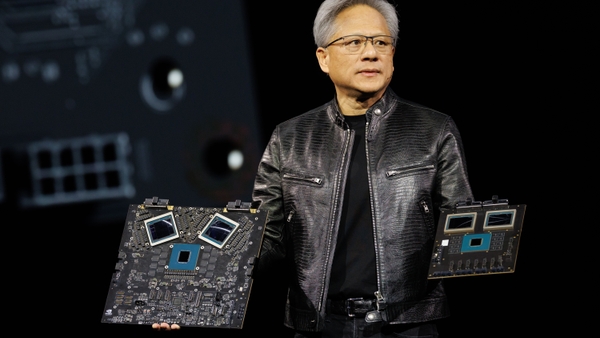
Tech is leading the downside in indices, with the Nasdaq (^IXIC) underperforming. NVIDIA (NVDA) is down roughly 2%–2.5% around $181 after reports that Chinese customs authorities are blocking imports of its H200 AI accelerators, even as the US administration formally approved exports of those chips to China subject to new security conditions. That leaves NVDA trapped between a fluctuating US policy stance and a Chinese response that prioritizes domestic chip development over dependence on US vendors. Management has described China as a roughly $50 billion AI market; today’s price action reflects the market’s doubt that this full addressable market will be monetized smoothly, even if hyperscaler and enterprise demand elsewhere remains extremely strong. At current levels, NVDA screens as High-beta Hold—long-term AI exposure is intact, but headline volatility around China risk is substantial.
Software continues to lag the broader S&P 500 for a second year. The recent Adobe (ADBE) downgrade, with AI cited as weakening its competitive edge, is emblematic: gen-AI tools from LLM providers and platforms like Meta are starting to erode the need for a full Adobe license for many users. Across the sector, investors are questioning pricing power and duration of growth in a world where AI commoditizes parts of the value chain. Application software as a group looks like a Selective Hold, with preference for names that can embed AI into existing products and monetize usage rather than simply defending old license models.
On the positive side, Alphabet (GOOGL) has solidified its position through a multi-year deal with Apple (AAPL). Gemini models and Google Cloud will sit at the heart of Apple’s revamped Siri and broader AI layer. Alphabet’s market cap has already pushed above $4 trillion on this narrative. The strategic message is clear: Google is willing to disrupt its own Search economics on its own terms, embedding itself as the default AI engine on both iOS and Android rather than letting competitors like OpenAI become the gateway. From a positioning standpoint, GOOGL is a Buy / Overweight on AI platform dominance and cloud leverage, while AAPL is a Core Hold—the deal de-risks its AI roadmap but does not yet redefine its earnings power.
**Media, cybersecurity and EVs: NFLX, WBD, PANW, FTNT, RIVN
In streaming, Netflix (NFLX) trades down around 1%–1.5% near $89 as it works on revised terms for its pursuit of Warner Bros. Discovery (WBD). Management is reportedly considering an all-cash ~$72 billion bid for Warner’s studios and HBO Max, abandoning the original structure that combined $23.25 in cash with $4.50 in NFLX shares. Since October, NFLX stock has fallen by about a quarter, making stock-heavy consideration less attractive to WBD holders. At the same time, Paramount Skydance (PSKY) has tabled a hostile all-cash offer near $77.9 billion for all of WBD. Investors are now asking whether Netflix will over-stretch its balance sheet and sacrifice financial flexibility for scale. At this price and risk profile, NFLX looks like a High-risk Hold, not a clear Buy, until terms are final.
Cybersecurity is under pressure after fresh Chinese restrictions. Reuters reports that Beijing has asked domestic companies to stop using software from a group of US and Israeli security vendors. Palo Alto Networks (PANW) and Fortinet (FTNT) both slipped roughly 3%–4% in early trading. These are fundamentally strong franchises, but the narrative is shifting from pure secular growth to geopolitically exposed infrastructure. That moves PANW and FTNT to Hold with a valuation ceiling until there is better visibility on China strategy and replacement demand.
In autos, Rivian (RIVN) is down around 7% near $17.50 after UBS cut the stock to Sell, even while raising the price target from $13 to $15. The downgrade highlights a broader rotation: investors are no longer rewarding EV names purely for delivery growth; they want clear, near-term visibility on positive free cash flow. Unless Rivian can demonstrate a rapid path to profitability and capital discipline, the stock remains a Sell / Underweight in a market that is ruthless on capital-intensive growth stories without AI exposure.
EM tech and services: INFY signals durable IT demand
In emerging-market tech services, Infosys (INFY) is a notable outperformer. The stock is up around 9% near $19.1 after Q3 revenue beat expectations and management raised full-year guidance. Revenue rose 8.9% to roughly 454.8 billion rupees (about $5.04 billion), ahead of estimates near 452.3 billion rupees, and full-year growth guidance has been lifted to 3%–3.5% from 2%–3%. Crucially, the beat is driven by financial-services clients ramping spend again, which confirms that IT budgets are not freezing despite macro noise and that AI, cloud and modernization projects are still translating into real services demand. INFY screens as a Buy, offering EM exposure, structural IT demand and leverage to financial-sector digitization with a cleaner geopolitical profile than many US software peers.
Retail divergences: Saks bankruptcy vs headline growth
Macro retail sales data show a 0.6% monthly gain in November and 3.3% year-on-year growth, but the micro picture is much more selective. Saks Global has filed for Chapter 11 after struggling to service the debt from its $2.7 billion Neiman Marcus acquisition and missing a $100 million interest payment. The company has secured roughly $1.75 billion in new financing and intends to keep all Saks Fifth Avenue and Bergdorf Goodman stores open through restructuring, with a new CEO stepping in after the previous chief lasted just two weeks.
This failure sits alongside earlier bankruptcies at Party City, Forever 21, Rite Aid and others, while Macy’s (M) and Kohl’s (KSS) continue to close stores. The pattern is straightforward: aggregate US consumption is holding up, but the value proposition is shifting toward off-price, e-commerce and experiences. Highly leveraged, mall-centric models are being repriced down or wiped out regardless of the headline retail sales growth rate. The segment is heavily idiosyncratic; there is no broad Buy call—investors should treat legacy department-store equities as Speculative or Avoid, while focusing on structurally advantaged discounters and online leaders.
Asia divergence: Japan records vs China deleveraging and record surplus
In Asia, the split between Japan and China remains stark. Japan’s Nikkei 225 has posted another all-time high, with Prime Minister Sanae Takaichi calling a snap election in early February to cement her position. The 10-year Japanese government bond yield has climbed to about 2.18%, the highest closing level since 1999, signaling that markets are finally pricing a meaningful exit from ultra-easy policy. A weaker yen and governance reforms support Japanese equities, and at current valuations Japan remains a Constructive Buy / Overweight for investors seeking developed-market cyclicals and industrial exposure outside the US.
China is more complicated. Regulators have raised the minimum margin requirement for financing securities purchases to 100% from 80% across Shanghai, Shenzhen and Beijing. The CSI 300 (000300.SS) erased an early 1.2% gain to close roughly 0.4% down as leveraged players adjusted positions. Yet macro data show a record trade surplus of about $1.2 trillion in 2025, with exports up 5.5% year-on-year in dollar terms. While shipments to the US fell, Chinese manufacturers offset this with new customers and strong AI-driven global demand. Major global houses like Goldman Sachs (GS) and BNP Paribas have turned more constructive on Chinese stocks and the yuan (CNY), with some forecasting appreciation toward 6.25 per dollar this year after the currency was allowed to break the 7 level.
Net-net, Chinese equities remain a High-risk Selective Buy for investors who can stomach policy volatility; the macro backdrop (record surplus, policy support, cheap valuations) is improving, but capital-market regulation and geopolitical risk still justify a discount.
Europe, dollar, Treasuries and cross-asset signals
In Europe, the Stoxx 600 has hit another record high, supported by subdued inflation, expectations of ECB cuts later in the year and earnings leverage to global AI and industrial capex cycles. European indices are benefiting from exposure to industrial automation, luxury and energy at lower valuations than the S&P 500, with a currency tailwind from a relatively soft dollar.
The US Dollar Index (DXY) is slightly weaker in the high-90s, supporting metals and EM FX but not yet signaling a disorderly dollar decline. US Treasuries have seen modest demand, with the 10-year yield dipping back to roughly 4.15%–4.16% as softer-than-expected PPI nudges inflation fears lower at the margin. Cross-asset, the structure is classic late-cycle: equities near records with increasing dispersion, credit still reasonably well-bid, commodities ripping higher, and safe-haven trades in gold, silver and selected EM FX gaining sponsor capital.
Crypto: BTC-USD as a high-beta macro hedge
Bitcoin (BTC-USD) trades around $95,000–$96,500, up roughly 2% on the session after bouncing from lows near $94,000. The behavior is consistent with the metals narrative: investors are allocating to assets outside the traditional fiat-bond-equity system as political pressure on the Fed escalates and debt dynamics remain unsustainable. The difference is volatility and regulatory risk. While gold and silver are at records with deep, liquid institutional participation, Bitcoin remains far more sensitive to liquidity swings, leverage and regulatory headlines.
In this context, BTC-USD functions as a Speculative Buy for investors explicitly seeking high-beta exposure to the debasement and geopolitics trade. For conservative capital, the cleaner hedge remains GC=F and SI=F.
Tactical stance: indices, sectors and key tickers – Buy, Sell, Hold
Pulling the threads together, the tactical ordering is clear. The S&P 500, Nasdaq and Dow are in a Hold / Mild Underweight zone after record runs, with earnings and macro still supportive but policy and valuation risk building.
Within sectors and key names:
US money-center banks (BAC, WFC, JPM, C) are Hold / Underweight until there is better visibility on regulation, funding costs and credit.
Payment networks (V, MA) move from straightforward Buy to Hold given credible APR-cap risk.
Gold and silver (GC=F, SI=F) are Bullish / Buy on dips, supported by fiscal, monetary and geopolitical conditions, with copper (HG=F) also constructive.
Energy and oil (CL=F, BZ=F, BP and peers) sit at Cautious Buy / Hold, with upside capped only by potential growth slowdown.
Mega-cap AI: GOOGL is a Buy / Overweight on platform dominance; AAPL is a solid Core Hold; NVDA is a High-beta Hold with structural upside but elevated China and policy risk.
Streaming and media (NFLX, WBD) are High-risk Hold until deal terms and regulatory response clarify the risk-reward.
Cybersecurity (PANW, FTNT) is a Hold, compelling businesses but now priced with a geopolitical discount.
Autos and EVs, specifically RIVN, screen as Sell / Underweight in the absence of near-term free-cash-flow visibility.
EM IT services (INFY) is a Buy, with clean leverage to global financial-sector tech spend and relatively low geopolitical overhang.
Crypto via BTC-USD is a Speculative Buy as a high-beta hedge for investors who can absorb extreme volatility.
Overall, leadership is rotating away from stretched US banks and parts of megacap tech toward metals, selected energy, EM IT and high-quality cyclicals. The market is no longer rewarding everything; it is rewarding balance-sheet strength, real-asset exposure and credible AI leverage, while punishing leverage, political risk and business models threatened by the same AI wave that lifted valuations in 2025.