

Stock Market Today - Nasdaq 23,501, S&P 6,915, Dow 49,098: Tech Rescues Wall Street as Intel Tanks
Intel sinks 17%, Nvidia advances, small caps retreat, and gold soars to $4,673 with silver above $100 after a volatile week driven by tariffs, Fed jitters and EM rotation | That's TradingNEWS
Stock Market Today After Friday Close: Tech Outperforms While Dow and Small Caps Break Momentum
Major Indices: Split Close, Second Straight Losing Week for ^DJI, ^GSPC, ^IXIC
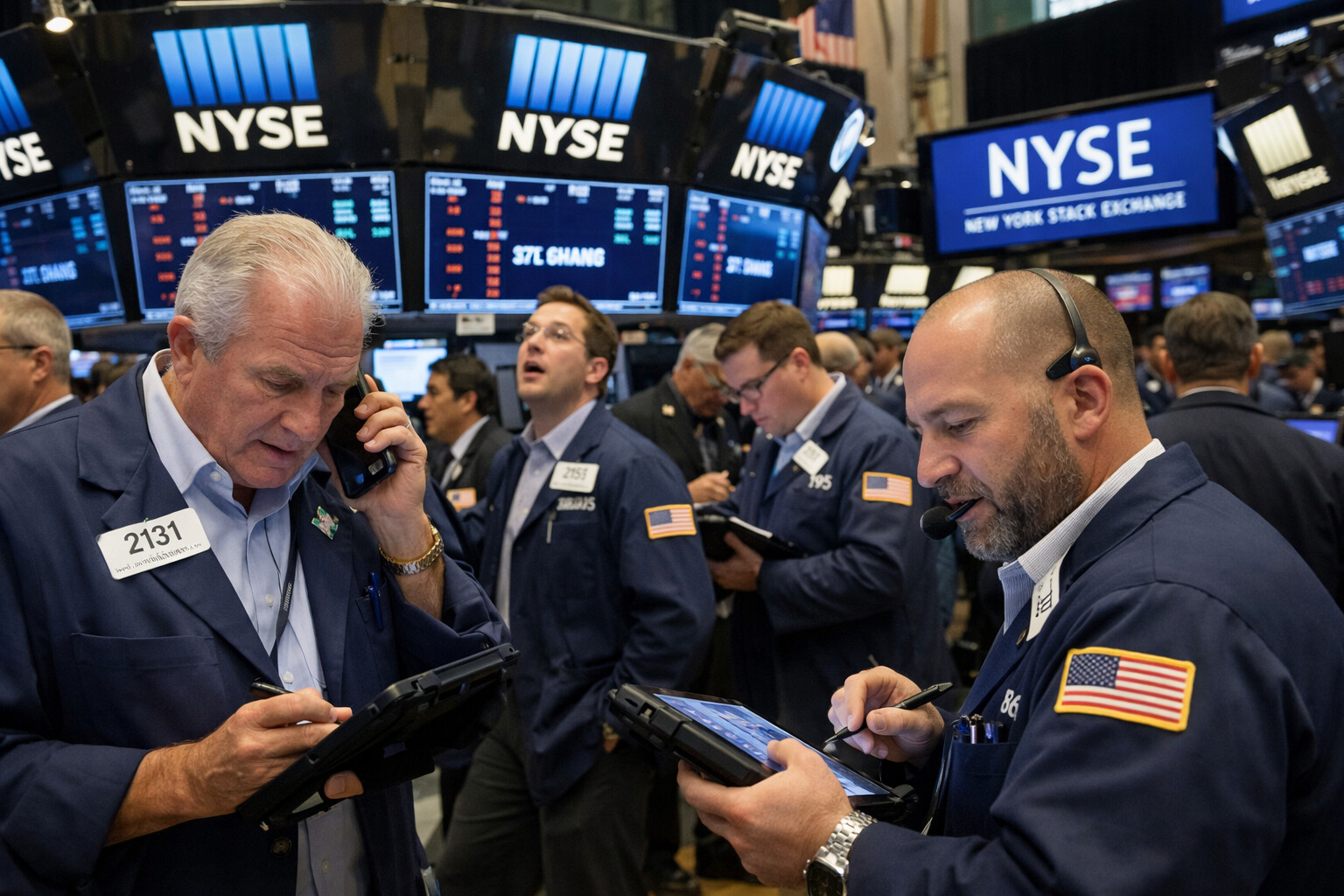
The close was defined by a sharp divergence: the S&P 500 (^GSPC**)** finished almost unchanged at 6,915.61 (+0.03%), the Nasdaq Composite (^IXIC**)** gained 0.28% to 23,501.24, and the Dow Jones Industrial Average (^DJI**)** dropped 0.58% to 49,098.71. All three logged a second consecutive weekly loss, with the Dow down about 0.5%, the S&P off roughly 0.4%, and the Nasdaq fractionally negative on the week. The move caps a volatile, holiday-shortened stretch dominated by Trump’s tariff threats on eight European countries over Greenland, the subsequent reversal, and a noisy rotation out of pure US exposure into emerging markets, metals and hard assets. The relief rally on Wednesday–Thursday recovered earlier damage, but Friday’s Dow slide put the 30-stock index back in the red for the week, underscoring how fragile sentiment remains under headline risk and position rebalancing.
Leadership Board: NVDA, MSFT, AMZN, META Carry ^IXIC While INTC Drags
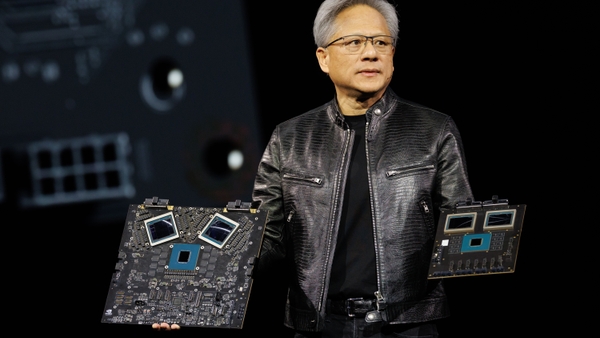
The Nasdaq and S&P 500 were once again held up by the AI and megacap complex. Nvidia (NVDA) gained about 1.6% to roughly $187.79 as investors digested two key China headlines: CEO Jensen Huang’s planned visit ahead of Lunar New Year and signs that Beijing is preparing to let major Chinese tech firms order H200 chips again. That combination keeps NVDA central to AI data center spending even with export restrictions in the background.
Microsoft (MSFT) rallied around 3.3%–3.4% to about $466–$467, extending its move as investors continue to price in AI cloud demand and software monetization. Amazon (AMZN) added about 2.1% to roughly $239.30, and Meta Platforms (META) climbed around 1.8% to about $659.12, reinforcing the “quality growth” bid within tech.
On the other side of the ledger, Intel (INTC) was the outlier and the single biggest drag on sentiment. The stock sank about 17% to roughly $45.07 after management paired a mixed Q4 print (EPS beat, revenue near expectations) with extremely soft Q1 guidance: revenue in a $11.7–$12.7 billion range and essentially breakeven adjusted EPS versus prior Street expectations for positive earnings. The company also admitted it lacks sufficient supply to fully meet seasonal demand in early 2026, a damaging message for a name trying to claw back credibility in AI and data center. The result: INTC is now on track for its worst single-day decline since mid-2024 and is firmly discounted relative to the rest of the AI hardware stack.
Small Caps and Transports: ^RUT Snaps Streak as Dow Theory Still Confirms Bull
The Russell 2000 (^RUT**)** reversed sharply from fresh record highs, sliding nearly 1.7–1.8% on the day to about 2,669, its worst session in roughly six weeks and enough to leave it down around 0.2% on the week. That pullback snaps a strong short-term run where small caps had outperformed in early 2026 and had pushed to new highs on Thursday. Even after the drop, ^RUT remains up about 7% year-to-date, outpacing the S&P 500’s sub-1% gain, but Friday’s action shows that the “reflation plus Fed-easing” narrative is not a one-way trade.
In contrast, the Dow Jones Transportation Average remains a structural positive. Transports have set multiple record closes and fresh intraday highs in January, confirming the current bull market under classic Dow Theory: both industrials and transports have printed new highs in the same general window, validating the underlying uptrend in economic activity and equity prices even as week-to-week volatility remains elevated.
Macro Pulse: PMIs, Sentiment and Trump-Driven Policy Noise
Macro data reinforced a picture of slow but positive growth. The S&P Global Manufacturing PMI printed 51.9 for January (just above December, slightly below consensus 52.1), while Services PMI held at 52.5 (flat versus last month, below a 53.0 consensus). The Composite PMI ticked to 52.8 from 52.7, signaling expansion but at a cooling pace versus the stronger readings seen in late 2025. Economically, that roughly maps to about 1.5% annualized GDP for December and January, consistent with what S&P’s chief economist flagged: solid, not spectacular growth with new business momentum “worryingly subdued.”
Consumer psychology is inching in the right direction but remains damaged. The University of Michigan Sentiment Index climbed to 56.4 in January from 52.9, beating expectations for 54.0. The current conditions sub-index jumped 9.9 points, while expectations improved 4.4 points. One-year inflation expectations fell to 4.0% (lowest since January 2025), though 5-year expectations nudged up to 3.3%, keeping long-run inflation worries alive. Importantly, overall sentiment is still more than 20% below levels a year ago, reflecting lingering pressure from high prices and concerns about labor market softening.
Overlaying these data points is a noisy policy backdrop. Trump’s threats to impose tariffs on multiple European countries over Greenland triggered a “sell America” impulse earlier in the week, pushing investors into gold, silver and emerging markets and pressuring the dollar. Once he walked back the tariffs and announced a “framework” with NATO’s Mark Rutte on Greenland, the market staged a two-day rebound, but Bank of America flow data show roughly $17 billion pulled from US equities during the week as global investors quietly rebalanced away from US risk assets.
Fed Chair Race and Rate Path: TSLA-Style Volatility Without the Chart
Fed policy risk now includes a personnel dimension. Trump has signaled he has essentially made his decision on a new Federal Reserve chair and hinted that an announcement will come “soon.” Odds in prediction markets shifted sharply toward Rick Rieder of BlackRock after reports that he has strong White House support and is viewed as willing to overhaul the institution. In betting markets, his odds jumped to around 50%, versus about 33% for Kevin Warsh and roughly 10% for Christopher Waller.
Markets now face a binary feel: a Rieder appointment would be read as a tilt toward a more markets-savvy, potentially flexible Fed but with a bias to use balance-sheet tools more aggressively; a different candidate could re-price the entire rates curve. That debate sits on top of an upcoming Fed meeting and rate decision, with PMIs and sentiment pointing to modest growth, while tariff and commodity pressure keep inflation risk alive. Equities are trading this as a volatility overhang rather than a directional macro signal – yet.
Sector Rotation: From “Sell America” to EM, Metals and Hard Assets
Capital flows confirm the narrative shift. As Trump escalated his rhetoric on tariffs, Greenland and Iran, investors accelerated a “quiet quitting” of US assets. Emerging-market equities are on their fifth straight weekly gain, with the broad EM index hitting record levels. Asian tech is leading, but Emerging Europe, Middle East and Africa have rallied all week and the Latin America benchmark is at its highest since 2018. Investors are openly diversifying away from Treasuries and the dollar and into EM stocks, EM currencies and commodities.
Within this, the move in metals has turned structurally aggressive. Gold is up around 15% year-to-date and roughly 71% over the last year, trading near $4,673 per ounce. Silver has broken through $100 per ounce for the first time, and platinum is up roughly 35% from early-2025 levels. The abrdn Physical Precious Metals Basket Shares ETF (GLTR) has returned about 26% in 2026 and surged 124% on a 1-year view, essentially turning a diversified metals basket into a “meme-like” chart. A veteran futures broker compared metals to prior parabolic blows in natural gas, cocoa, the euro and cotton, arguing that current levels are detached from fundamentals and vulnerable to a sharp unwind.
The broader trade is clear: outflows from US equities, a softer dollar, aggressive inflows into EM and metals, and a market increasingly willing to pay up for anything viewed as outside the US policy blast zone.
Natural Gas and Winter Storm Risk: NG=F Vol Explodes
US natural gas futures (NG=F) just posted one of their most violent short-term moves on record. Front-month contracts surged 63% over three sessions, then dropped as much as 7.6% on Friday to around $4.66 per MMBtu, still leaving the contract on track for its largest weekly gain since at least 1990.
Fundamentals justify at least part of the move: an Arctic storm is sweeping across the Plains, Great Lakes, Mid-Atlantic and Northeast, with >12 inches of snow expected in some regions and significant freezing rain and sleet in the South. Goldman Sachs estimates the freeze could temporarily knock out more than 10% of US gas production as wells and infrastructure ice over. Authorities are already warning of “significant to locally catastrophic” ice accumulations, long power outages, and travel that in some areas becomes effectively impossible.
The combination of spiking heating demand, potential supply outages in key producing regions, and speculative short covering explains the blow-off rally. The sharp intraday reversal on Friday shows that a lot of the panic buying was positioning-driven, not purely fundamental.
Oil and Geopolitics: BZ=F Stabilizes on Iran Risk and Tariff Whiplash
Crude is trading a more muted, policy-linked path. Brent crude (March ’26, BZ=F) sits around $65.88 after falling roughly 2% earlier in the week, then rebounding as Trump publicly warned that a US “armada” is heading toward Iran and repeated that Tehran must not restart its nuclear program. The rhetoric reinforces the risk of supply disruption in the Gulf just as the market is trying to balance slower global growth expectations with OPEC+ discipline.
At the same time, tariffs and “America First” energy messaging complicate demand and FX dynamics. The same geopolitical noise that sent investors out of US equities has simultaneously boosted EM commodities and triggered rotation into energy-linked EM names, even as crude itself trades in a relatively tight range near the mid-$60s.
Financials and Payments: COF, V, MA Face Policy and M&A Cross-Currents
Traditional financials are dealing with a messy overlay of regulation and strategic deals. Capital One (COF) fell roughly 3–4% after announcing the acquisition of corporate card and fintech startup Brex for $5.15 billion, paid half in cash and half in stock. The deal price is about 60% below Brex’s peak valuation just over $12 billion from 2021, and it comes on the heels of Capital One’s $35 billion Discover acquisition. The Street read the latest deal as strategically logical – expanding the business payments footprint – but near-term dilutive and another demand on capital just as the regulatory backdrop gets tougher.
The entire card complex remains under a cloud from Trump’s push to cap credit card APRs at 10%. Visa (V) and Mastercard (MA) are reportedly working with the administration on products that comply with a 10% cap. Analysts covering the networks argue the long-term earnings hit is likely limited and see both stocks as positioned for a relief rally into earnings as worst-case fears recede. The trade here is not about imminent collapse of the business model but about how quickly the multiple can re-rate once regulatory risk is better defined.
Consumer and Services: SBUX, DRI, SHW and the Tax-Refund Trade
Among consumer names, the tone is mixed but with clear differentiation. Starbucks (SBUX) has a potentially pivotal week ahead, with earnings on Wednesday and an investor day on Thursday. Deutsche Bank expects some downside to FY 2026 guidance but sees 2027–2028 as disproportionately strong as the company rebuilds margins and leans into operational efficiency. The stock added about 1% into Friday’s close as investors position for improved visibility on same-store sales and cost controls.
Darden Restaurants (DRI), owner of LongHorn Steakhouse and Olive Garden, was upgraded to outperform with a target of $235 (around 14.5% upside from $206.17). The thesis hinges on higher US tax refunds adding roughly 1.3% to comps across its key brands, plus easing labor and commodity inflation into FY 2027 while menu prices continue to move higher. The stock is already up about 12% in 2026, and the call effectively leans into a “tax-refund and value dining” mini-cycle.
In contrast, Sherwin-Williams (SHW) was cut to hold with a trimmed target near $380, implying only about 8% upside from current levels. With 2026 shaping up as the third straight year of sub-10% earnings growth and the stock still trading at around 29x EPS and 21x EBITDA, the name no longer justifies its historical “elite compounder” multiple without a clearer re-acceleration path.
Tech Hardware and Semis: INTC Stumbles, TSM, NVDA, AMAT Tighten Their Grip
The major semiconductor story is the widening gap between legacy CPU names and advanced foundry/AI players.
Intel (INTC), as noted, suffered a roughly 17% collapse to around $45, after signaling breakeven Q1 earnings and revenue barely above $11.7–$12.7 billion, with comments that it lacks sufficient supply for seasonal demand. The guidance and operational messaging undermine the narrative of a smooth AI pivot and leave the stock at risk of further de-rating if execution doesn’t improve quickly.
By contrast, Taiwan Semiconductor Manufacturing (TSM) sits on the other side of the industry’s power curve. The stock trades around $334.61, up 2.21% on the day and boasting a $1.7 trillion market cap. Over the last 20 years, TSM has delivered approximately 19% annual price returns and 23% annualized total return including dividends. Even using a more conservative forward assumption of 15% annualized, a $1,000 position today mathematically compounds toward roughly $16,300 over 20 years. The point is not the exact number; it’s that process leadership and scale give TSM a structural moat in foundry economics that INTC simply does not have today. TSM remains the default manufacturing partner for smartphones, PCs, data centers, automotive and a growing share of AI accelerators.
Nvidia (NVDA) continues to look like the critical choke point in AI infrastructure. The potential reopening of China for H200 orders, plus the CEO’s trip to the region, suggests that even a partially constrained China business can remain material. The stock’s 1.6% move on Friday is modest given the size of prior runs, but the strategic message is unchanged: NVDA is still the premier way to own AI hardware at scale.
Equipment vendor Applied Materials (AMAT) added another structural bullish datapoint. Deutsche Bank Research upgraded the stock to buy, hiked its target from $275 to $390 (over 22% upside), and flagged that its WFE (wafer fab equipment) environment assumptions for 2026–2027 are now roughly 10% above consensus. The firm also sees AMAT’s valuation discount to semicap peers as “overdone,” setting up scope for both earnings and multiple expansion if the AI capex cycle persists.
Short Squeeze Risk: SNDK as Crowded Memory Trade
Few charts explain the risk of being short the AI supply chain better than Sandisk (SNDK). The stock is up roughly 99% year-to-date and over 1,200% in the last twelve months, driven by a structural shortage in flash memory as data centers and AI workloads consume capacity faster than supply has been coming online. Analysts have doubled price targets on the back of margin expansion as SNDK doubles prices into scarcity.
Short interest has risen to about 7.5% of float, and option open interest has ramped in tandem. Mark-to-market losses for shorts now sit near $3 billion, and a proprietary short squeeze score places SNDK in an “extreme” risk zone. Despite a roughly 5.9% pullback into the close (with the stock finishing near $473.83 after hours), positioning remains fragile. Any incremental positive catalyst – pricing commentary, capacity delays from a competitor, or another AI-capex headline – can trigger a violent squeeze.
Defensive Tech Services and Government IT: BAH, ISRG, COUPANG
Away from pure semis, several idiosyncratic tech and tech-adjacent names moved on fundamentals. Booz Allen Hamilton (BAH) jumped about 7% after signaling that federal contract awards are re-accelerating following a period of budget-cut driven turbulence, including disruption tied to the Department of Government Efficiency (DOGE). The backlog increased to roughly $38 billion, and management nudged EPS guidance higher even as revenue guidance remained essentially flat to slightly lower. The market is treating BAH as a high-quality compounder with temporary top-line noise rather than a structurally impaired story.
Intuitive Surgical (ISRG) rose around 2–3% post-earnings after reporting Q4 revenue of $2.87 billion versus expectations closer to $2.75 billion, and adjusted EPS of $2.53 against a consensus in the $2.26 area. Procedural growth and installed base expansion for its surgical robots remain intact.
Coupang (CPNG) gained about 3% after a rating upgrade to Buy despite lingering overhang from a cyberattack and data-leak concerns; the Street is clearly willing to look through one-off operational setbacks in exchange for renewed growth and margin expansion in Korean e-commerce.
Airlines and Autos: ALK Premium Strategy vs TSLA Software Pivot
In transport, Alaska Air Group (ALK) advanced roughly 5% after delivering Q4 EPS of $0.43, well ahead of a $0.11 consensus, on revenue near $3.6 billion with capacity up 2.2%. The key takeaway: premium and loyalty are carrying the business. First Class and Premium Class revenues rose 7.1% year-over-year, while Main Cabin revenue declined 2.4%, though even Main Cabin showed sequential improvement. Management highlighted strong demand trends among high-income travelers and an accelerating premium mix, consistent with what Delta (DAL) and United (UAL) have reported.
Tesla (TSLA), by contrast, fell about 0.7% on a controversial product move rather than earnings. Elon Musk has removed the basic Autopilot functionality from new Model 3 and Model Y vehicles and is pushing buyers toward the more expensive Full Self-Driving (FSD) software. The market treated this as a high-risk upsell attempt: potentially improving per-vehicle software economics but inviting regulatory and reputational blowback if customers see it as degrading the base product. A senior executive at a major brokerage went as far as to call TSLA “a belief system more than a fundamentals stock,” underscoring how much of the valuation still rests on long-dated autonomy and robotaxi narratives.
Bubble Narratives and Gold: ^GSPC vs Kiyosaki’s “Biggest Bubble” Call
Macro commentary from high-profile voices continues to clash with price action. Robert Kiyosaki recently labeled current conditions the “biggest bubble in history” and predicted that baby boomers’ 401(k)-heavy portfolios would be crushed in an imminent crash. Since his specific tweet calling for a bust, the S&P 500 has climbed about 36%, with the index posting cumulative gains near 196% over the long window used by some high-profile stock-picking services.
Kiyosaki recommends hedging with hard assets and has been long gold since 1972, publicly targeting prices as high as $27,000 per ounce based on forecasts from Jim Rickards. Reality today: gold near $4,673, up 71% year-over-year, delivering huge returns but still far from that target. He also promotes gold IRAs through custodians like Priority Gold, arguing that combining physical gold with IRA tax advantages protects retirement savings from both crashes and currency debasement. The trade-off is straightforward: storage costs, custodian fees and liquidity constraints versus the inflation and tail-risk insurance that physical bullion provides.
From a Trading News perspective, what matters is not whether the “$27k” number is realistic, but that the narrative is clearly resonating: US equity outflows, surging metals, high-profile bubble talk, and an investing public still mentally scarred by prior drawdowns. That mix supports continued bid for gold and silver unless the Fed delivers a cleaner disinflation-plus-growth outcome than the market currently expects.
Speculation Corner: USAR vs MP in the Rare Earth Race
The rare earth complex gave retail traders another high-beta story to debate. USA Rare Earth (USAR) trades around $24.64, up 8.5% on the day and over 30% in 2026, with a market cap highlighted in different sources between roughly $2.7–3.7 billion despite no meaningful revenue. The entire thesis rests on its Texas Round Top deposit and a fully integrated “mine-to-magnet” strategy:
– Round Top hosts 15 of 17 rare earth elements plus lithium and other critical minerals.
– The long-term plan is to mine ore in Texas, process materials at a facility in Oklahoma, and manufacture high-performance magnets for EVs, wind turbines, defense systems and electronics.
– The company is also running its own processing R&D in Colorado to cut costs and environmental impact.
If the project executes, USAR could become one of the only US suppliers of key heavy rare-earths such as dysprosium and terbium, where domestic capacity is currently minimal. But every step between here and there is unproven: no operating mine, no scaled processing, no magnet output, and a magnet plant scheduled for completion in Q1 2026 while Round Top isn’t expected to produce until late 2028. That gap means early magnet production will rely on third-party feedstock.
The listed peer and benchmark is MP Materials (MP), trading near $69.58 with a functioning mine at Mountain Pass in California and an already-built magnet factory. MP is further along the execution curve but still carries its own commodity and policy risk. In relative terms, USAR is the higher-beta, higher-uncertainty vehicle: it can generate outsized returns if the mine-to-magnet plan works, but it is also exposed to dilution and project slippage if capital markets tighten or construction timelines slip.
Read More
-
PFFA ETF: 9%+ Preferred Income ETF Holding Its Ground Near $22
24.01.2026 · TradingNEWS ArchiveStocks
-
XRP ETFs XRPI and XRPR Suffer First $40M Red Week as XRP Drops Back Toward $1.91
24.01.2026 · TradingNEWS ArchiveCrypto
-
Natural Gas Price Forecast - NG=F Jumps 70% To Five-Year High As Winter Storm Fern Slams US
24.01.2026 · TradingNEWS ArchiveCommodities
-
USD/JPY Price Forecast - USDJPY=X Crashes Below 157 as Intervention Risk and BoJ 0.75% Hit the Dollar
24.01.2026 · TradingNEWS ArchiveForex
Emerging-Market Infrastructure: Why JSE Suddenly Appears on Radar
The rotation into EM assets is also bringing less obvious plays into view, such as JSE Ltd, the operator of the Johannesburg Stock Exchange. This is not a flashy story; it is a classic market-infrastructure business monetizing:
– Trading fees across equities, bonds and derivatives
– Listing fees for South African and regional companies
– Clearing, settlement and market-data services
With ISIN ZAE000004693, JSE effectively gives investors a leveraged play on South African capital markets: rising volumes, more listings and greater foreign participation feed directly into earnings. The stock trades more like a steady, income-oriented exchange operator than a growth rocket, with volatility driven by domestic macro, regulation and risk appetite for South African assets.
Compared with US exchange operators like Nasdaq or CME Group, and with global peers like London Stock Exchange Group or Hong Kong Exchanges, JSE sits in a lower-visibility niche. That lack of hype is precisely why emerging-market allocators are starting to talk about it: as flows move away from US-centric assets, exchange operators in EM become a way to ride both local equity booms and structural financial deepening. Still, this is an EM-currency and country-risk trade; investors must be comfortable with South Africa’s macro and regulatory backdrop, not just the business model.
AI, Chips and Long-Duration Compounding: TSM as Quiet Wealth Machine
Against the noise of day-to-day swings, Taiwan Semiconductor Manufacturing (TSM) is a textbook example of a long-duration compounder at the heart of AI, cloud and consumer electronics. The stock’s roughly 23% annualized total return over two decades reflects three structural advantages:
– Technological lead in advanced nodes, enabling it to manufacture chips competitors simply cannot build at scale.
– Deep, sticky relationships with top clients – from smartphone OEMs to hyperscale cloud providers and AI chip designers like NVDA and AVGO.
– Massive capital investment and know-how in fab construction and operation, which create a barrier to entry measured in tens of billions of dollars and many years.
The math is straightforward: if TSM were to grow shareholder returns at 15% annually from here, a $1,000 stake compounds toward the $16,300 region over 20 years. That is not a forecast; it is a demonstration of why the market is willing to pay a premium multiple for a business that effectively taxes global semiconductor volume. In a market that spends plenty of airtime on hyper-speculative AI names, TSM remains one of the cleanest ways to own the infrastructure that almost every AI and tech success story depends on.
US Equities vs Metals and EM: Positioning Snapshot
Flows and price action paint a coherent picture:
– US large caps: still near record levels, but with indices like ^DJI and ^GSPC now printing back-to-back weekly losses amid policy noise.
– Small caps: strong year-to-date run in ^RUT fading into a 1.7–1.8% single-day drop, suggesting investors are not ready to fully embrace a broad domestic risk-on trade while policy volatility is this high.
– Metals and gold: aggressive inflows, parabolic charts in GLTR, gold, silver and platinum, and open talk from seasoned traders that these moves are not fundamentally justified at current speed or slope.
– EM equities and FX: multi-week winning streaks, record highs in EM indices and a clear narrative of diversifying away from the dollar and Treasuries.
In short, investors are not abandoning US risk, but they are reallocating around it – leaning into non-US growth, commodities and idiosyncratic special situations while they wait for Fed policy, the Fed chair appointment and tariff risk to become clearer.
Verdict: Buy/Sell/Hold Calls Across Key Themes
Based strictly on the data and flows you provided, the risk-reward profile looks as follows:
– US Large-Cap Indices (^GSPC**, ^DJI, ^IXIC): HOLD / neutral, with a slight bearish bias on the Dow given concentration in lagging financials and INTC-style value traps. Valuations are not cheap, policy risk is elevated, but earnings strength in megacap tech still prevents a high-conviction “sell.”
– Mega-Cap AI / Cloud (NVDA, MSFT, AMZN, META, TSM): BULLISH / BUY, with preference for TSM and NVDA as core AI infrastructure plays and MSFT as the software layer monetizing AI adoption. All three have credible growth runways and structural advantages; they are not cheap, but the data you provided justifies a positive stance.
– Intel (INTC): BEARISH / SELL. The guidance miss, admission of supply constraints and widening gap to TSM argue that capital is better deployed in structurally advantaged names. The stock may bounce tactically after a 17% collapse, but on fundamentals it does not screen as an attractive long.
– Gold, Silver, GLTR: TACTICAL HOLD, STRATEGIC BUY WITH CAUTION. The trend is clearly up, supported by US-asset outflows and policy risk. However, the speed of the move and “GameStop-style” commentary flag elevated blow-off risk. Position sizing and time horizon are critical: fine as a hedge or multi-year store of value, dangerous as a short-term chase.
– Natural Gas (NG=F): HIGH-RISK TRADING BUY ONLY, not an investment. The 63% spike and subsequent 7–8% drop are pure volatility. Fundamentals justify higher pricing into the storm, but this is a short-horizon trade, not a core holding.
– USA Rare Earth (USAR): SPECULATIVE BUY for aggressive capital, AVOID for conservative investors. The upside is substantial if mine-to-magnet execution works, but there is no revenue, heavy capex, and a multi-year gap between plant completion and Round Top production. Treat it as a venture-style position that can go very right or very wrong.
– MP Materials (MP): MODERATELY BULLISH / BUY relative to USAR. It already has a producing mine and magnet factory, so the execution risk is lower, though still meaningful. For investors bullish on US rare earth independence, MP offers a more de-risked way to express that view.
– JSE Ltd (JSE): HOLD / NICHED BUY for investors explicitly seeking EM financial infrastructure exposure. The business is fundamentally sound but tightly linked to South African macro and currency risk. Not a must-own, but a rational piece of a diversified EM allocation.
– Darden (DRI) and Starbucks (SBUX): CAUTIOUS BUY / OUTPERFORM tilt. Both sit on the right side of the tax-refund and premium-consumer narratives. DRI benefits from higher refunds and easing costs; SBUX needs to prove its 2027–2028 margin story next week but has clear operating levers.
– Sherwin-Williams (SHW): HOLD to LIGHTEN / SELL ON STRENGTH. Premium multiple with sub-10% earnings growth and macro headwinds in housing is not an attractive skew. Without visibility to re-accelerated EPS growth, multiple compression is the base case.
– Capital One (COF) and card networks (V, MA): COF = HOLD with execution risk, V/MA = BUY ON REGULATORY DIPS. The 10% cap headlines are painful but unlikely to destroy the network model; V and MA should benefit from relief rallies once the regulatory pathway is clearer. COF must prove it can digest both Discover and Brex while navigating fee caps.
These are analytical, market-level opinions based on the numbers and events you provided, not personalized investment advice.