Stock Market Today: Tech And AI Put Nasdaq Back On Top To Open 2026
Nasdaq, S&P 500, Dow And Global Indices – Early Outperformance Map
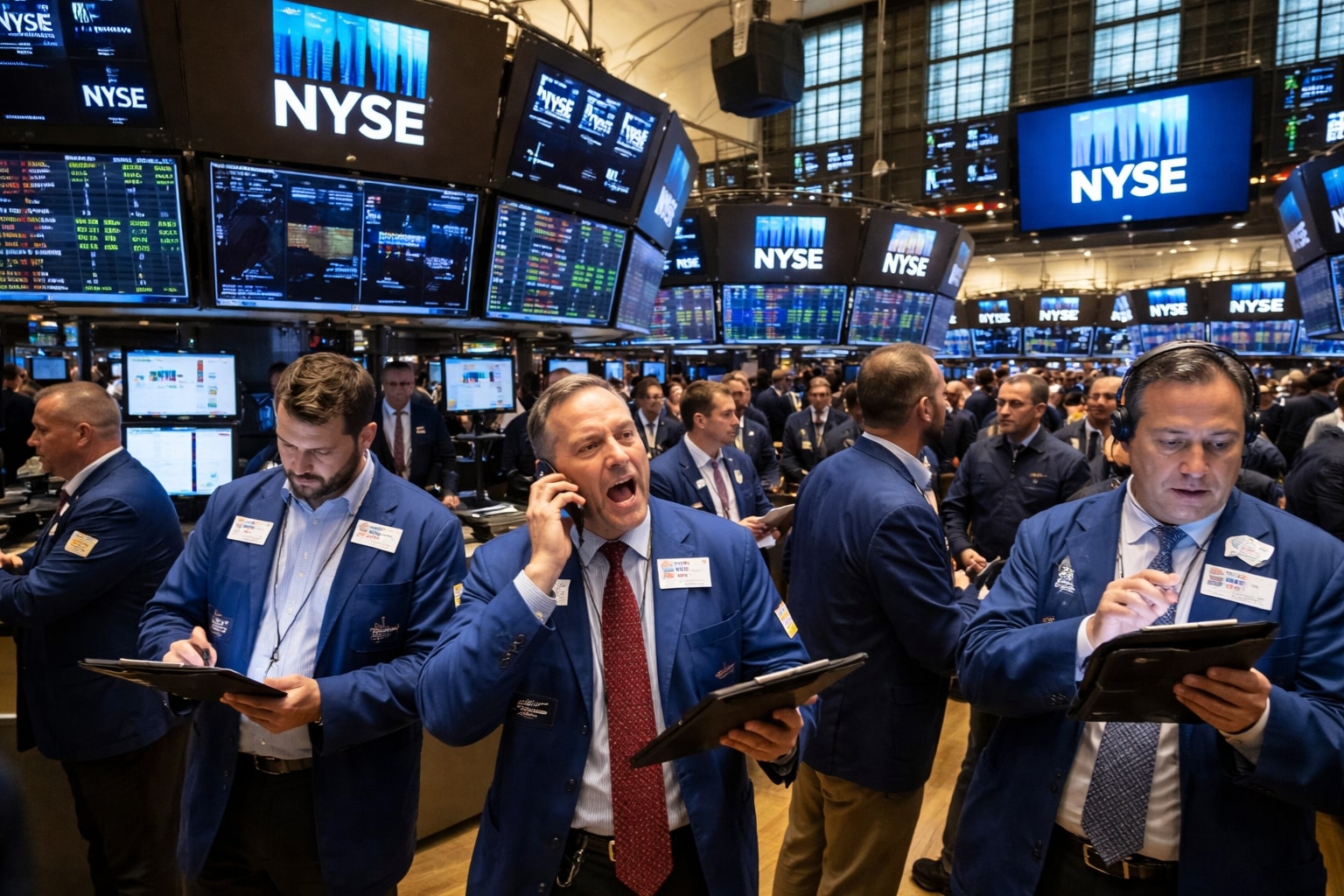
The first trading day of 2026 confirms that the AI-and-chips trade is still in control. The S&P 500 trades near 6,881.86, up roughly 0.5%, while the Nasdaq Composite outperforms around 23,467.24, gaining close to 1.0%–1.3%. The Dow Jones Industrial Average lags at about 48,118.15, up just 0.1%, reflecting a familiar pattern: growth and mega-cap tech pull ahead while more cyclically tilted names grind higher more slowly.
The Russell 2000 sits near 2,493.25, up about 0.46%, showing participation from small caps but without explosive leadership. Volatility stays compressed with the VIX around 14.7, consistent with a risk-on regime and subdued demand for downside protection. On the macro side, the U.S. 10-year Treasury yield trades near 4.18%, barely changed, while the U.S. Dollar Index hovers around 95.9–98.4, a modest tailwind for risk assets rather than a headwind.
This comes after an exceptional 2025: the Nasdaq gained around 20%, the S&P 500 about 16%, and the Dow roughly 13%, all driven disproportionately by artificial-intelligence beneficiaries. For Trading News readers, the risk-reward profile is straightforward: U.S. large caps are expensive after an ~80% three-year run from 2023, but the earnings and capex cycle in AI still supports an upside bias. On indices, the stance is Nasdaq – Buy on weakness, S&P 500 – Hold with a bullish tilt, Dow – Neutral/Hold, given its slower earnings growth profile.
Semiconductors And AI Infrastructure: NVDA MU INTC Dominate Early Gains
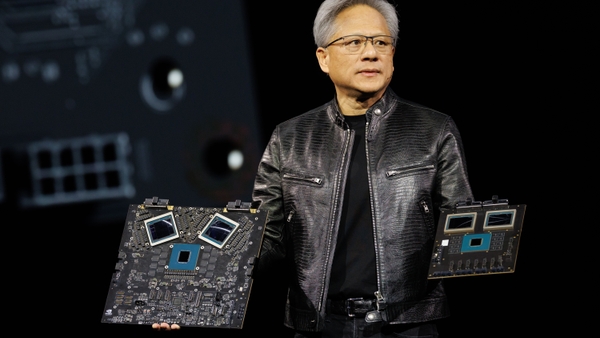
Leadership inside the Nasdaq 100 is concentrated where it has been for two years: chips and AI hardware. Nvidia (NVDA) advances more than 2%–3% intraday after a roughly 39% gain in 2025, supported by heavy spending on accelerators and data-center AI infrastructure. Micron Technology (MU) jumps about 8% on the session; its stock already surged around 239% in 2025, as high-bandwidth memory became indispensable for AI training clusters. Intel (INTC) rallies about 7.5%, reflecting optimism that its foundry and AI turnaround finally begin to translate into share-price repair.
The move is global. In Asia, South Korea’s Kospi hits a record high, up more than 2%, with Samsung Electronics gaining over 7% and SK Hynix adding around 4% as investors rotate deeper into memory and logic suppliers feeding the AI build-out. Within the U.S. sector ETFs, AI-heavy tech baskets and semiconductor funds are again outperforming the broad S&P 500, underlining that the 2025 theme has not reversed; it has resumed after a year-end wobble.
From a positioning standpoint, the numbers justify differentiated calls. NVDA still commands a premium multiple, but forward revenue visibility and margin strength support a Buy rating for investors comfortable with volatility. MU remains a Buy as a leveraged memory play on AI, with secular demand likely to offset cyclical swings. INTC is a Hold: there is upside if execution on process technology and foundry wins improves, but the market is already discounting a large part of the turnaround.
Baidu (BIDU), Chinese AI And Global Tech Rotation
U.S.-listed Baidu (BIDU) becomes one of the day’s highest-beta winners. The stock spikes roughly 10%–12% after the company confirms that its AI chip unit Kunlunxin has confidentially filed for a Hong Kong listing, with earlier fundraising valuing the unit near 21 billion yuan (about $3 billion). The spin-off moves Baidu from being looked at purely as a search and cloud player to a more integrated AI platform monetizing proprietary silicon.
Regionally, risk appetite for Asia tech improves in tandem. Hong Kong’s Hang Seng Index rises more than 2%, and AI-linked Korean names ride the same wave. This broadens the AI trade beyond the U.S. megacaps and into regional champions, which had traded at lower valuations amid geopolitical risk.
For Trading News, BIDU upgrades from value-trap territory to a Buy for higher-risk capital, as the Kunlunxin deal crystallizes hard value and signals policy alignment with Beijing’s domestic chip ambitions. Nevertheless, position sizing has to respect ongoing U.S.–China export controls and listing risks.
Tesla (TSLA) Vs BYD: EV Crown Shifts While Wall Street Bets On Robotaxis
The most controversial tape of the session belongs to Tesla (TSLA). The company reports Q4 2025 deliveries of about 418,227 vehicles, a 16% drop versus the prior year and below the roughly 422,850 analyst consensus Tesla itself had circulated earlier in the week. Full-year deliveries of 1,636,129 vehicles are 9% below 2024, marking a second consecutive annual decline in volume.
Despite that, TSLA trades around $451–$452, up roughly 0.4%–1.5% on the day and about 19% year-on-year. The market is explicitly choosing to price Tesla as an autonomy and physical-AI option rather than a traditional OEM. Analysts and investors are leaning on the view that 2026 is a “defining year” with volume production of robotaxis/Cybercabs and greater monetization of self-driving software and energy storage.
Meanwhile, the volume crown shifts decisively to China. BYD announces sales of around 4.6 million vehicles in 2025, including about 2.26 million battery electric vehicles, up 28% from 1.76 million the prior year. That makes BYD the world’s largest EV seller by units. Chinese peers Nio (NIO) and Li Auto (LI) also show strong December figures of 48,135 and 44,246 units respectively, with their U.S. listings gaining 2%–4%.
From an investment perspective, Tesla’s equity is now a binary bet: either the autonomy and robotaxi narrative scales into high-margin software revenues, or the stock derates closer to conventional automakers as volumes stagnate. Given today’s numbers and valuations, TSLA is a Hold – the upside is substantial if full autonomy is achieved, but the execution and regulatory risks are equally large. By contrast, BYD and the stronger Chinese EV names are Buys for investors willing to accept China-specific risk in exchange for visible unit growth and more conventional volume economics.
Tariff Delay And Furniture Retail: RH W WSM Benefit While Housing Stays Stretched
Trade policy delivers a rare clean win for a specific industry group. On Dec. 31, President Trump signs a proclamation under Section 232 of the Trade Expansion Act, delaying for one year planned increases in tariffs on upholstered furniture, kitchen cabinets and vanities. The 25% duty imposed in September remains, but a scheduled increase to 30% on upholstered furniture and 50% on cabinets and vanities is pushed out.
Equity reaction is immediate. RH (RH) jumps roughly 6%–8%, Wayfair (W) climbs around 5%–7%, and Williams-Sonoma (WSM) adds about 2%–3%. These are direct tariff-exposed names whose gross-margin pressure would have intensified on higher rates.
The relief, however, comes against a structurally tight housing backdrop. A Zillow study cited today estimates that the average 30-year mortgage rate, currently about 6.18%, would need to fall more than 4 percentage points for a typical U.S. home to become affordable for a median-income household on a 20% downpayment assumption. In expensive markets such as New York (average home value above $800,000) and Los Angeles (near $1 million), affordability would remain out of reach even at a 0% mortgage rate under that framework.
For furniture and home goods names, the implication is nuanced. Lower-than-expected tariffs are a clear positive for RH, W, and WSM, supporting a Buy bias on tactical horizon. But housing affordability issues cap volume growth. The trade is therefore more about margin relief and premium customer resilience than broad-based unit expansion.
Macro Backdrop: Inflation, Wages, Housing Reforms And Consumption
Inflation expectations into 2026 remain elevated versus pre-pandemic norms. Core PCE inflation, which averaged below 2% before 2021, surged to 5.6% in 2022 and has since eased but is still projected by many economists to stay above the 2% Fed target through at least another year. Trump’s tariff regime is an explicit wildcard: higher duties on goods raise import prices, while his immigration crackdown may tighten labor supply in sectors that rely heavily on migrant workers, lifting wages and potentially embedding more inflation.
The White House is also signaling aggressive housing reforms for 2026, with Trump promising that “mortgage payments will be coming down even further” and describing planned moves as among the “most aggressive housing reform plans in American history.” Details are thin, but the direction of travel is clear: policy will attempt to offset high rates and constrained supply with targeted interventions. Until specifics arrive, markets will treat this as rhetoric rather than a quantifiable macro input.
On the ground, U.S. households are already strained. By the end of 2024, roughly 5% of employees had taken hardship withdrawals from retirement accounts, up from 2% in 2018, and about 13% of adults said they could not cover a $400 emergency expense by any means. Around 37% would need to borrow or sell assets to meet that cost. That softness in financial resilience tempers any overly bullish consumption narrative, even as equities hit records.
Student Loans, “One Big Beautiful Bill” And Long-Term Demand
The “One Big, Beautiful Bill” reshapes the education finance landscape over the next two years. For undergraduates, subsidized and unsubsidized federal loan limits remain unchanged, but Parent PLUS borrowing is capped at $20,000 per year with a $65,000 lifetime limit per child, ending the previous ability to borrow up to full cost of attendance. Starting 2026–2027, graduate students lose access to Grad PLUS loans and are restricted to borrowing up to $100,000 in unsubsidized loans, or $200,000 for professional degrees such as medicine and law.
These caps will restrain tuition inflation over time but also pressure discretionary spending for younger households, as more of their cash flow is directed toward constrained borrowing or alternative financing. For public markets, the immediate effect is modest; over a multi-year horizon, it can dampen demand for premium discretionary goods, travel and some segments of housing tied to younger buyers.
IRS Direct File, Tax Industry And Household Cash Flows
The IRS Direct File pilot, which allowed taxpayers in 25 states to file federal returns directly via the IRS, is being discontinued ahead of the next filing season after costing roughly $41 million and being used by about 296,531 filers—only 0.2% of all returns. The Treasury argues that private providers offer “better alternatives,” and the system will lean more heavily on the Free File program for incomes under $84,000, even though only about 2% of eligible taxpayers used it last season.
For markets, the story is not about headline CPI but about where household dollars flow. More reliance on private tax software and paid preparers marginally shifts income toward listed tax and fintech firms, while the removal of a free public option can slightly increase frictional costs for lower-income filers. It’s not a big GDP driver, but at the margin it reinforces the theme that households are facing more nickel-and-dime leakage, which constrains discretionary demand at the lower end.
UK FTSE 100 Outperforms And Value/International Rotation Theme
Outside the U.S., the FTSE 100 breaks through the 10,000 level for the first time, capping a 2025 gain of roughly 22%, which actually outpaced the S&P 500’s 16% advance and the Nasdaq’s 20% climb. Performance was driven by miners, energy and defense names—Fresnillo, Endeavour Mining, Rolls-Royce—many of which more than doubled.
Fund managers such as IBOSS/Kingswood explicitly highlight that the U.K. market still looks “relatively cheap” compared with parts of the U.S., and they intend to keep a relative overweight. That is consistent with the broader valuation gap: U.K. large caps trade at lower forward P/E multiples with higher dividend yields than U.S. tech-heavy indices.
For Trading News positioning, this supports a Buy/Overweight on the FTSE 100 versus a Hold on the S&P 500, especially for income-oriented portfolios. Investors who were underweight ex-U.S. equities now have hard performance data showing that value and international exposure can outperform even in an AI-led year.
Gold, Silver, Oil, Bitcoin And Cross-Asset Signals
Across commodities and crypto, today’s numbers reinforce a mixed but risk-friendly picture. Gold futures trade around $4,365 per ounce, up about 0.6%, extending a powerful 2025 run in which the metal repeatedly set new records as real yields stabilized and geopolitical risk stayed elevated. Silver is more volatile, jumping roughly 3.8% to about $73.27. The S&P GSCI commodity index edges lower near 545.98, as energy softness offsets precious-metals strength.
In energy, West Texas Intermediate (WTI) hovers around $56.70–$56.73 per barrel, down roughly 1.2%–1.3%, while Brent trades in the low $60s. Oil’s slide from higher 2025 levels reflects softer demand expectations, the impact of tariffs on global growth and the perception that supply constraints are less acute.
Bitcoin (BTC-USD) trades close to $89,200–$89,350, up around 1.3% on the day but still digesting its first annual drop since 2022, as spot bitcoin ETFs that were heavy buyers for most of 2025 turned net sellers, unloading roughly 73,000 BTC since October. AI’s capital magnetism—drawing institutional money toward large language models, chips and infrastructure—has clearly taken some oxygen out of the crypto complex.
Positioning across these assets leads to differentiated calls. Gold remains a Hold to modest Buy as a hedge with strong central-bank and retail demand. Oil at current levels is a Hold, with asymmetry tilted to the upside if growth surprises or supply disruptions emerge. Bitcoin is strictly a Speculative Hold, with long-term potential balanced against competition for capital from AI and changing ETF flows.
GLP-1 Wave, Consumer Habits And Sector Winners
Another structural theme shaping 2026 is the rapid expansion of GLP-1 obesity drugs. Supply bottlenecks and insurance coverage issues are slowly easing, prices are trending lower and oral formulations are expected, which will broaden access dramatically. Names like Novo Nordisk (NVO), maker of Wegovy, and Eli Lilly (LLY), producer of Zepbound, stand to benefit from millions more patients entering treatment.
The consequences for markets extend beyond pharma. As more people lose weight and shift health trajectories, spending patterns in food, beverages, fitness, apparel and even travel change. Investors are positioning for winners in healthcare and potential losers in snack foods and sugary drinks. Given fundamentals and pipeline strength, NVO and LLY remain clear Buys, while consumer names exposed to high-calorie categories should be treated selectively rather than as broad “buy anything” plays.
Berkshire Hathaway, Retail Investors And Market Structure
On the structural side of equity markets, Warren Buffett publicly argues that Berkshire Hathaway (BRK.B) has “the best odds” of any company to remain relevant 100 years from now, handing operational control to Greg Abel while sitting on a cash pile reported near $358 billion. That cash mountain and Berkshire’s record as a disciplined allocator underpin a Hold to Buy rating; the shares are unlikely to be the top performer in an AI mania, but they remain a high-quality core holding with optionality if valuations reset.
At the same time, retail traders now exert more lasting influence than during the 2021 meme-stock burst. Flows in 2025 show that everyday investors have remained very active, pushing some moves ahead of institutions and challenging the old “smart money vs dumb money” split. This matters for Trading News readers, because liquidity pockets and short squeezes can emerge faster and last longer than traditional models predict.
Indices And Sector Verdicts: Buy, Sell Or Hold From Today’s Tape
Putting all of today’s data together, the leadership map is clear. Nasdaq and AI-centric tech remain the outperformers, supported by earnings and capex, not just narrative. S&P 500 rides that strength but at rich valuations after three consecutive double-digit annual gains. Dow lags yet still benefits from a soft-landing consensus and stable rates. Overseas, FTSE 100 and select international value markets have already demonstrated they can outperform the U.S. in a year dominated by AI.
Verdicts for Trading News:
Nasdaq / AI-heavy tech – Buy on pullbacks, with focus on names like NVDA, MU, leading Korean memory and select AI platforms such as BIDU where structural growth and policy tailwinds align.
S&P 500 – Hold with slight bullish bias; upside remains but risk-reward is no longer asymmetric after the run from 2023.
Dow – Hold, suitable for defensive exposure but not the primary engine of outperformance.
FTSE 100 and international value – Buy/Overweight relative to U.S. indices for investors seeking cheaper earnings and higher yields.
TSLA – Hold, binary robotaxi and autonomy story with real upside but rising competitive risk as BYD and Chinese EVs gain share.
Across the cross-asset board, the loudest signal from today’s session is that markets are still willing to pay for AI growth, still comfortable with equity risk at a VIX near 15, and still leaning into tech-led outperformance while quietly rotating some capital toward cheaper international markets and high-quality cyclicals.
That's TradingNEWS