
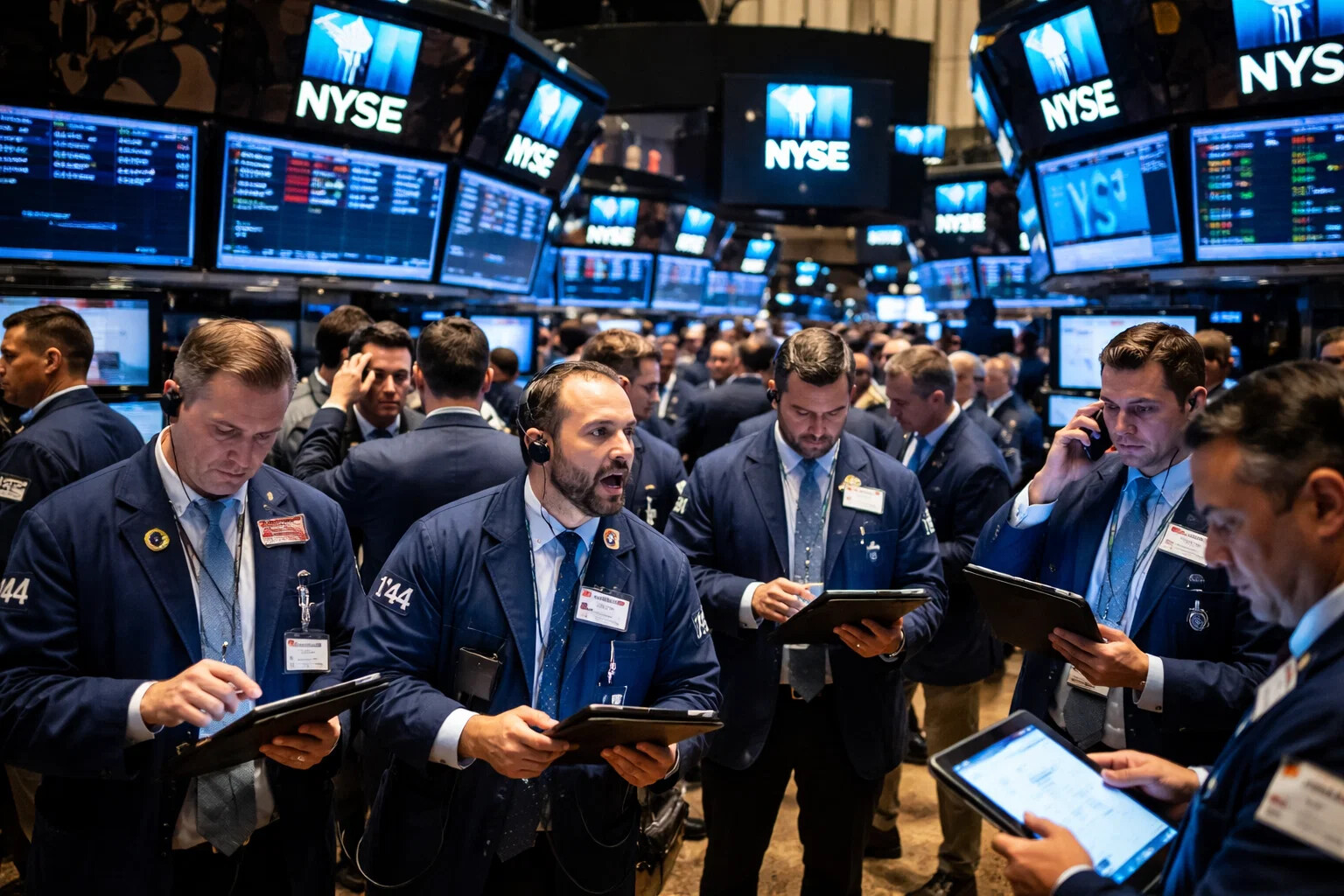
Stock Market Today: S&P 500, Dow Jones, Nasdaq Lifted by AI Chip Rally as TSMC Jumps and Oil Falls to $59
TSM (+5%) and ASML rip on a $52–$56B capex plan, GS and MS top forecasts, BLK assets hit $14T, Russell 2000 sets records, and crude, gold and silver unwind this week’s Iran risk premium | That's TradingNEWS
Stock Market Today: AI Chips Drag Futures Higher, Banks And Commodities Reset
Futures Snapshot: Nasdaq Outperforms, S&P 500 Follows, Dow Stalls
U.S. futures are pointing straight back toward risk. Nasdaq 100 futures (NQ=F) are up roughly 0.9%–1.1%, S&P 500 futures (ES=F) gain about 0.4%–0.5%, and Dow Jones Industrial Average futures (YM=F) are flat to slightly negative around -0.1%. The message is simple: money is rotating back into high-beta tech and AI after two red sessions, while the price-weighted Dow is stuck because it doesn’t carry enough pure AI leaders. Under the hood, this is not a defensive tape; it’s a classic “buy the dip in growth” move with the Nasdaq back in control.
AI Engines: TSM, NVDA, AMD And INTC Reclaim The Market Narrative
The market’s center of gravity is clearly back on the AI hardware chain. Taiwan Semiconductor Manufacturing Company (TSM, 2330.TW) just printed a monster quarter: Q4 net profit jumps about 35% year-on-year to roughly TWD 506 billion (around $16 billion) and revenue climbs 21% to a bit over TWD 1.046 trillion (around $33 billion). That isn’t a mature, slowing business; that is an AI-driven growth engine. Management is not pretending this is a one-off. They are guiding for strong 2026 growth and lifting capex from around $40 billion last year to a new range of $52–$56 billion for 2026. That is an extra ~+$12–$16 billion of real money locked into capacity, packaging and advanced nodes. U.S.-listed TSM trades roughly 5%–6% higher on this and drags the whole AI complex with it. Nvidia (NVDA) bounces after being hit earlier in the week on Chinese customs issues around the H200 accelerator. The political noise is still there, but the earnings and capex signal from its key foundry is much louder. Advanced Micro Devices (AMD) adds more than 1% in early trade, riding the same wave of hyperscaler AI demand. The custom AI chip market is expanding, and AMD is clearly inside that spend. Intel (INTC) is the surprise “second derivative” winner here. Citi upgrades INTC from Sell to Neutral and pins the call on tight capacity at TSM’s packaging business and rising demand for Intel’s advanced packaging and future 18A/14A nodes. On top of that, TSM’s own CEO calls Intel a “formidable competitor.” That’s not casual wording from the industry leader. INTC trades about 3% higher today and has already rallied roughly 150% over the last year, reflecting the market’s shift from “Intel is dead” to “Intel will actually win foundry and packaging business in this AI cycle.” On top of all this, you have Trump’s policy overlay: a 25% tariff on certain imported semis and a 25% government skim on Nvidia’s H200 AI chip sales into China. Margin hit? Yes. Death blow? No. The key point is that the H200 is allowed into China under this structure. It’s a tax, not a ban, and that means NVDA, TSM, AMD and INTC can still monetize Chinese demand instead of watching it evaporate.
Equipment Leverage: ASML, LRCX And AMAT Ride TSM’s $52–$56 Billion Capex Plan
The most leveraged play on TSM’s spending blowout is not just the chip designers; it’s the equipment makers. ASML (ASML, ASML.AS) jumps more than 6%–7%, sending its market cap over $500 billion in Amsterdam. That move is not just optics. ASML essentially owns extreme ultraviolet (EUV) lithography and sits at the choke point for cutting-edge AI chips. If TSM is ramping capex toward the mid-$50 billion range, a meaningful slice of that flows directly into ASML’s tools. U.S.-listed ASML stock also jumps above 4% pre-market. Lam Research (LRCX) rips almost 9% and Applied Materials (AMAT) climbs around 7%–8%. These are the workhorses behind deposition, etch and packaging. When TSM lifts spend by double digits in dollars, these companies are basically selling shovels in a gold rush. The math is straightforward: higher capex at TSM means more tools, longer utilization, fatter backlogs and stronger earnings power at ASML, LRCX and AMAT over the next 2–3 years. That is why a single line of guidance out of TSM moved tens of billions of market cap across the equipment segment in one session.
Index Structure: Nasdaq And Russell 2000 Lead, S&P 500 Tracks, Dow Lags
Look at the indices as a scoreboard. The Nasdaq Composite (^IXIC) dropped about 1.0% yesterday to roughly 23,472, the S&P 500 (SPX) slipped around 0.5% to the 6,926 area, and the Dow hovered in the 49,000 region with mild pressure. Yet the Cboe Volatility Index (VIX) sits near 15.9, down about 5%, which means options markets do not see this as the start of a crisis. The small-cap Russell 2000 (RUT) is the tell. It climbed 0.7% yesterday, hit a record intraday high around 2,651, and closed at a fresh all-time high. That’s its fourth gain in the last five sessions and leaves it up about 1% week-to-date. When the Russell is printing records while the Nasdaq is catching a bid and the VIX is under 16, this is not a fearful market. It is a risk-on market where traders are rotating between mega-cap AI and smaller cyclicals rather than exiting equities.
Big Money Print: GS, MS and BLK Show Financials Are Not The Problem
Financials are not flashing stress; they are printing real money. Goldman Sachs (GS) delivers equity trading revenue of roughly $4.31 billion, up 25% from a year ago and well ahead of about $3.65 billion expected. Fixed income, currencies and commodities (FICC) revenue hits around $3.11 billion, up 12.5%. Investment banking fees rise 25% to about $2.58 billion, just a touch below expectations near $2.66 billion. GS shares trade choppy—initially up about 1% pre-market, then down around 1%—because the market is always skeptical about how repeatable record trading numbers are, but there is no sign of capital stress or credit panic. Morgan Stanley (MS) prints a more “steady compounder” quarter. Q4 earnings per share land near $2.68 versus about $2.44 expected, on revenue of roughly $17.89 billion versus $17.77 billion consensus. The strength comes from wealth management, which is exactly what long-only investors want to see: recurring, fee-rich income tied to assets under management, not just a hot trading desk. MS is up about 2% pre-market around $181. BlackRock (BLK) shows you where the world’s money is actually going. Q4 client inflows hit about $342 billion, with $268 billion of that going into long-term strategies and around $181 billion into ETFs. Assets under management hit around $14 trillion. The ETF platform alone sits near $5.5 trillion. Full-year flows, including money market and cash funds, are about $698 billion. BLK adds roughly 2% pre-market, trading above $1,110. If there were a real systemic financial problem brewing, these three tickers—GS, MS, BLK—would not look like this. They are telling you that trading is strong, wealth is sticky, and global investors are still shoving money into ETFs.
Macro Pulse: 198,000 Jobless Claims, Positive Manufacturing, 10-Year Near 4.15%
The macro tape today is clean and equity-supportive. Weekly initial jobless claims drop to about 198,000 versus a 215,000 consensus, with the four-week average sliding to roughly 205,000. That’s the lowest since January 2024 and nowhere near a recession signal. Layoffs remain low; the labor market is cooling slowly but not breaking. The manufacturing data finally look less ugly. The Empire State Manufacturing Index jumps to around 7.7 from negative territory the prior month, and the Philadelphia Fed survey swings from about -8.8 to around 12.6. Both beat forecasts by a wide margin. You’re moving from contraction to mild expansion in two key regions at the same time AI capex is ramping. Treasuries price this as “better growth, but not runaway inflation.” The 2-year yield sits around 3.55%, the 10-year near 4.15%. Yes, the curve is still inverted, but it is not steepening into a panic. The U.S. Dollar Index (DXY) trades around 99.4, modestly stronger, but still inside a normal range. That combo—sub-200k claims, positive regional manufacturing, yields around 3.5%–4.2%, dollar stable—is exactly the kind of backdrop where the S&P 500 and Nasdaq can grind higher without forcing the Fed into a new tightening cycle.
Commodities: Crude, Gold, Silver And Copper Give Back The Fear Premium
Commodities are bleeding off the geopolitical premium they built earlier in the week. West Texas Intermediate crude (CL=F) trades around $59–$60 per barrel, down about 4%–4.5% after closing near $62 yesterday, the highest print since early October. Brent (BZ=F) slides below $65, losing roughly 3%–4%. The driver is Trump’s changed tone on Iran. He signals he may hold off on any immediate military response after being told Tehran will stop killing protesters. The odds of near-term disruption to Iranian supply and the Strait of Hormuz drop, and the risk premium comes out of the barrel price. U.S. crude inventories rise by about 3.4 million barrels, the biggest build since early November. Add more Venezuelan barrels heading toward the U.S. and disruptions in the Black Sea, and you have WTI trading at one of its deepest discounts to Brent in roughly 15 months—a clear signal of localized oversupply. Gold (GC00) trades about 0.7% lower around the $4,600 area on the contract scale. Silver (SI00) does what silver always does: it overshoots both directions. After spiking above $93 on haven demand and tariff fears, it drops back toward $88.8, down almost 3% in one move. Copper (HG00) has already rallied roughly 23% since November to above $13,000 per tonne. That rally has been driven largely by speculative flows, and now big houses are calling for a slide toward about $11,000 per tonne by December 2026. You’re moving from “everything is going to squeeze” to “most of the copper move is likely behind us.” Net result: inflation pressure from commodities is easing at the margin, which is good for growth stocks and bad for anyone who chased the late stage of the metals ramp.
Read More
-
ASML Stock Price Forecast - ASML Near $1,350; NASDAQ:ASML Joins $500B Club On AI Memory Supercycle And EUV Ramp
15.01.2026 · TradingNEWS ArchiveStocks
-
XRP Price Forecast; XRP-USD Around $2.10 - XRP ETF Demand And EU License Aim At $2.22 Break
15.01.2026 · TradingNEWS ArchiveCrypto
-
Oil Price Forecast: WTI (CL=F) Tests $59 Support While Brent (BZ=F) Retreats To $63
15.01.2026 · TradingNEWS ArchiveCommodities
-
NLR ETF at $145.21: Uranium, Nuclear Power and the AI Baseline Energy Trade
14.01.2026 · TradingNEWS ArchiveMarkets
-
GBP/USD Price Forecast - Pound Shrugs Off 0.3% UK GDP Beat As Strong USD Caps Upside
15.01.2026 · TradingNEWS ArchiveForex
Single-Stock Action: SPOT, PEN, BSX, ENTG And DAL Show The Micro Volatility
Individual names are moving a lot more violently than the indices. Spotify (SPOT) trades about 1%–2% higher after raising its U.S. premium subscription price from $11.99 to $12.99, with similar moves in Estonia and Latvia. A $1 bump sounds small, but at scale it materially lifts revenue and falls straight through to profit, because marginal cost per subscriber is low. The market is pricing in real pricing power and low churn risk. Penumbra (PEN) explodes higher after Boston Scientific (BSX) agrees to buy it for about $14.5 billion, or roughly $374 per share. That’s about a 19% premium to PEN’s last close. PEN trades up around 12%–13% toward the deal price, while BSX slips about 2% as investors price the acquisition cost and integration risk. This is classic med-tech M&A: large cap uses its balance sheet to buy high-growth innovation. Entegris (ENTG) gains around 7% after declaring a $0.10 per share quarterly dividend. Management is basically telling the market: “We are confident enough in our cash flows and in the semi cycle to start sending cash back.” ENTG sits right at the intersection of AI, specialty materials and now yield. Delta Air Lines (DAL) is the poster child for the K-shaped consumer. Its latest earnings show revenue from premium cabins now beats economy revenue. Wealthier passengers are paying up for comfort; price-sensitive travelers are cutting back. That split gives DAL margin leverage in the front of the cabin and pressure in basic economy, but overall it proves that premium demand is robust even as the low end of the consumer budget gets squeezed.
Crypto And Regulation: COIN Hit By Stablecoin Bill Delay
Crypto-exposed stocks are stuck inside a regulatory mess. Coinbase (COIN) and peers are trading around headlines that the Senate Banking Committee has delayed debate on a major digital-asset bill just hours after COIN publicly pulled its support for the latest draft. The sticking point is stablecoins. The bill, as written, would limit the ability of platforms to pay yield or rewards on stablecoin balances. That hits right at the economic heart of COIN’s stablecoin business model. Remember: yield on customer stablecoin deposits is a big margin driver for exchanges and custodians. If that is capped or over-regulated, the revenue line gets compressed even if trading volumes stay high. For the sector, this delay is not just timing; it’s direction. Crypto executives who helped Trump push a stablecoin law through in mid-2025 now worry that the U.S. will fall behind jurisdictions that already have clear rules. For COIN stock, that means a persistent regulatory discount on the multiple until the rulebook is fixed.
Policy Front: Tariffs, Iran, Greenland And Immigration As Background Risk
Policy is noisy but not detonating the market. On chips, Trump’s 25% tariff on certain semiconductors and the 25% government cut on Nvidia’s H200 sales into China are clearly negative for margins, but the key word is “allowed.” H200s can go into China under this tax structure. AI exports are being monetized and controlled, not shut off. On Iran, Trump’s decision to hold off on a strike after assurances about protest crackdowns is exactly why crude and gold are backing off. The risk is still there, but the immediate war trade is unwinding. In the Arctic, talks between U.S., Danish and Greenlandic officials end in what Danish officials call a “fundamental disagreement” over Greenland’s status, even as NATO forces build up on the island. That is a long-tail risk for Arctic routes and resources, not a today trade, but it is part of the geopolitical backdrop. On immigration, a U.S. freeze on new immigrant visas for citizens of 75 countries adds another layer of policy unpredictability. None of these headlines change the earnings numbers for TSM, NVDA, MS or BLK today, but they do feed single-stock and sector volatility when news hits.
Volatility Reality: Quiet Indices, Wild Single-Stock Moves
Here is the structural truth of this market: the indices look calm, individual names do not. The S&P 500 advanced around 16% last year with an AI-heavy leadership, but within its 100 largest components there were 40+ episodes where a stock dropped five standard deviations or more in a single session. That is statistically insane for such large names and the highest count since the late 1990s. You’re seeing the same pattern now. The VIX sits below 16; SPX and ^IXIC look “orderly.” Meanwhile, PEN jumps double digits on a deal, ASML, LRCX and AMAT spike on a single capex line, COIN whips on regulatory headlines, and smaller names are trading like options. AI-driven algos and options-heavy positioning compress reactions into one-day explosions. If you hide only in indices, you miss big upside. If you chase every single-stock move without risk control, you get blown up.
Positioning Call: Where I Stand On AI, Financials, Small Caps And Defensives
On AI semis and equipment—TSM, NVDA, AMD, INTC, ASML, LRCX, AMAT—this setup is a Buy, not a hedge. TSM’s 35% profit jump, revenue up 21%, and capex ramp to $52–$56 billion in 2026 is a direct statement that this AI build-out is not peaking. ASML over $500 billion market cap, LRCX and AMAT ripping 7%–9%, and Intel being called “formidable” by TSM itself all confirm that the cycle is real. There will be sharp pullbacks on every policy headline, but the core trend is higher. On the indices, I would treat the S&P 500 and Nasdaq as Buy on dips, not neutral. You have 198,000 jobless claims, positive New York and Philly manufacturing, 10-year yields around 4.15%, and no red lights from GS, MS or BLK. That is not a backdrop where you sit in cash and wait for a crash. On small caps via the Russell 2000, the fact that RUT is making fresh all-time highs and is up 1% this week while mega-caps were wobbling tells you risk appetite is broadening. Here the stance is a Selective Buy: quality balance sheets, real earnings, and leverage to improving manufacturing and domestic demand. On defensives—gold, silver, crude—after the spike and reversal, the move here is Hold, not chase. The geopolitical premium is already being drained out; new longs at these levels have asymmetrically more downside if Iran stays quiet and inventories keep building. Bottom line: this “Stock Market Today” tape is risk-on with AI back in the driver’s seat, financials confirming stability, and commodities cooling off. The rational stance is to be long AI and high-quality U.S. equities, use the single-stock volatility rather than fear it, and keep defensives as insurance instead of your core position.