




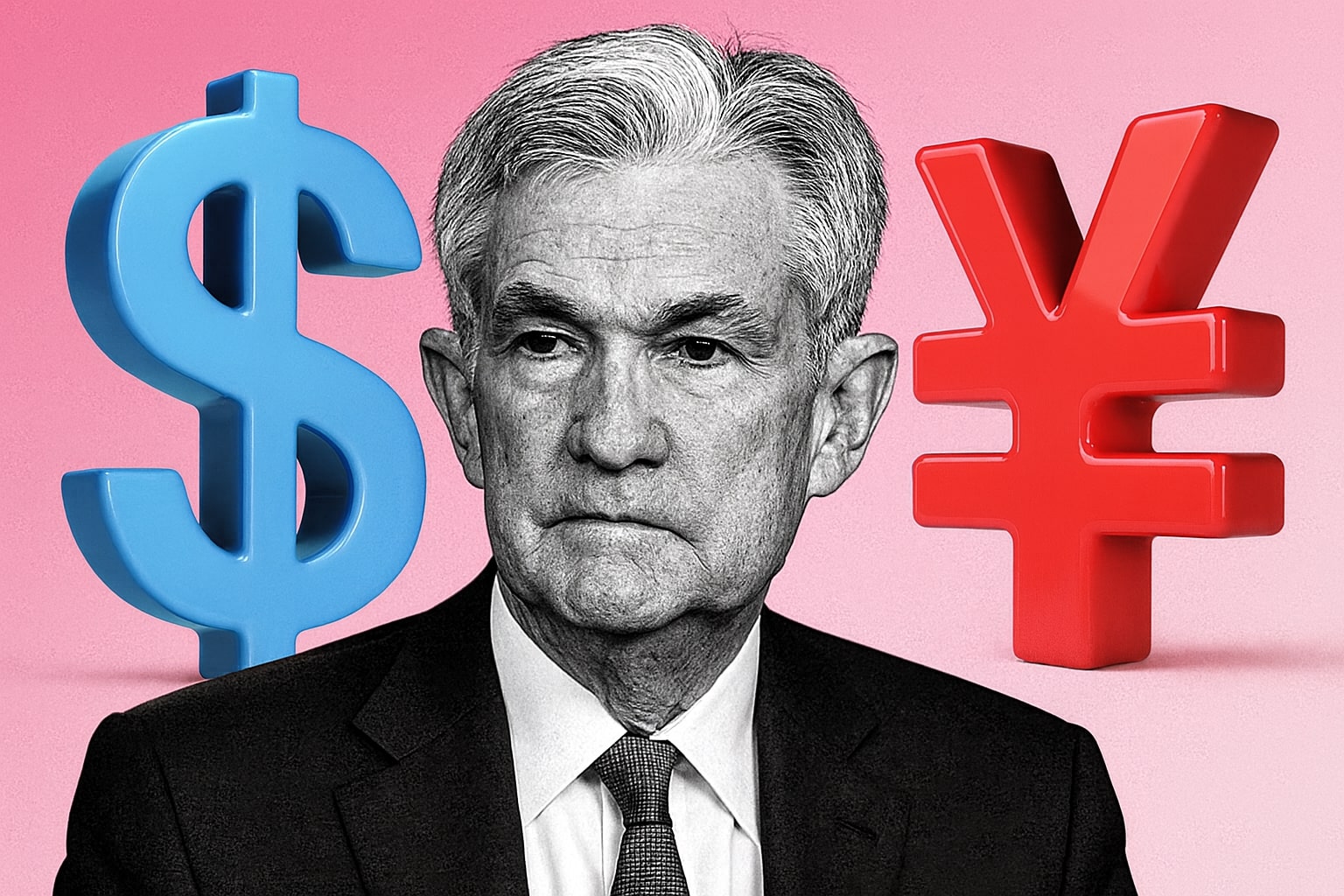
USD/JPY Price Forecast - Dollar to Yen At 155: Yen Strength Builds As BoJ Hike And NFP Collide
USD/JPY stalls below 156.00 with 154.00–153.50 support as Tankan hits 15, BoJ targets 0.75% and a $500B yen carry trade sits exposed to a downside break | That's TradingNEWS
USD/JPY: Yen Tests 155 As BoJ Hike Clash With Fed Cuts Keeps The Carry Trade On Edge
Spot USD/JPY Around 155–156 After 158 Rejection And Momentum Loss
USD/JPY is trading in the 155.0–155.5 zone, roughly 0.3–0.5% lower on the day, after failing to sustain the spike toward 158.0 seen in late November. The pair slipped to an intraday low near 154.8 and is hovering just under the 21-day simple moving average around 156.0, which is acting as short-term resistance and capping every attempt to push higher. On the downside, immediate support sits in the 154.2–154.0 band, reinforced by the 50-day moving average; a clean break there would bring the 153.0 psychological level and then the 100-day area close to 151.0 into play. Momentum gauges confirm the stall: RSI on the daily chart has bled back toward the 50 line, and MACD is below its signal line with a deepening negative histogram, signalling that upside impulse is fading rather than accelerating. fxempire.com+1
BoJ Path: From Negative Rates To 0.75% And A 1.95% 10-Year Yield
The engine behind the yen recovery is the shift in Japan’s rate regime. The Bank of Japan is widely expected to raise its policy rate by 25 bps to 0.75% at the December 18–19 meeting, the highest level since the mid-1990s and the first move since the prior 0.50% step. Roughly 90% of surveyed economists expect that hike, and market pricing implies total tightening of about 67–75 bps by the end of 2026, taking policy close to 1.0% if the economy absorbs each step. At the same time, Japan’s 10-year government bond yield has climbed toward 1.9–2.0%, up from roughly 1.1% at the start of 2025, an 80–90 bp rise in less than a year. That is a structural change for a market that spent a decade pinned under explicit yield-curve control. The key point for USD/JPY is that the rate gap is no longer a one-way story: Japan is now slowly tightening into an environment where the Fed has already shifted to cuts, which compresses the interest-rate differential that powered the carry trade for years.
Read More
-
SCHD ETF Price at $27: Can SCHD’s 4% Yield and 9.15% Dividend Growth Beat High-Yield Covered Call ETFs?
15.12.2025 · TradingNEWS ArchiveStocks
-
XRP ETFs Close on $1B Inflows as XRPI at $10.92 and XRPR at $15.52 Hit 52-Week Lows
15.12.2025 · TradingNEWS ArchiveCrypto
-
Natural Gas Price Forecast: NG=F Holds the $4 Floor as Oversupply Clashes with 2026 LNG Demand
15.12.2025 · TradingNEWS ArchiveCommodities
-
GBP/USD Price Forecast - Pound Holds 1.34 Ahead of BoE 3.75% Cut and Key US Jobs Data
15.12.2025 · TradingNEWS ArchiveForex
Cross-Market Fallout If USD/JPY Breaks: Nikkei, EM FX And Crypto Leverage In The Firing Line
The next directional move in USD/JPY will not stay confined to FX screens. Japanese equities remain tightly linked to yen swings. The Nikkei 225 benefited from a weaker yen as exporters’ overseas earnings translated into fatter margins; a sustained shift in USD/JPY from the current 155–156 band toward 145 or even 140 would erode that FX tailwind and pressure earnings expectations. Global risk assets already learned in August how fast a yen-driven shock propagates: the S&P 500’s ~6% three-day drop and the VIX spike to the mid-60s underscored the role of carry flows in supporting risk. Emerging markets sit on the other side of a large chunk of those positions. One recent month saw EM portfolios draw about $45 billion of inflows, with $41.5 billion into debt and only $3.3 billion into equities, while ex-China EM stocks recorded nearly $7.4 billion of outflows. That composition signals that investors are already rotating defensively. A disorderly move lower in USD/JPY as yen shorts are forced out would likely accelerate EM equity and FX selling, especially in high-yielders like MXN and BRL that have been popular carry targets. Crypto is the highest-beta expression of this liquidity. Bitcoin has already rolled off peaks above $100,000 into the low-$90,000 range, and prior stress episodes showed that a 15% BTC drop can trigger around $4 billion in forced liquidations, with cascading margin calls. When yen funding tightens and USD/JPY slides, those highly levered structures amplify the shock rather than diversifying it away.
Short-Term Trading Range In USD/JPY: 156.00–157.00 For Selling, 154.00–153.50 For Tests Of Demand
In the very near term, USD/JPY is boxed between clearly defined edges while traders wait for confirmation from central banks and data. On the topside, the first supply layer runs through 156.00, then 157.00, and finally the 158.00 spike high that stopped the prior impulsive rally. Any combination of a softer-BoJ message and stronger US data that propels price into that band will meet existing supply from macro desks that are already scaling into short-USD/JPY exposure. On the downside, the first test is whether 155.00 holds on closing basis; below that, the 154.20–154.00 shelf comes into play as the first real demand band, before the broader structural support zone around 153.50 that daily and intraday charts flag as critical. A daily close below 153.50 would confirm that the multi-month uptrend has rolled over into a medium-term downcycle, opening a path toward 151.00 and possibly the round 150.00 level where authorities have historically shown sensitivity. Until either the 158.00 top or the 153.50 base gives way, range trading remains the dominant regime, with rallies into 156.0–157.0 better suited for distribution than for fresh longs and short-lived dips into the low-154s offering tactical mean-reversion opportunities for fast money.
Verdict On USD/JPY: Sell-On-Rallies Stance With A Bearish Medium-Term Bias
Taking the full set of numbers together, USD/JPY around 155 does not offer attractive risk-reward on the long side. The BoJ is on track to take rates to 0.75% with a credible path toward roughly 1.0% over the coming year, backed by a Tankan outlook at 15 and improving business sentiment. The Fed has already cut to 3.50–3.75%, with markets discounting 57–64 bps more easing by 2026 and a funds rate near 3.4%. The yen is broadly stronger across G10 FX, with daily gains of 0.44–0.75% against majors, while speculative positioning still shows sizeable short-JPY exposure despite a 40% reduction from extremes. Technically, the pair is capped below 158.00, pinned under the 21-day average at 156.00, and supported only by a tiered floor at 155.00, 154.00, 153.50 and 151.00, which invites selling into strength rather than aggressive dip-buying at current levels. With roughly $500 billion in yen-funded carry still outstanding and BoJ policy converging toward more normal rates as the Fed edges lower, the directional call is clear based on the data you provided: USD/JPY is a Sell on rallies with a bearish medium-term bias, favouring new shorts into pushbacks toward 156.0–157.0 and targeting a break toward 153.50–151.00, while respecting that NFP, CPI and the BoJ decision can trigger sharp, temporary squeezes inside that broader downtrend setup.