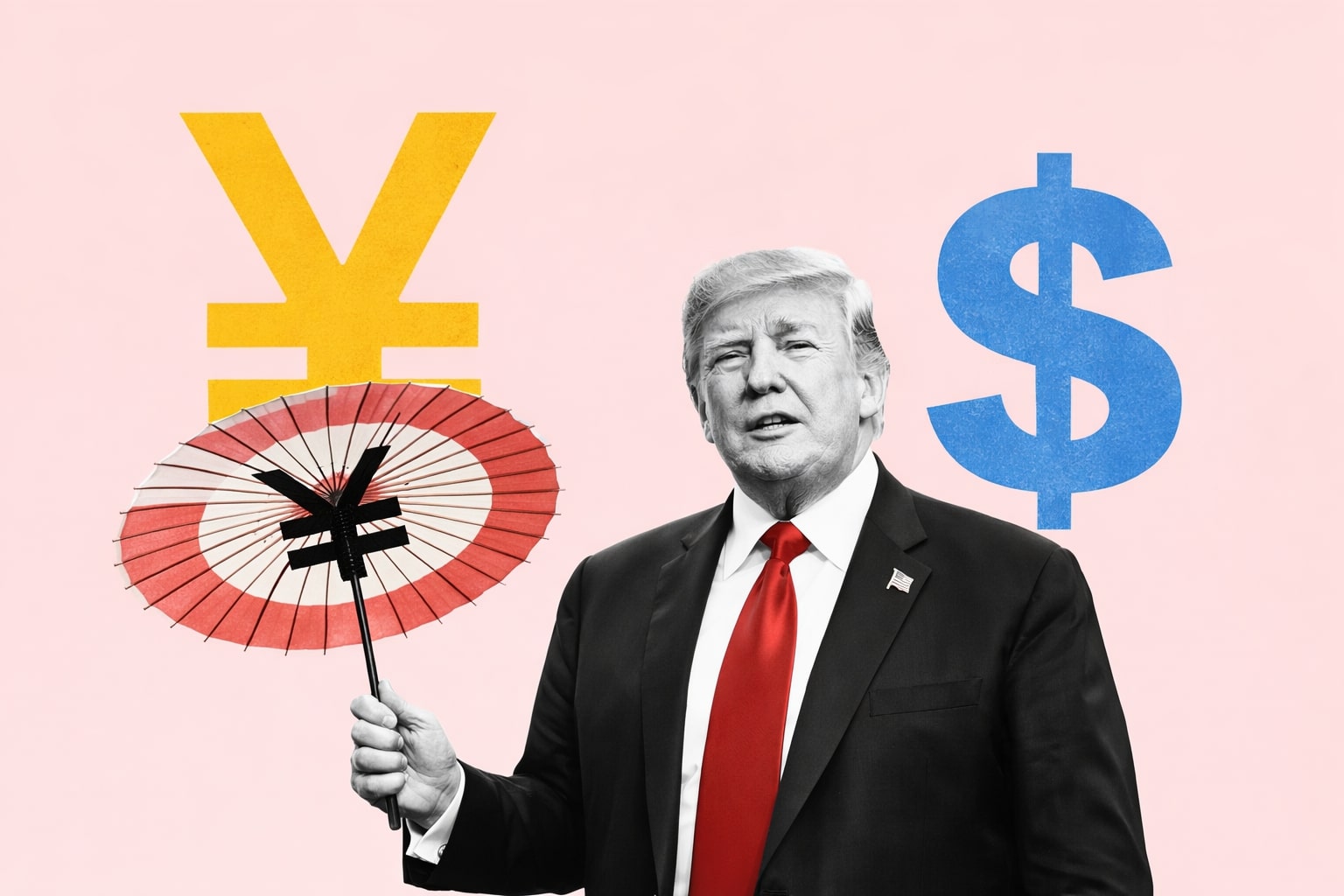





USD/JPY Price Forecast - USDJPY=X Tests 157.75: One-Year Highs with 155–140 Downside Back on the Radar
Yen slides as USD/JPY climbs into the 157–158 intervention zone while markets juggle NFP, a US Supreme Court tariff decision, Fed cut timing, and BoJ’s next hike, with 158.9–161.9 capping upside and a break of 155 opening the door toward 150–140 | That's TradingNEWS
USD/JPY near 157–158: stretched after a 12.7% rebound from 2025 lows
USD/JPY has rallied roughly 12.7% off its 2025 low and is trading just below a dense resistance band after testing one-year highs around 157.7–157.8. Spot pushed up to about 157.75 on generalized yen weakness, with intraday levels quoted around 157.39–157.75 as the dollar gained for a fourth straight session and the US Dollar Index added about 0.15%, reaching a four-week high. This move extends a powerful advance from the April 2025 trough but now runs into the 2025 high-week close at 157.70, with the 2025 swing high at 158.88 and a major resistance cluster at 160.74–161.95 overhead. Price has carved out a clear weekly opening range just below those ceilings, and the next directional leg in USD/JPY hinges on how that range breaks once US jobs data and key US Supreme Court rulings hit the tape.
Macro divergence in USD/JPY: Fed cuts vs BoJ normalisation mostly priced
The classic policy-divergence trade in USD/JPY is largely matured. Markets are already discounting the Federal Reserve easing cycle while assuming a slow, conditional path toward Bank of Japan normalisation. Swaps build in two full Fed cuts by about October 2026, with the first cut probability above 80% by April, while BoJ pricing assumes a 25 bp hike to around 0.75% (widely expected at the December 19 meeting with roughly 94% odds) and another hike priced out to October 2026, with the risk of it being pulled forward above 50% by June. Interest-rate differentials remain wide enough to support the dollar for now, but that support is fragile: an earlier, deeper Fed easing path or a more assertive BoJ would compress US–Japan 10-year spreads quickly and erode the carry premium that underpins long USD/JPY. Conversely, if the Fed stays slower and the BoJ drags its feet, spreads could re-widen, but that would clash with mounting political and volatility risks that increasingly lean toward a softer dollar and stronger yen over a 6–12 month horizon.
US data, Fed path and tariff ruling: binary catalysts for USD/JPY around 157–160
Near-term, USD/JPY is being driven by US macro prints and the legal backdrop around tariffs. The immediate focus is on the December US employment report: consensus looks for nonfarm payrolls around 60k after 64k previously, with unemployment dipping from 4.6% to about 4.5%, and average hourly earnings around 3.6% year-on-year versus 3.5% prior. Weaker-than-expected jobs data would revive expectations for an earlier Fed cut in March, undermining the dollar and pushing USD/JPY lower from the 157–158 area. Stronger payrolls and firmer wage growth would have the opposite effect, potentially driving another test of the 158.88 high and re-pricing the first cut further out. A second binary driver is the US Supreme Court ruling on Trump’s reciprocal tariffs and the use of IEEPA: an adverse ruling could force the government to refund roughly $150 billion in tariff revenue, widen the fiscal deficit and stoke concerns about longer-term Treasury supply. That would normally steepen the US curve and, in isolation, could support USD/JPY, but if markets interpret it as a political shock undermining fiscal discipline, it could also trigger risk-off, dollar volatility and a reassessment of US assets. The combination of labour data, Fed rhetoric and tariff litigation means USD/JPY at 157–158 is sitting directly in front of event risk that can flip positioning quickly.
Japan’s mixed data: household spending supports BoJ hawks, wages argue for caution on USD/JPY
Japanese macro data are sending conflicting signals that matter directly for USD/JPY. On the positive side for BoJ hawks, household spending rebounded sharply in November: up 6.2% month-on-month after a 3.5% drop in October, and 2.9% higher year-on-year after a 3.0% contraction previously. With private consumption near 55% of Japan’s GDP, this rebound supports the case for demand-driven inflation and a higher neutral rate, reinforcing Governor Ueda’s recent hints that further hikes are possible if prices and activity align with BoJ projections. Yet wage data point the other way. Average cash earnings rose only 0.5% year-on-year in November, a sharp slowdown from October’s 2.5% (revised from 2.6%), and overtime pay grew just 1.2% versus 2.1% earlier. Sluggish wage growth, when combined with a weak yen and elevated import costs, erodes purchasing power and raises the risk that consumption softens again, cooling core inflation. The market’s reaction is clear: the implied probability of a 25 bp BoJ hike at the January meeting slid from about 20% to just 5% after the wage print. For USD/JPY, the message is that the short-term policy path remains cautious, limiting immediate yen strength, but the medium-term trajectory still leans toward gradual BoJ normalisation if wages recover as expected in December bonuses. That asymmetry underpins a bearish bias over 6–12 months even as short-term data allow the pair to test intervention-sensitive highs.
Rates, spreads and correlations: why US yields still dominate USD/JPY direction
Correlation work across 10-year yields shows that USD/JPY remains primarily a function of US rates rather than Japanese yields. Historically, the pair tracked the US–Japan 10-year spread closely until the “Liberation Day” tariff shock, when the reciprocal tariff announcement temporarily broke the relationship even though spreads stayed wide. Rolling 60-day correlations between USD/JPY and both outright US 10-year yields and 10-year differentials have recently been modest, but shorter 20-day windows show that the link is starting to re-tighten. That implies the market is reverting to a familiar playbook: as long as there is no large political shock, moves in US yields and spread expectations drive USD/JPY, while risk sentiment and volatility only dominate during extreme episodes. Before mid-2024, extended periods of positive correlation were broken mainly by discrete risk-off events like the Q3 growth scare or intervention waves, after which spreads reasserted themselves. Going into 2026, the base case is that the pair remains highly sensitive to any repricing of Fed cuts and longer-dated yields, especially given that BoJ normalisation is shallow and slow. If Fed independence is questioned by the Supreme Court’s ruling on the Lisa Cook dismissal and potential changes to the Board’s composition, that could accelerate a drop in US yields and create downside air pockets in USD/JPY that are not yet fully priced.
Read More
-
FDVV ETF: $57 Price, 3% Yield And AI-Powered Dividend Growth As Markets Hit Record Highs
09.01.2026 · TradingNEWS ArchiveStocks
-
XRPI and XRPR: XRP ETFs Slip to $12.08 and $17.09 While XRP-USD Holds the $2.10 Line
09.01.2026 · TradingNEWS ArchiveCrypto
-
Natural Gas Price Hovers Near $3.20 as Storage Draws Challenge Warm Winter
09.01.2026 · TradingNEWS ArchiveCommodities
-
GBP/USD Price Forecast - Pound At 1.34 As NFP And Fed–BoE Divergence Put 1.3380 Support To The Test
09.01.2026 · TradingNEWS ArchiveForex
Seasonality and intervention risk: why the upside in USD/JPY looks capped near 160
Seasonal patterns and official intervention risk both argue that the upside in USD/JPY from current levels is limited. Seasonality suggests January is often soft for the pair, while months around the Japanese fiscal year start on April 1 and the half-year in October tend to show better odds of yen weakness as flows and rebalancing favour overseas assets. Conversely, summer months show a clear skew: July has recorded five positive and fifteen negative outcomes in the sample, with August logging eight positive and twelve negative, pointing to a tendency toward yen strength when liquidity thins and global investors reduce risk. On top of that, the Japanese authorities have repeatedly drawn a de-facto intervention line in the 157–160 zone; current trading around 157–158 is already inside that corridor. Official rhetoric about “excessive moves” and “disorderly markets” has historically preceded actual FX intervention when USD/JPY sat in this region. From a probability standpoint, there is an estimated 10% chance that USD/JPY finishes 2026 above 161.95, the area defined by the 2024 high-week close and 2024 swing high, while the more probable range scenario keeps the pair below that ceiling. The combination of seasonal softness in parts of the year and the ever-present threat of intervention means a sustained break and hold above 160.74–161.95 is unlikely without an extreme shift in Fed policy or a new shock in Japan.
Technical map for USD/JPY: resistance stacked at 157.70–158.88 and 160.74–161.95
Technically, USD/JPY is stretched but still inside its broader uptrend from the April low. On the weekly chart, price bounced cleanly from pivotal support at 155.03 (the November 2024 high-close) and rallied into resistance at the 2025 high-week close near 157.70. That level aligns with the weekly median-line in a pitchfork drawn off the April advance, creating a confluence zone where rallies are now stalling. Immediate resistance sits at 157.70, then the 2025 swing high at 158.88. Above that, the next critical band is 160.74–161.95, defined by the 2024 high-week close and 2024 swing high, and identified in the 2026 outlook as the key region where a “larger reaction” is likely if reached. On the downside, initial weekly support is still 155.03; a deeper pullback would target 153.65 (a key prior pivot) and then the cluster of the 2022 and 2023 highs around 151.91–151.94. There is also a structural pivot around 156.65, the 23.6% retracement of the April advance, where the lower pitchfork parallel converges over the next few weeks; a weekly close below that upslope would strongly suggest that a more significant top has formed and that a larger corrective phase is underway. On daily time frames, USD/JPY trades above both the 50-day and 200-day EMAs, so the trend signal remains formally bullish, but weekly RSI and MACD are rolling over from overbought territory, showing waning upside momentum even as price presses resistance.
Scenario analysis: range probabilities and tail risks for USD/JPY in 2026
The 2026 scenario map for USD/JPY is skewed sideways to lower rather than higher despite the current strength. From immediate resistance just under 158, the first key ceiling is at roughly 158.76–158.88; from there down to major support around 140.25, the probability of the pair staying within that range over the year is estimated near 75%. A further 10% probability sits on a blow-off extension above 161.95, while about 15% attaches to an abrupt downside break below 140.25, likely triggered by a large risk-off event or a regime shift in Fed policy. Tail risks on the downside include a Supreme Court outcome that undermines Fed independence and forces a more aggressively dovish FOMC composition, an adverse ruling on tariffs that destabilises US fiscal expectations, or a sharp correction in AI-linked equities that drives a broad risk-off episode and unwind of carry trades. On the Japanese side, a hawkish BoJ neutral rate in the 1.5%–2.5% range and wage growth that recovers strongly in December bonuses would increase the probability of multiple hikes and a narrower US–Japan rate differential, potentially dragging USD/JPY toward 140 over 6–12 months as yen carry positions are cut. Upside risks to this bearish skew are clear: a dovish BoJ neutral rate closer to 1.0%–1.25%, disappointing wages, strong US jobs data, and hawkish Fed rhetoric that delays cuts. Even in those scenarios, however, intervention risk and the difficulty of sustaining price above 160.74–161.95 constrain how far the pair can run without provoking either official action or a sharp reversal as positioning becomes crowded.
Final USD/JPY stance: stretched at resistance, downside skew, Sell bias into 2026
Pulling the strands together, USD/JPY around 157–158 is trading rich to its medium-term risk profile. The pair has already rallied about 12.7% off its 2025 low, sits just below the 2025 high-week close at 157.70, and faces layered resistance at 158.88 and 160.74–161.95 with weekly momentum indicators rolling over from overbought readings. Macro drivers are shifting away from pure divergence toward a regime where Fed cuts, BoJ normalisation, political risk around Fed independence, and tariff litigation all increasingly favour narrower rate differentials and higher volatility, both typically yen-supportive over a 6–12 month horizon. Japanese data are mixed, but the combination of recovering household spending (+6.2% m/m, +2.9% y/y) and still-subdued wages (+0.5% y/y) argues for gradual BoJ tightening rather than renewed easing, while US data are at risk of disappointing against optimistic labour expectations. Seasonality undermines the sustainability of extended dollar-yen strength, and intervention risk near 157–160 caps the upside. Against this backdrop, the risk/reward profile does not favour chasing USD/JPY higher from current levels. The base case is a sideways-to-lower path, with pullbacks toward 155, 153.65 and potentially the 151.90 area over the coming quarters, and a non-trivial chance of a deeper move toward 145–140 if Fed cuts accelerate or political shocks hit US yields. The probability of a durable break above 161.95 is low. On that basis, the stance here is clear: for a 6–12 month horizon, USD/JPY is a Sell / bearish bias, with rallies into the 157.70–158.88 band offering better entry than new longs at these levels.