NASDAQ:NVDA – $4.6T AI Core Under Stress-Test For Growth And Pricing
Market Snapshot For NASDAQ:NVDA Around $188.85
NASDAQ:NVDA trades near $188.85, up 1.26% on the day, with a market cap of about $4.59T. The stock sits between a 52-week low of $86.63 and a high of $212.19, on a trailing P/E of roughly 46.77 and a forward multiple around the mid-20s based on current estimates. That valuation rests on data center AI dominance and extremely high profitability, not a story stock. The latest quarter shows $57.01B in revenue, up 62.49% year over year, and $31.91B in net income, up 65.26%, for a net margin close to 55.98%. The equity market is paying a premium multiple for a business that converts more than half of each revenue dollar into profit while still growing at 60%+.
Strategic Impact Of The $20B Groq Acquisition On NVDA’s AI Moat
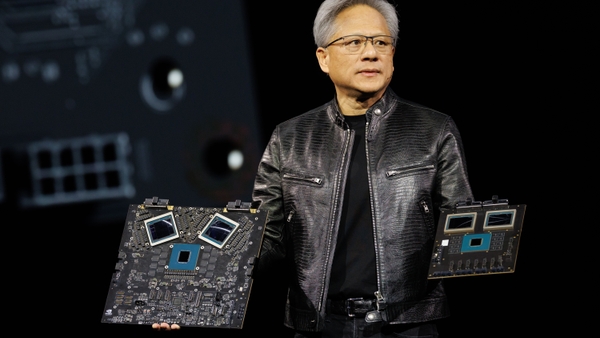
Nvidia’s $20B acquisition of Groq is not a small tuck-in; it is a deliberate move to lock in leadership in low-latency inference and attack Google’s TPU strategy at the architectural level. Groq had raised $750M at a $6.9B post-money valuation only a few months before this deal, so Nvidia is effectively paying roughly three times that valuation and about 40x estimated 2025 sales to secure IP and engineering talent. The structure is a non-exclusive licensing and asset acquisition, not a full corporate takeover, which keeps Groq’s cloud operations outside Nvidia and avoids heavy antitrust scrutiny. The real prize is Groq’s Language Processing Unit architecture and the team behind it, led by Jonathan Ross, the original architect of Google’s TPU, who now heads ultra-low-latency engineering at Nvidia. Groq’s LPUs use on-chip SRAM instead of external HBM3e, with around 230MB of memory but roughly 80 TB/s of bandwidth, optimized for deterministic, ultra-low-latency inference. By contrast, Nvidia’s Blackwell GB200 training parts carry about 192GB of HBM3e with around 8 TB/s of bandwidth, tuned for massive training and heavy batch inference. Integrating LPU-class blocks into Nvidia’s upcoming Rubin and Feynman architectures lets the company offer a hybrid rack that trains gigantic models on GPUs and serves real-time agents on LPUs inside the same CUDA ecosystem. That shift marks the end of the “GPU-only” narrative and strengthens Nvidia’s position just as workloads migrate structurally from training to inference. At a $4.59T valuation and over $60B in cash, a $20B spend is about one quarter of recent free cash flow and strategically more important than financially dilutive.
Profitability Profile: NVDA As A Margin Outlier In Global Equities
The latest financials confirm Nvidia as one of the most profitable large companies on the planet. With $57.01B in quarterly revenue and $31.91B in net income, the net margin near 55.98% is well above mega-cap norms. EBITDA of $36.76B implies extremely high operating leverage from the AI data center stack. Earnings per share climbed 60.49%, mirroring net income growth. On the balance sheet side, Nvidia reports $60.61B in cash and short-term investments, up 57.48% year over year. Total assets stand at $161.15B against total liabilities of $42.25B, leaving equity at about $118.90B. Return on assets is close to 59.64%, and return on capital is roughly 74.88%, numbers consistent with a quasi-utility in AI infrastructure rather than a cyclical chip vendor. Free cash flow of about $13.56B over the latest period sits below the net income line because of heavy capex and acquisition spending, but operating cash flow of $23.75B shows the underlying cash generation. Cash from investing around –$9.02B and cash from financing near –$14.88B, mainly buybacks, lead to a minimal net cash change of around –$153M. In practice, Nvidia is running a model where hyperscalers and governments fund AI, and roughly half of those dollars eventually drop into shareholders’ equity.
Revenue Path: From $57B Run-Rate To A $350B+ AI Engine
Analyst models in the material you provided now assume Nvidia can reach roughly $320–350B of revenue by FY2027, up from $57.01B today. That implies an enormous expansion in two to three years driven by Blackwell, Rubin and Vera Rubin ramps plus incremental China volume. After 2027, a 20% compound annual growth assumption from 2027 to 2031 takes Nvidia into a revenue zone where the AI infrastructure market approaches or exceeds $1T in annual spend. Part of the upward revision versus older models comes from the reopening of China as a revenue stream. Under a new export framework, Nvidia can ship H200-class parts into China with a 25% revenue skim to the US government on those sales. That cut compresses margins somewhat on that subset of revenue but brings back a market that can contribute tens of billions of extra sales. Estimates citing over 2M H200 orders from Chinese tech companies show how important that volume can be to bridging the path from $57B to hundreds of billions. If Nvidia hits these levels, its revenue alone becomes a material share of global AI capex and forces every hyperscaler to manage around Nvidia’s pricing decisions.
Hyperscaler Funding Limits And The Implied TAM Ceiling For NVDA
The key constraint on Nvidia’s growth trajectory is not internal capacity but customer balance sheets. The hyperscalers and large government buyers are the ones writing the checks. The cash-flow table in the material points to aggregate operating cash flow north of $600B per year across Microsoft, Alphabet, Apple, Meta, Amazon, Oracle and others, with about $300B of additional capex capacity after subtracting current investment programs. That headline figure includes roughly $100B of potential incremental capex from Apple, which has not yet fully committed to the AI infrastructure race. Other players such as Oracle already have negative free cash flow after capex and high net debt, making it difficult to keep scaling AI spend at the current pace. If Nvidia’s revenue climbs towards $320–400B annually at today’s pricing, that implies a very large share of all incremental hyperscaler capex flowing into Nvidia hardware and software. That is only sustainable if AI revenue lines at the hyperscalers – cloud AI services, AI-enhanced ads, enterprise software upsell – catch up quickly. Otherwise, the capex growth rates embedded in Nvidia’s models will collide with shareholder pressure at the customer level, and buyers will either slow deployments or demand lower prices per unit of compute.
Pricing Power, AI TAM Assumptions, And Potential Margin Normalization For NVDA
The current AI TAM narratives implicitly assume that Nvidia can maintain today’s pricing on GPUs and racks. If Nvidia cut prices across its AI portfolio by 30%, the nominal TAM in dollars shrinks by roughly 30% as well. A $1T AI hardware and software spend becomes closer to $700B, with the savings accruing to hyperscalers’ internal returns, not to Nvidia shareholders. Nvidia has already demonstrated that it is willing and able to flex pricing to support utilization and ecosystem dominance. Gross margins peaked near 65% in 2022, then dropped to around 57% by mid-2023 when gaming and crypto-linked demand softened. With the AI wave, margins expanded again. That record shows Jensen Huang will not hesitate to raise prices when the market allows it but will also cut aggressively when demand needs support. With gross margins far above peers and net margins above 50%, Nvidia has ample room to trim pricing on high-end SKUs and still operate at profitability levels that AMD, Intel and most megacaps cannot match. The real risk for investors is not a sudden collapse in economics but a gradual glide from today’s extreme net margin into a still-elite, lower band if price cuts become necessary to keep the AI capex machine running.
Competitive Pressure From AMD And NASDAQ:INTC Against NVDA’s Dominance
Advanced Micro Devices and NASDAQ:INTC represent the primary silicon competition against NASDAQ:NVDA, while Google’s TPUs and other proprietary accelerators challenge Nvidia at the hyperscaler level. AMD’s long-term profitability targets in data center AI essentially rely on Nvidia preserving the current pricing umbrella; a broad price reset would compress AMD’s potential margins at least as hard as Nvidia’s. Intel is repositioning around foundry services and custom chips, offering an alternative path for hyperscalers that want more control over their silicon stack. Meanwhile, large customers like Google, Meta and others continue investing in their own AI ASICs to reduce long-term dependence on Nvidia. The Groq acquisition is Nvidia’s pre-emptive response to that trend. By internalizing LPU architecture and Jonathan Ross’s team, Nvidia narrows the performance and cost-per-token gap between CUDA-based inference and TPU-class custom solutions. When the Rubin and Vera Rubin generations blend training GPUs and LPU-class inference inside a single rack, the value proposition becomes end-to-end: one ecosystem from training to ultra-low-latency deployment. That makes it harder for AMD, Intel or a single hyperscaler to credibly offer a superior total solution, even if they can undercut price at the silicon level.
Balance Sheet Strength, Cash Deployment, And Buyback Capacity At NVDA
One of Nvidia’s biggest strategic weapons is its balance sheet. With $60.61B in cash and short-term investments and total liabilities of $42.25B, the company sits in a net cash position even after agreeing to pay $20B for Groq’s assets and licensing. Total equity of $118.90B supports a profit engine generating $31.91B of net income per year and tens of billions in operating cash flow every quarter. Capex and acquisition outflows around $9.02B in the latest period, plus about $14.88B in financing outflows driven mainly by buybacks, still leave net cash movement essentially flat. That means Nvidia can continue returning capital to shareholders while funding node transitions at TSMC, expanding supply capacity and absorbing targeted deals like Groq without stressing its financial structure. Compared with Oracle or smaller infrastructure players that are stretching their balance sheets to participate in AI, Nvidia can withstand external shocks in wafer pricing, memory costs or regulatory delays without needing to sacrifice R&D, capex or buybacks in the short term.
Risk Set For NVDA: Demand Timing, Substitution, And Regulatory Friction
The main risk cluster for NASDAQ:NVDA revolves around the timing and scale of AI monetization at its customers relative to capex, the pace of substitution into custom or competitor silicon, and regulatory or policy friction. If hyperscalers cannot translate AI infrastructure spend into revenue and margin expansion quickly enough, they will either cap AI capex or aggressively push for price cuts. If proprietary accelerators such as TPUs or in-house chips at the large platforms approach Nvidia’s performance at substantially lower total cost of ownership, the pricing umbrella shrinks and Nvidia’s bargaining power diminishes. On the policy front, export controls have already forced a new structure on H200 shipments into China, with roughly 25% of that revenue stream effectively taxed. More aggressive export bans or industrial policies could hit future products or key customers. The Groq deal, structured as a licensing and asset acquisition rather than a full corporate takeover, shows Nvidia is aware of antitrust and regulatory limits and willing to design around them. None of these risks destroys the franchise, but they can compress growth and multiples if they materialize simultaneously.
Investment Stance On NASDAQ:NVDA At $188.85 – Buy, But With Entry Discipline
At around $188.85 per share, NASDAQ:NVDA trades on roughly 25x forward earnings and 46.77x trailing earnings while running a net margin near 56% and compounding revenue above 60% year over year. A forward-looking discounted cash flow framework using a revenue base around $350B by 2027, 20% annual growth for the subsequent five years and a 25x exit multiple on free cash flow implies fair value near $181 per share on a strict intrinsic basis and a five-year expected annualized return around 15–16% from current levels. If the market is willing to assign Nvidia a 30x forward multiple again as Rubin, Vera Rubin and Groq integration deliver upside to earnings and free cash flow, a medium-term fair value zone closer to $225–$230 is reasonable, with a longer-range upside scenario pushing beyond $300 if free cash flow scales faster than current models. The downside scenario is largely about margin normalization and slower AI monetization at customers, which would compress returns into high single digits but still leave Nvidia as a dominant AI infrastructure platform. On that balance of probabilities, the stock is a buy rather than a hold or sell, but it is a buy that demands entry discipline. The rational approach is staged accumulation on weakness around or below the $180–$185 area, constant monitoring of hyperscaler capex commentary and pricing signals, and regular review of insider behavior through the NVDA insider transactions page and the broader NVDA stock profile to ensure management’s actions remain aligned with the long-term AI thesis.
That's TradingNEWS