Stock Market Today: Dow Jones, S&P 500 And Nasdaq Rebound As Gold Soars To $4,859 And Netflix Slumps
Wall Street bounces from its worst sell-off in months as tariff fears on Greenland ease, gold and silver set fresh records, Netflix slides on its Warner Bros. Discovery cash bid and Intel, United Airlines and Kraft Heinz move sharply on earnings and stake news | That's TradingNEWS
Stock Market Today: Rebound Under Greenland Shadow
Major Indices: Dow, S&P 500, Nasdaq Lead A Controlled Comeback
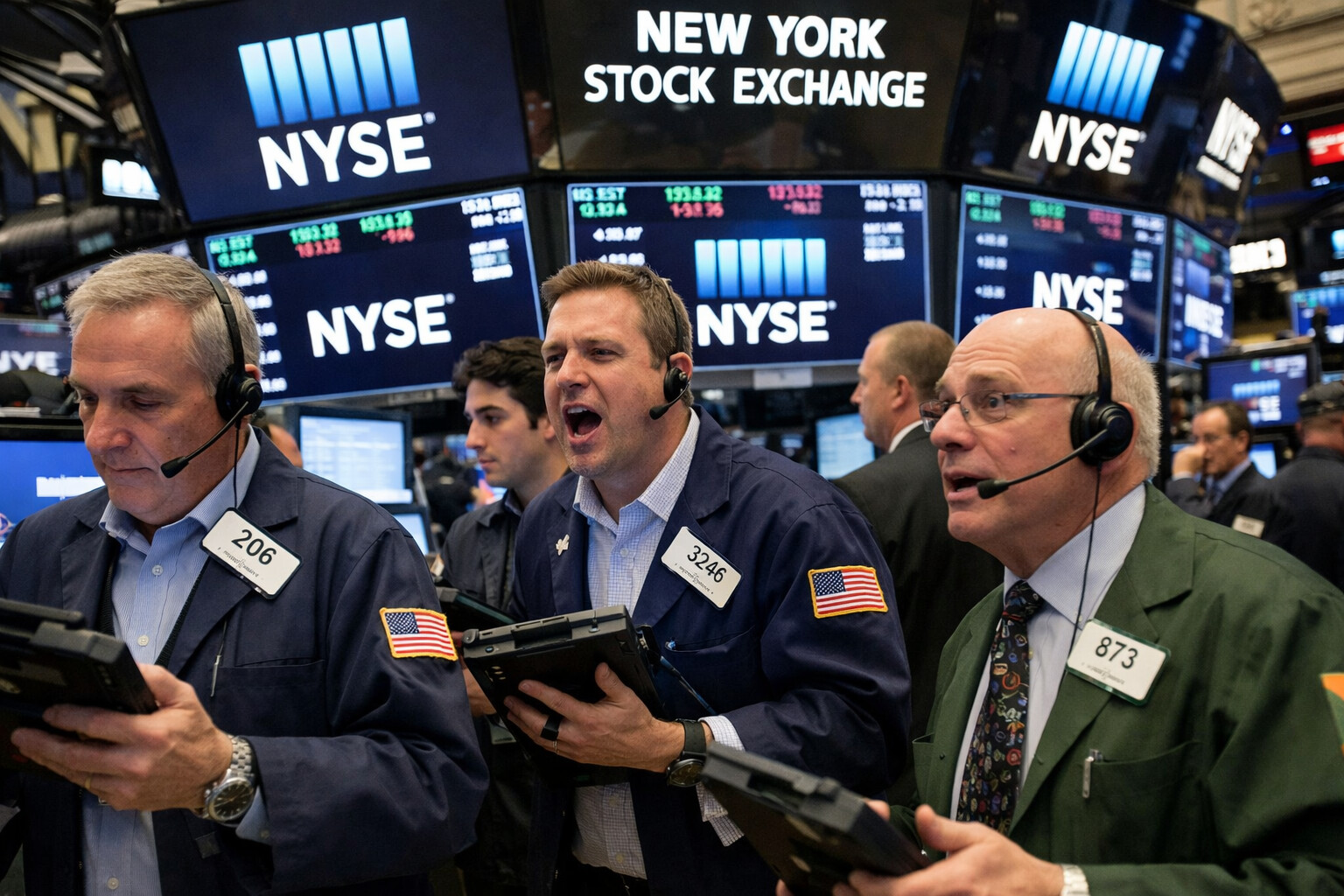
The rebound is real but not euphoric. The Dow Jones Industrial Average (DJIA) trades near 48,786, up about 0.6% after losing 1.8% on Tuesday. The S&P 500 is around 6,846, gaining roughly 0.7% after a prior 2.1% drop that marked its worst session since Oct. 10. The Nasdaq Composite is near 23,112, up around 0.7% after a sharp 2.4% slide that briefly pushed the index negative for 2026. The Russell 2000 trades around 2,669, up close to 0.9%, showing that smaller caps are participating but not leading. The VIX sits around 18.9, down almost 6% on the day, which signals an easing of panic but not a return to the complacency that dominated much of late 2025. The KBW Nasdaq Bank Index near 167.9 is up close to 1.8%, showing financials are comfortable with today’s slight retreat in yields after yesterday’s spike.
Greenland Negotiations: From Force Risk To Tariff Standoff
The catalyst for this bounce is precise. At the World Economic Forum in Davos, President Donald Trump explicitly said the U.S. “won’t use force” to acquire Greenland. That single line removed an extreme geopolitical tail risk which had triggered Tuesday’s “sell America” move across equities, bonds and the dollar. At the same time, Trump doubled down on the objective. He called for “immediate negotiations” to secure the island from Denmark, after threatening tariffs on eight European countries that oppose the sale. The threat structure has shifted from potential military escalation to a drawn out trade war over territory, which is less catastrophic but far from benign. The European Commission has already responded. The European Parliament has suspended work on implementing the U.S.–EU trade deal that would cut tariffs on U.S. industrial goods. European leaders, led by Ursula von der Leyen and Emmanuel Macron, are preparing to deploy the EU Anti-Coercion Instrument. That tool can restrict U.S. access to the single market, block U.S. firms from public tenders, constrain capital flows and target specific sectors. The market message is simple. The worst scenario of forced annexation is off the table, but the path ahead is one of prolonged tariff friction. That environment caps the upside on cyclicals and keeps a premium under havens.
Dollar Assets, Treasuries And The ‘Sell America’ Undercurrent
The Treasury market is sending its own warning. The 10-year yield surged to about 4.30% on Tuesday, its highest close since Aug. 21, before easing back near 4.29% today. That jump, triggered by tariff threats and fiscal concerns, raised borrowing costs across mortgages and corporate credit. The U.S. dollar index trades around 96, down roughly 0.1%, which reflects a mild but clear move toward diversification. A notable signal came from AkademikerPension, a Danish pension fund, which announced it will sell about $100 million in Treasuries due to “poor” U.S. government finances. The absolute size is small, but the direction is important. It aligns with the quieter institutional trend of trimming dollar exposure under the “America First” framework. U.S. Treasury Secretary Scott Bessent publicly dismissed this narrative in Davos and labeled some of the selling fears as media amplification of a single analyst view. Markets are not fully buying that. A 10-year pinned near 4.3% in a world searching for safety is a sign that investors are demanding a risk premium for policy volatility and fiscal slippage. From an allocation standpoint, long-duration Treasuries remain a Hold, not an aggressive Buy, until tariff risk and Fed leadership uncertainty become clearer.
Safe-Haven Rotation: Gold, Silver And Bitcoin
The gold trade is the clearest outperformer in this entire set-up. Gold futures trade around $4,859 per ounce, up close to 2% on the day and at a new record high. Silver has broken above $90, underscoring the intensity of the move into precious metals. The drivers are layered. Real yields are slipping as inflation remains moderate while nominal yields spike and then fade. Central banks and long-horizon investors are diversifying away from pure dollar exposure, and Greenland-linked tariff threats add a direct geopolitical catalyst. The S&P GSCI Spot Index near 575.8, up about 0.8%, shows broad commodity strength, but the leadership is clearly in havens rather than traditional growth-linked energy. Bitcoin (BTC-USD) trades around $89,530, essentially flat on the day. That is notable. Crypto is not acting as the primary shock hedge in this episode; instead, it trades like an asset that already enjoyed a huge move and is now consolidating. Positioning and regulatory overhangs keep it from absorbing incremental Greenland risk the way gold is absorbing it now. On the numbers and flows, gold remains a clear Buy on dips, silver is a high-beta Buy for aggressive accounts, and Bitcoin is a Hold, not the core hedge for this specific macro risk.
European Equities: Tariff Anxiety Caps Risk Appetite
European markets are responding more directly to the Greenland tariff threat. The Stoxx 600 is down around 0.2%, with most major regional indices in the red. The rhetoric from Brussels and national capitals is hardening. Von der Leyen calls the new tariff push a “mistake” and promises an “unflinching” response. Macron points to the Anti-Coercion Instrument as the preferred weapon, which raises the risk of a protracted standoff that hits European exporters, U.S. industrials and cross-border financials together. This backdrop argues for underweight European cyclicals tied to transatlantic trade and a selective Hold in European defensives, rather than a broad regional Buy.
Macro Politics: Davos, Credit-Card Caps And Fed Power Struggles
Trump used his Davos stage to do more than talk Greenland. He claimed that without the U.S. “you don’t have a country” when referring to Switzerland, and highlighted how prior 30% tariffs forced Swiss negotiators back to the table. He revived his push for a temporary 10% cap on credit-card interest rates for one year and called on Congress to implement it. Such a cap would compress bank and card-issuer margins and could tighten access to consumer credit if lenders pull back. JPMorgan CEO Jamie Dimon has labeled a blanket rate cap an “economic disaster,” warning it would hurt small businesses, restaurants, retailers and travel companies that rely on revolving credit. The Supreme Court is preparing to hear a case around removing Fed governor Lisa Cook, a fight that goes straight to the core of central bank independence. Trump also signaled he will name the next Fed chair “in the not-too-distant future,” hinting at a male candidate and keeping names like Rick Rieder, Christopher Waller and Kevin Hassett in focus. This set of moves expands the policy risk premium. Investors now must price tariff risk, territorial negotiations and a potential reshaping of the Fed’s leadership and independence. The macro setup supports higher term premiums in Treasuries, stronger bid for gold, and a more volatile path for bank and card issuers.
Big Tech And Growth: NFLX Sells Off, INTC Surges, AI Bubble Gets Tested
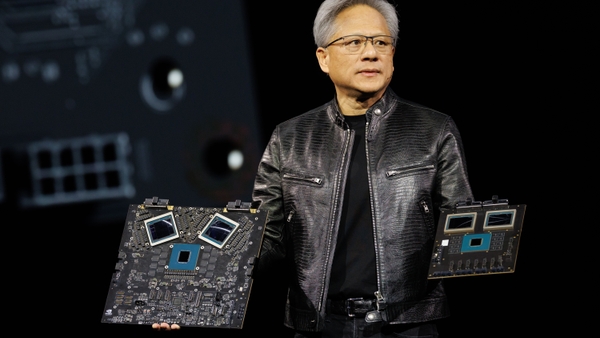
Large-cap growth is no longer a one-direction trade. Netflix (NFLX) is the clear underperformer. The stock trades just above $83–85, down roughly 4–7% in today’s session, despite delivering headline beats. Revenue came in at $12.05 billion versus about $11.97 billion expected. EPS printed at $0.56 versus $0.55 estimated. Global paid subscribers hit 325 million, a new milestone. The pressure comes from the outlook and capital allocation, not the backward-looking numbers. Netflix is guiding operating margin of roughly 31.5% for 2026, below consensus around 32.7%. It also sees about $11 billion in free cash flow, again short of the most optimistic projections. On top of that, the company paused share buybacks to preserve cash for an all-cash, roughly $72 billion bid for Warner Bros. Discovery (WBD). Analysts are cutting price targets. The market is saying clearly that a giant, cash-intensive deal with a slightly softer margin profile does not justify prior valuations. Given the peak near $133.91 last June and the current derating, NFLX is best viewed as a Hold at current levels and a Sell into aggressive rallies, unless management proves that the WBD move can generate clear, quantifiable synergies. In contrast, Intel (INTC) is one of the S&P 500 standouts, up more than 7%. The bid reflects growing confidence that Intel can participate in the broader compute and AI cycle instead of being left behind by rivals. After a decade of underperformance, the bar is low; any credible roadmap on foundry services, server chips and AI-linked accelerators is enough to attract capital. On this tape, INTC is a speculative Buy for investors willing to tolerate execution risk, with the understanding that the stock remains sensitive to any sign of slippage. The broader AI complex is entering a harder phase. Research from a major European house frames 2026 as the year of disillusionment, dislocation and distrust for AI. Enterprises moving from pilots to production are discovering real-world limits, from accuracy and latency to integration costs and the uncomfortable fact that in many use cases AI is not yet cheaper than human labor. The result is multiple compression in software and infrastructure names that were priced for an effortless AI super-cycle. The appropriate stance here is selective Hold on cash-rich, platform-level leaders and avoidance of thinly capitalized AI pure-plays that are most exposed to the coming reset.
Defensive Healthcare: JNJ Beat Fades On Valuation
Johnson & Johnson (JNJ) delivered a solid quarter and 2026 guidance ahead of estimates, yet the stock is down about 3.5%. The reason is positioning. The market chased JNJ into the print, helped by strong messaging at the JPMorgan Healthcare Conference and by a wider flight to defensive balance sheets. When a crowded defensive trade meets a “good but not spectacular” set of numbers, the result is exactly what you see today. Fundamentally, JNJ’s diversified pharma and medtech engine remains intact, with attractive cash generation and a relatively low regulatory risk profile compared to high-beta biotech. The valuation, however, no longer screens as a bargain after the prior run. The numbers justify a Hold stance. New capital likely finds better risk-reward in names that have not been bid up as aggressively into earnings.
Read More
-
XAR ETF: Defense-Tech ETF Riding Trump’s $1.5 Trillion Military Super-Cycle
21.01.2026 · TradingNEWS ArchiveStocks
-
XRP ETFs Bleed $53M While XRP-USD Clings to $1.90: Can XRPI and XRPR Avoid a Deeper Slide?
21.01.2026 · TradingNEWS ArchiveCrypto
-
Natural Gas Price Skyrockets Toward $5: NG=F Short Squeeze Meets Deep Freeze
21.01.2026 · TradingNEWS ArchiveCommodities
-
GBP/USD Price Forecast - Pound Tests 1.3450 as Sticky UK Inflation and Trump’s Greenland Tariffs Hit the Dollar
21.01.2026 · TradingNEWS ArchiveForex
Financial Infrastructure: IBKR Execution Solid, Market Reaction Muted
Interactive Brokers (IBKR) reported adjusted EPS of $0.65, beating estimates around $0.59. That is a clean beat for a brokerage that thrives on active trading, margin balances and global connectivity. Despite this, the shares are down close to 1%, reflecting modest profit-taking in a jittery macro environment. The structural story is unchanged. IBKR remains one of the most efficient platforms for active traders and institutions, with strong operating leverage as volumes scale. The combination of solid EPS, expanding product breadth and global reach supports a Buy on weakness view. Today’s dip looks more like noise than a thesis break.
Airlines And Travel: UAL Profitable On Paper, Subsidized By Credit Cards
United Airlines (UAL) is up about 3–4% after posting $3.4 billion in 2025 profit and laying out robust expectations for 2026. Management guides adjusted EPS of $12–14, broadly in line with the $13.16 consensus, and near-term EPS of $1.00–1.50 versus about $1.13 expected. The company emphasizes that the week ending Jan. 4 was the highest flown revenue week in its history, and the week ending Jan. 11 was its highest ticketing and business-sales week ever. Under the surface, though, the unit economics are still fragile. CASM stands at 16.46 cents, above PRASM at 16.18 cents. That means United is losing money on transporting passengers and relying on credit-card partnerships and ancillary revenues to generate profit. Delta (DAL) showed a similar pattern, with CASM 19.31 cents versus PRASM 17.37 cents. The structural message is unchanged. Airlines remain financially leveraged plays on credit-card economics and capacity discipline, not stable cash machines from core flying alone. Given the volatility in oil, tariff risk and potential pressure from any credit-card rate cap, UAL is a Hold, not a high-conviction Buy, after the post-earnings bounce.
Consumer Staples Shock: KHC Hit As BRK.B Prepares To Exit
The sharpest single-name blow-up in staples is Kraft Heinz (KHC). The stock is down roughly 5–6.5% after the company disclosed that its largest shareholder, Berkshire Hathaway (BRK.B), has registered its entire stake—about 325.4 million shares, roughly 27.5% of the company’s common stock—for potential sale. Berkshire has already marked down the book value of that stake by about $3.8 billion after tax. Former CEO Warren Buffett described Kraft Heinz’s planned split into two companies as “disappointing” and indicated that new CEO Greg Abel expressed that view to the company. The optics are brutal. A cornerstone value investor is preparing to exit a once-flagship branded food bet after years of underperformance and balance-sheet strain. With the shares already down nearly 20% over the past year, this filing adds an overhang that will cap any near-term multiple expansion. On this setup, KHC is a Sell into strength. Any short-term rally would likely be met with supply from large holders de-risking exposure.
Retail Turnaround: CRI Upgraded To Buy On Strategic Reset
Not all consumer names are broken. Carter’s Inc (CRI) is being reframed as a credible turnaround. Citi upgraded the stock to Buy from Neutral and lifted its price target to $50 from $34, implying roughly 42% upside from the prior close around $37.54. The stock is up about 6.8% today. Over the past 12 months, CRI had dropped about 36%, as comps fell sharply from 2022 to 2024. Under new CEO Doug Palladini, who joined in April 2025, Carter’s has shifted strategy. Key moves include store closures, a push upmarket toward higher-priced goods and more aggressive use of pricing power. Comps turned positive in 2025 after years of contraction. The new leadership and positive comp inflection justify a speculative Buy stance for investors seeking a 2026 turnaround story, with the caveat that execution risk in soft consumer demand remains high.
Meme Legacy And Insider Confidence: GME Sees CEO Buying
The meme-era survivor GameStop (GME) remains highly speculative, but the insider signal is unambiguous. CEO and chairman Ryan Cohen bought 500,000 shares at a weighted average price around $21.12, raising his stake to more than 41 million shares, roughly 9.2% of the company. The stock trades near $21.64, up about 2.6% in the latest session. Cohen’s purchase does not fix the core business, which still faces structural pressure from digital distribution and competition. It does, however, anchor a floor under sentiment. Insider alignment at this scale argues against heavy short exposure at current levels. The risk-reward profile is still binary. For diversified portfolios, GME is at best a high-risk Hold or small speculative Buy, never a core position.
AI Trade Fatigue: From Story To Scrutiny
Away from single names, the AI complex is facing its first real test. A detailed note from a major European research institute frames 2026 as a year of disillusionment, dislocation and distrust in AI. Enterprises are moving from enthusiasm to hard evaluation. They are finding that real-world deployments run into issues of accuracy, liability, operational cost and integration complexity. Many AI-heavy workflows are not yet cheaper than human labor once compute, engineering and oversight are included. On top of that, the legal and regulatory environment is tightening. Investors are reacting by cutting valuation multiples, especially in software names that promised aggressive margin expansion purely from AI. The days of buying anything labeled “AI” and outperforming the Nasdaq are over. The rational stance is to Hold or Buy only the most capital-rich, ecosystem-level players while avoiding high-burn, narrow AI stories that depend on perpetual bullish funding.
Broad Verdict: Risk Assets Still Viable, Havens In Control
Pulling the numbers together, the picture is clear. The Dow, S&P 500 and Nasdaq are staging a respectable rebound after their worst day since October, but the leadership is narrow and the rally sits on top of record gold prices and an elevated VIX. Gold near $4,859 and silver above $90 confirm that capital is paying for protection, not chasing unhedged risk. Treasury yields around 4.29–4.30% on the 10-year reflect discomfort with tariffs, fiscal trends and Fed uncertainty. NFLX is under pressure and is better treated as a Hold or Sell on strength until it proves that the WBD bid and margin path can create real value. INTC and select cyclicals can be tactically Bought, but position sizes should reflect execution risk and policy volatility. KHC is a Sell on the Berkshire exit overhang. CRI is a legitimate turnaround Buy for high-risk capital. GME is a speculative Hold at best, anchored mainly by CEO buying rather than fundamentals. On the index level, the market backdrop is choppy but not broken. The appropriate stance is neutral-to-cautiously bullish on U.S. equities overall, outright bullish on gold and silver, and selective, valuation-sensitive on single-name risk until the Greenland tariff path and Fed leadership picture are resolved.