

Stock Market Today: Dow Outperforms at 48,271 While S&P 500 and Nasdaq Slide on Oracle AI Debt Fears
S&P 500 trades just below flat as Nasdaq weakens, ORCL drops about 5% on a stalled $10B data-center deal, oil rebounds with WTI near $56 and Brent around $60 after Trump’s Venezuela tanker blockade | That's TraidngNEWS
Stock Market Today: Dow Holds the Line While Nasdaq and S&P 500 Fade After Jobs Shock
Index Rotation: Dow Jones Outperforms as Nasdaq Tech Trade Loses Momentum
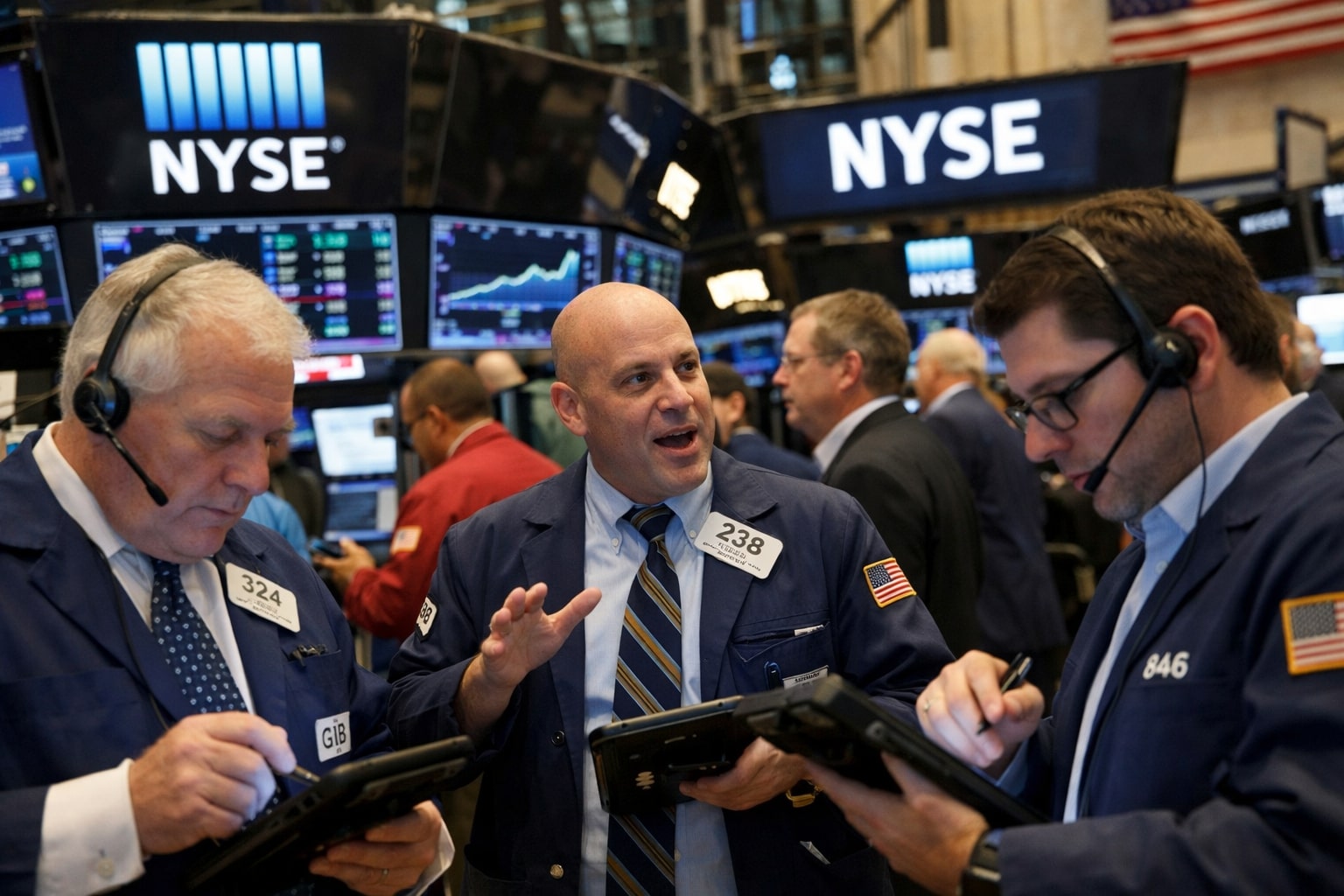
The U.S. equity tape is split three ways. The Dow Jones Industrial Average (^DJI) is the relative winner, up around 0.3%–0.4% with the index trading near 48,271.43, a gain of about +157 points (+0.33%). The S&P 500 (^GSPC) is marginally negative, down roughly 0.1%, and the Nasdaq Composite (^IXIC) is the weak link, slipping about 0.2%–0.3% after a brief positive open. Different feeds show the same pattern: one snapshot has the Dow up 0.4%, the S&P 500 down 0.1%, and the Nasdaq off 0.2%, while another shows the Dow adding 116 points (+0.2%), the S&P 500 up 0.1%, and the Nasdaq up 0.1% as it tries to stabilize after a three-session losing streak. Across the last two sessions the Dow and S&P 500 have already logged three straight declines of around 0.6% and 0.2% respectively, while the Nasdaq had briefly turned higher by 0.2% yesterday as investors tried to pick AI and growth names off the lows. Today’s tape says leadership is rotating: the Dow’s value-heavy, financial and industrial mix is holding up; the broader S&P 500 is pinned between cyclicals and high-multiple growth; the Nasdaq is being dragged by renewed pressure in AI and cloud infrastructure stocks.
Labor Market Jolt: Jobs Losses, 4.6% Unemployment and Fed Cut Expectations
The catalyst behind this three-day wobble is the delayed labor data dropped after a government shutdown backlog. The report shows the U.S. economy shed 105,000 jobs in October, while 64,000 jobs were added in November, beating the 45,000 consensus but nowhere near a strong expansion. At the same time, the unemployment rate jumped to 4.6%, the highest level since 2021. That combination—negative October payrolls and only modest November hiring—is what knocked the Dow by 0.6% and the S&P 500 by 0.2% on Tuesday and extended the losing streak. On the policy side, Federal Reserve Governor Christopher Waller has publicly said the Fed still has room to cut, pointing to “50 to 100 basis points” of potential easing ahead. He is also one of the finalists to replace Jerome Powell and is set to emphasize Fed independence directly to President Donald Trump. New York Fed President John Williams is also on the tape today. The jobs numbers and these comments are feeding a tug-of-war: weaker labor data support rate cuts, but a higher unemployment rate also increases recession risk if the Fed mismanages timing.
Inflation Watch: CPI, Tariffs and the Risk of Stubborn 3% Headline Inflation
The next data shoe is Thursday’s CPI report. Economists expect headline consumer inflation to run at about 3.1% year-over-year, up from 3% in September, and core CPI at around 3.0%, in line with the prior print. Inflation had nearly cooled back toward the Fed’s 2% goal earlier this year before Trump’s “Liberation Day” tariff package pushed costs higher. One concrete example: Nike (NKE) now estimates tariffs could cost roughly $1.5 billion annually, up from a prior $1.0 billion forecast, and the stock—trading near $67 and down about 11% year-to-date—is priced for volatility with options implying a ±7% swing around earnings. The 10-year Treasury yield has ticked up to around 4.16%, and the U.S. dollar index sits near 98.38, as bond traders try to reconcile higher structural inflation from tariffs with a softer labor market. A hotter CPI print keeps yield pressure on the Nasdaq and long-duration tech; a cooler number opens the door for the Fed to lean toward the 50–100 bps of cuts Waller flagged.
Energy Shock Repriced: WTI (CL=F) and Brent (BZ=F) Bounce on Trump’s Venezuela Blockade
Oil has flipped from relentless slide to geopolitical squeeze in two sessions. West Texas Intermediate (CL=F) briefly fell below $55 on Tuesday, touching the lowest level since early 2021 as traders fixated on a global supply glut. Then Trump used his platform to order a “TOTAL AND COMPLETE BLOCKADE OF ALL SANCTIONED OIL TANKERS” entering and exiting Venezuela. That message triggered an immediate reversal: WTI futures rebounded more than 2% to around $56.40, while Brent (BZ=F) climbed roughly 2% to just under $60, with a print near $59.91, up $0.99 (+1.68%). The U.S. had already seized one tanker of Venezuelan crude last week and deployed warships to the Caribbean, and this move escalates the pressure on President Nicolás Maduro. For equities, the rebound gives a bid to energy names inside the S&P 500 and Dow, but it also adds another inflation input just as the Fed tries to cool price pressures. If WTI holds above the mid-$50s and Brent stays near $60, fuel and transport costs will reinforce the case for keeping policy tight longer, which is a headwind for the Nasdaq and growth stocks.
Safe Havens Split: Record-Like Gold and a Tired BTC-USD Rally
Classic safe haven flows are back, but they are not uniform. Gold futures are trading up nearly 1% around $4,370 per ounce, only about $28 below the all-time high of $4,398 set on Oct. 20. With unemployment at 4.6%, tariffs embedded in corporate cost structures, and geopolitical risk rising in Venezuela and Russia-Ukraine, investors are paying a premium for the one asset that doesn’t depend on central bank credibility or tech multiples. In comparison, Bitcoin (BTC-USD) is struggling to behave like “digital gold.” Spot BTC has bounced to roughly $89,834.93, up $2,690.13 (+3.09%) on the day, but it is still about 7% lower for the year and far below the record above $126,000 reached in early October. Volumes are soft, investors are pulling money from Bitcoin ETFs, and derivatives markets show limited appetite to lever into a rebound. Even steady buying from Michael Saylor’s Strategy Inc. (MSTR) has not restored sustained upside momentum. The message: gold is acting as the clean hedge, while BTC-USD looks more like a high-beta risk asset that’s losing sponsorship into year-end.
**AI Trade Stress Test: Oracle (ORCL), Debt Fears and the Shadow Over NVDA, AVGO, MU
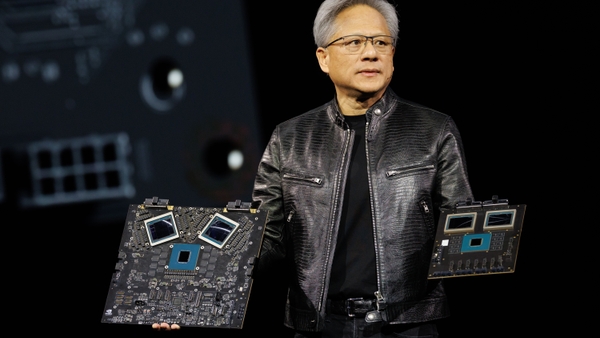
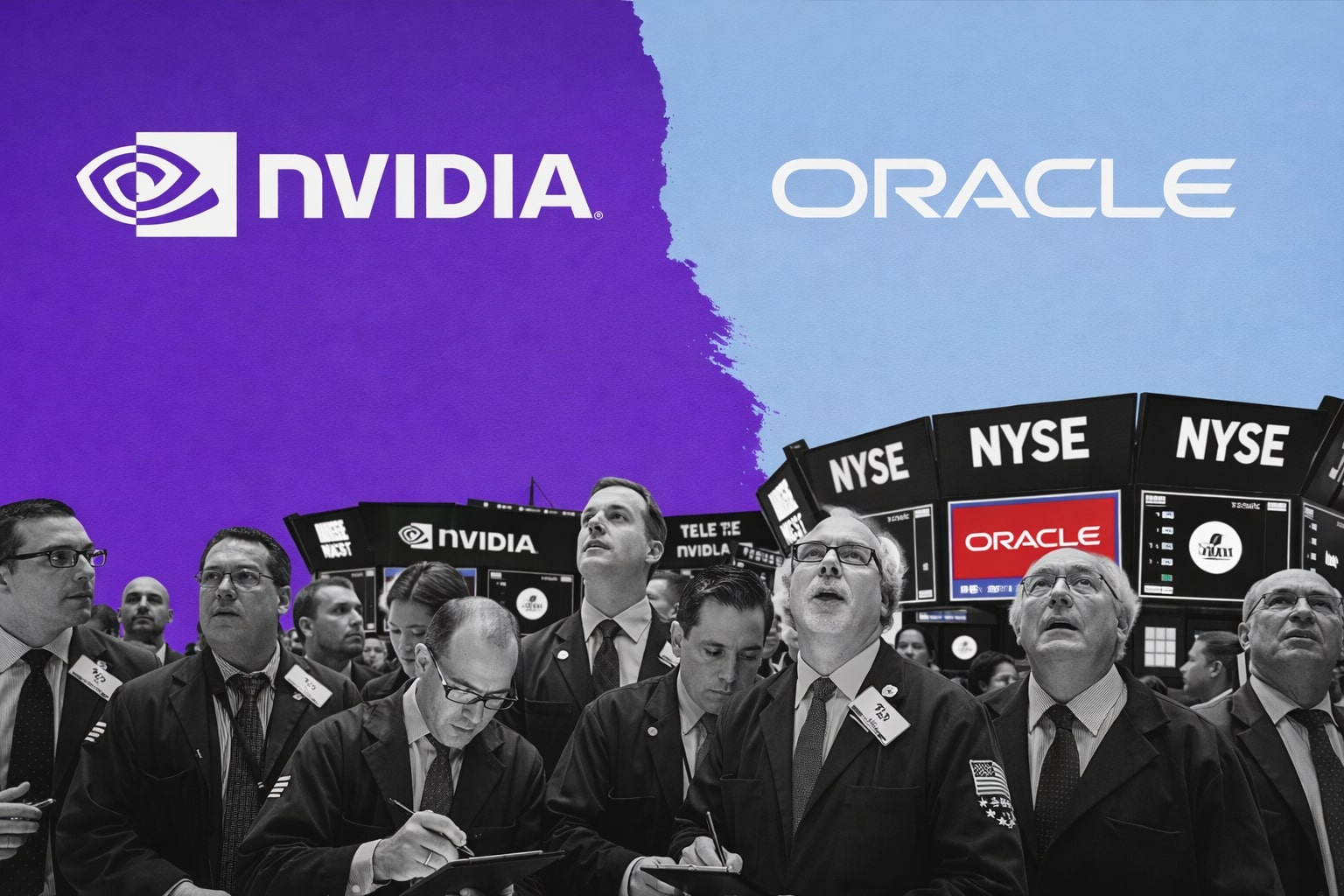
The most important single stock story for the Nasdaq and S&P 500 Tech sleeve today is Oracle (ORCL). Shares trade around $179–180, down roughly 4.8%–5.0% on the session with prints such as $179.55 (-$9.10, -4.82%) and $179.20 (-$9.45, -5.01%). The trigger is a Financial Times report that private lender Blue Owl Capital walked away from a $10 billion financing deal for Oracle’s new Michigan data center being built to serve OpenAI. That dropped financing deal lands on top of an already heavy balance-sheet narrative. Oracle’s latest quarterly SEC filing revealed around $248 billion of off-balance-sheet lease obligations, and the combination of higher capex, rising costs, and dependence on a single mega-tenant in OpenAI is pushing credit investors to hedge more aggressively. Oracle credit default swap spreads have now widened to their highest levels since 2009, signaling real concern about the company’s leverage trajectory even as management reiterates a commitment to preserving an investment-grade BBB rating. This isn’t just an Oracle story. Nvidia (NVDA) is down around 2%, leading Dow decliners as investors revisit just how durable hyperscale AI demand really is. Broadcom (AVGO), which bounced 2.3% yesterday after steep post-earnings selling, is down another ~2% intraday. The sector is waiting on Micron Technology (MU), which is up around 1.5%–3% ahead of its earnings report tonight. If MU confirms strong high-bandwidth memory and server demand, the current AI pullback can stabilize; a soft guide would deepen the re-rating across the AI ecosystem and keep the Nasdaq under pressure.
From Bitcoin Mines to AI Campuses: Hut 8 (HUT) and the Power/Infrastructure Trade
While front-line AI names wobble, the second-derivative infrastructure trade is strengthening. Hut 8 Corp. (HUT)—once a pure-play Bitcoin miner—is up about 15.44%, trading near $42.54, after announcing a $7 billion deal to lease and develop a 245-megawatt data center on the River Bend campus in Louisiana. The lease term is 15 years, with the first construction phase expected to finish by early 2027. This is part of a broader pivot where former crypto miners like HUT, CoreWeave (CRWV) and Applied Digital (APLD) redeploy their access to high-voltage power, cooling infrastructure and specialized real estate into AI hosting. In a market where suitable sites and grid capacity are scarce, these companies are repositioning themselves as energy-infrastructure platforms leveraged to long-term compute demand rather than speculative token prices.
**Lithium, Rare Earths and High-Beta Winners: ATLX, ALB, SQM, AU, MP, PLTR
Resource names tied to electrification and AI hardware are also participating in the risk rotation. After China moved to revoke certain mining rights, lithium prices spiked and miners followed. Atlas Lithium (ATLX) jumped nearly 8%, Albemarle (ALB) and Sociedad Química y Minera de Chile (SQM) each added roughly 4%, while Lithium Argentina gained around 5% and Lithium Americas climbed about 2.5%. These moves layer on top of standout year-to-date winners across materials and AI-adjacent names: AngloGold Ashanti (AU) has surged about 264% in 2025, MP Materials (MP) is up roughly 242%, and defense-tech and AI software name Palantir (PLTR) has climbed nearly 150%, even after a 16% drawdown in November as investors briefly rotated out of the AI complex. The pattern is clear: the market is willing to pay aggressive multiples for scarce inputs—lithium, rare earths, high-quality gold production and mission-critical AI platforms—even as it starts to question how much leveraged capex the large AI infrastructure builders can sustain.
**Mega-Cap Tech, Streaming M&A and AI Platforms: AMZN, NFLX, WBD, PSKY
In mega-cap tech, Amazon.com (AMZN) is quietly outperforming. The stock is trading near $224.50–$224.70, up about 0.87%–0.96% on the day, after reports that Amazon is in talks to invest around $10 billion in OpenAI, in a deal that could value the ChatGPT parent at over $500 billion and pave the way for an eventual $1 trillion IPO. For AMZN, a multibillion-dollar stake would lock in OpenAI workloads on AWS, highlight Amazon’s own AI chips as a credible alternative to NVDA GPUs, and secure long-duration cloud revenue from one of the fastest-growing AI tenants. But it also deepens the circularity where Big Tech funds AI platforms whose valuations depend on Big Tech’s capex. In media, the streaming consolidation story is shifting prices. Warner Bros. Discovery (WBD) trades around $28.81, down about 0.33%, while Netflix (NFLX) is up about 2.60% near $97.03, and Paramount Skydance (PSKY) is weaker after its $108.4 billion offer for WBD was labeled “inferior” by Warner’s board. The board is urging shareholders to back Netflix’s $27.75 per share binding agreement for WBD’s studios, library and HBO Max, arguing that the Netflix deal has firm debt commitments and no equity financing risk, while PSKY’s package relies on a less transparent equity backstop. For S&P 500 Communication Services, this is a classic clean-up phase: heavily levered old-media assets are being pulled into stronger platforms, but the winners must still execute on integration and cost discipline.
Tesla (TSLA) and the Autonomy Repricing: Robotaxi Tests and the $1 Trillion AI Optionality
Tesla (TSLA) is near the top of its 2025 range even on a flat day. The stock is trading around $489.33, marginally down 0.11% intraday, but that follows a 4% jump on Monday and another 3% rally on Tuesday, taking TSLA back to prices last seen a year ago. The latest leg higher is tied to confirmation from Elon Musk that Robotaxi testing is now underway in Austin, Texas, without a safety driver in the front seat. That development gives substance to Tesla’s long-promised autonomous fleet thesis. The equity market is now explicitly paying for Tesla’s AI and robotics optionality. One prominent estimate puts the AI/autonomy opportunity at at least $1 trillion of potential value for TSLA, and there is an expectation that over the next 3–6 months, regulatory barriers around Full Self-Driving and autonomous operations will ease under the Trump administration. The risk is symmetrical: if Robotaxi testing scales and regulators cooperate, the current valuation can be justified by high-margin software and mobility revenue; if there is a setback—regulatory, legal or safety-related—the stock is exposed, because a meaningful portion of the current price rests on autonomy rather than incremental EV unit growth.
Big Banks and Deregulation: BAC, JPM, WFC, C Turn Capital Into Growth
Away from tech, the strongest structural tape is in large U.S. banks. Bank of America (BAC) trades near $55.22, up 0.74%, JPMorgan Chase (JPM) changes hands around $317.55, up 0.63%, while Wells Fargo (WFC) and Citigroup (C) also sit near record levels. The fundamental backdrop is the best in roughly fifteen years. Global investment banking volume is on pace to climb about 10% from 2024 to its highest since 2021, even after tariff shocks and IPO delays linked to the government shutdown. Trading divisions have benefited from volatility in rates, FX and equities, and banking analysts expect net income across BAC, JPM, WFC and C to reach record highs. On top of earnings power, deregulation from the second Trump administration is poised to free up serious balance-sheet capacity: Goldman Sachs analysts estimate that policy changes could deliver between $180 billion and $200 billion of excess capital to U.S. banks by the end of next year. That capital can go into buybacks, higher dividends, bolt-on acquisitions, or balance-sheet expansion. For the Dow and S&P 500 Financials, this combination of record profits and looser regulation is why banks are outperforming the broader market into year-end.
Read More
-
Reddit Stock Price Forecast - RDDT at $244: Can 68% Growth and 91% Margins Support a 130x P/E?
10.01.2026 · TradingNEWS ArchiveStocks
-
XRP Price Forecast: XRP-USD Holds Near $2.09 as $1.47B ETF Inflows Fuel Next Breakout Above $2.41
10.01.2026 · TradingNEWS ArchiveCrypto
-
Oil Prices Spike Toward $59 WTI and $63 Brent as Iran Unrest and Venezuela Upheaval Hit Supply Risk
10.01.2026 · TradingNEWS ArchiveCommodities
-
Stock Market Today: Dow 49,504 and S&P 6,966 Hit Records as Jobs Miss, Trump’s $200B Mortgage Push and AI Rally Fuel Risk-On Week
10.01.2026 · TradingNEWS ArchiveMarkets
-
GBP/USD Price Forecast - Pound Slides Toward 1.34 Floor as Hot US Data and Fed–BoE Gap Hit Sterling
10.01.2026 · TradingNEWS ArchiveForex
Cyclicals, Housing and Industrials: LEN, NUE, JBL, GIS, GPS, MEDLINE
Cyclicals are sending a mixed, but very specific, signal about the real economy. In housing, Lennar (LEN) is down about 4.2%–4.3%, with prints such as $112.63 (-$4.94, -4.20%) and $112.50 (-$5.07, -4.31%), after posting adjusted Q4 EPS of $2.03, missing the $2.24 consensus, even though revenue of $9.37 billion beat expectations of around $9.13 billion. Guidance for fiscal Q1 calls for 17,000–18,000 deliveries and 18,000–19,000 new orders, both softer than the Street wanted. Management explicitly flagged that “even as interest rates moved slightly lower,” the overall housing market remains “challenged,” with affordability constraints still biting. In steel, Nucor (NUE) guided Q4 profit down to $1.65–$1.75 per share, well below the $2.16 consensus. Earnings are expected to decline in all three operating segments compared with Q3 due to seasonality and fewer shipping days. The stock is down about 3% pre-market, but management says order backlogs are “materially higher” than a year ago, supported by demand in energy, infrastructure, data centers and manufacturing, and sees 2026 as a stronger year as policy, tax and trade moves support domestic build-out. On the positive side, Jabil (JBL) is the standout early S&P 500 gainer. The company delivered preliminary fiscal Q1 2026 core EPS of $2.85 versus expectations for $2.68, on revenue of $8.31 billion, up nearly 19% year-over-year and above the $8.00 billion consensus. For the current quarter, Jabil forecasts core EPS of $2.27–$2.67 on revenue of $7.5–$8.0 billion, with midpoints above analyst estimates, and for the full year it projects core EPS of $11.55 on $32.4 billion of revenue. Shares jumped about 8% and are up roughly 60% this year, powered by demand in its Intelligent Infrastructure segment across cloud, data-center, networking and capital equipment. In staples, General Mills (GIS) rose about 2.53% to $48.21. The company reported EPS of $0.78, below the $1.04 estimate, but revenue of $4.86 billion beat expectations of $4.78 billion. For the full fiscal year ending in May, GIS expects net sales growth between -1% and +1%, with adjusted operating profit and EPS both projected to fall 10%–15%. The stock trades at a discount to packaged-food peers, and many analysts argue these headwinds are already in the price. On the consumer and retail side, Gap Inc. (GPS) was upgraded to “outperform” by Baird. The new price target of $33 implies about 22% upside from Tuesday’s close, with the stock trading near $27.59, up $0.53 (+1.94%). The call is that brand reinvigoration at Old Navy and Gap is driving sustainable share gains, supported by stronger customer acquisition and higher average unit retail. In primary equity markets, Medline just upsized its IPO by $1 billion to around $6.2 billion, with shares priced at $29 near the top of the range, implying a market cap of about $53.4 billion. It is now set to be the largest U.S. IPO of 2025, signaling that risk appetite in the primary market is returning after the post-2021 slump.
Regulatory, Legal and Fraud Headlines: Tricolor, Fed Independence and Political Risk Premiums
Not all single-name headlines are constructive. U.S. prosecutors have charged senior executives at bankrupt subprime auto lender Tricolor Holdings—including Daniel Chu and David Goodgame—with a years-long “systematic fraud” scheme from 2018 through September 2025 that misrepresented loan collateral quality to extract billions from lenders and investors. That saga is one reason why parts of the financial sector still trade with an embedded risk premium despite record profits at the largest banks. On the policy side, Waller’s comment that he will “absolutely” stress the Fed’s independence in his meeting with Trump is not a throwaway. With the administration openly pushing tariffs, ordering naval blockades of Venezuelan tankers, and influencing regulatory treatment in sectors like EVs and banking, investors are watching how much autonomy the central bank can actually maintain. That political overlay is part of why gold at $4,370, DXY at 98.38, 10-year yields at 4.16%, and BTC still off its highs are all coexisting with an S&P 500 that is only modestly below record levels.
Market Verdict: Positioning Across Dow, S&P 500, Nasdaq, Energy, AI and Financials
Putting the full tape together, the cross-asset signals are clear. The Dow—with its heavier weight in banks, industrials and energy—is the relative outperformer and can reasonably be viewed as a HOLD to selective BUY on weakness, backed by record earnings at BAC, JPM, WFC, and C, plus deregulation that could unlock $180–$200 billion in excess capital. The S&P 500 is more balanced; with headline inflation near 3%, unemployment at 4.6%, and CPI plus Fed cuts in play, broad U.S. equities screen as a core HOLD, with upside skewed toward quality cyclicals like JBL and strong-capital banks, and downside concentrated in highly levered AI-capex stories like ORCL. The Nasdaq remains the most vulnerable in the short term. Debt-heavy AI infrastructure builders (ORCL, some cloud names) are under pressure, NVDA and AVGO are re-rating, and the market still needs confirmation from MU that data-center demand can offset valuation and policy risk. Here, the stance is selective HOLD/trim, favoring cash-rich, diversified platforms (AMZN) over names reliant on aggressive off-balance-sheet financing. Energy and hard assets—via WTI, Brent, AU, MP, lithium producers, and HUT 8’s shift into data centers—are behaving like BUY-rated hedges: they benefit from geopolitical escalation, structural under-investment in supply, and AI’s insatiable demand for power and materials. Housing-linked cyclicals like LEN and tariff-sensitive consumer names like NKE sit firmly in HOLD to LIGHTEN territory until there is either a clearer rate-cut path or evidence that affordability and tariff drag are easing. Finally, TSLA is priced as a leveraged call option on autonomy. With Robotaxi tests in Austin and a $1 trillion AI/robotics narrative now embedded in the stock, the risk/reward is binary: it is a high-beta BUY only for investors willing to accept that a regulatory or execution misstep could unwind the latest rally very quickly. Overall, the market today rewards tangible cash flow, balance-sheet strength and real assets, while forcing investors to reprice any AI story that leans too heavily on leverage, circular funding or unproven demand.