

Stock Market Today: S&P 500 at 6,900, Nasdaq at 23,400 as AI Giants and Precious Metals Reverse
NVDA and TSLA lead tech lower, silver crashes back from $80, gold sinks over 4%, oil rebounds near $58, while DBRG jumps on SoftBank’s $16-per-share bid and GM’s $80 stock crowns it 2025’s top US automaker | That's TradingNEWS
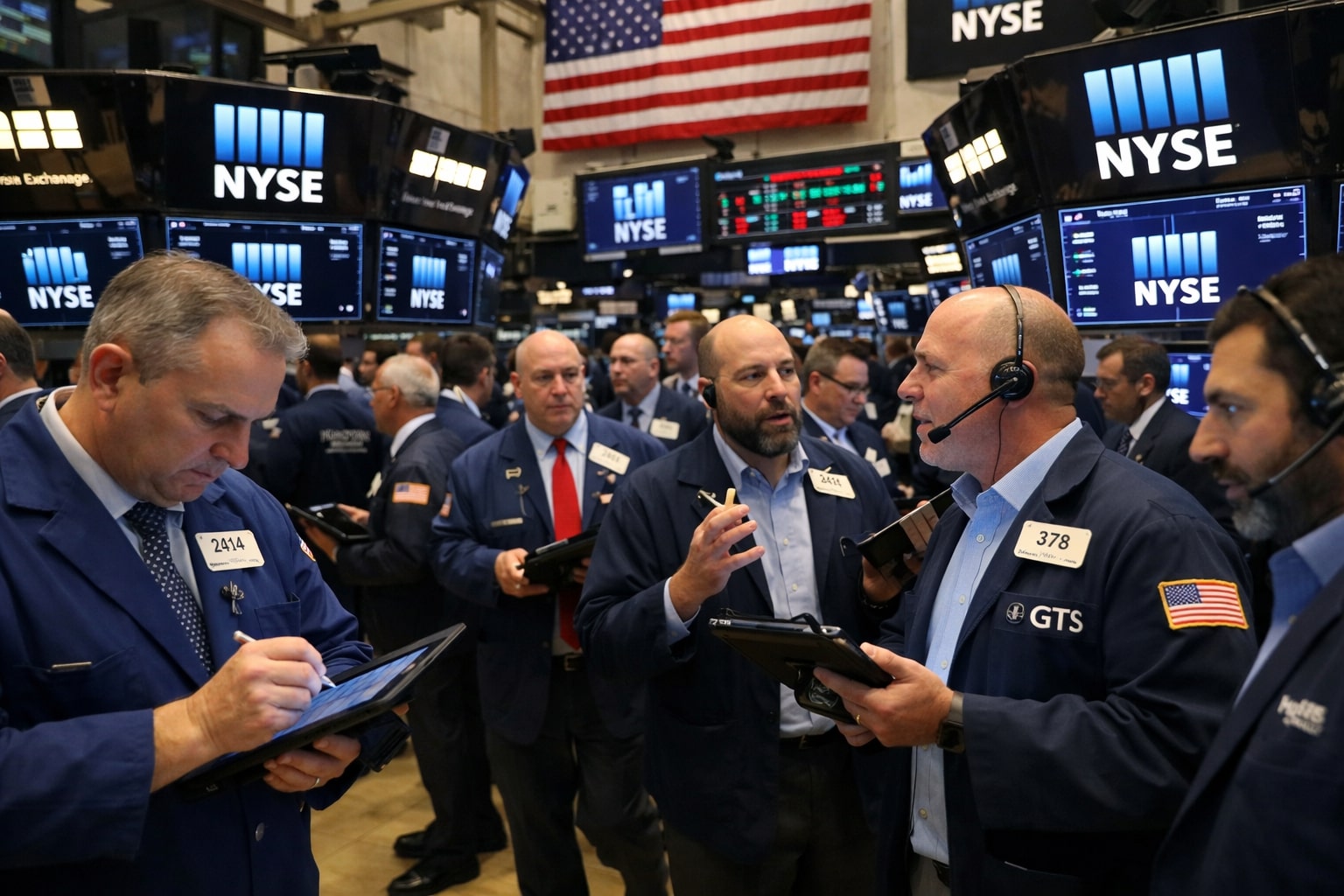
Stock Market Today - Wall Street Pulls Back As S&P 500, Nasdaq, Dow Ease Off Record Territory
The last week of 2025 starts with sellers in control after a year of outsized gains. The Dow Jones Industrial Average (DJIA) trades around 48,500–48,521, lower by roughly 0.4%. The S&P 500 (SPX) sits near 6,900, off about 0.4–0.5%, and the Nasdaq Composite (IXIC) hovers around 23,420–23,435, down approximately 0.7%. Even with today’s drop, the scorecard for 2025 remains strong: the S&P 500 is ahead by more than 17%, the Dow is up about 14%, and the Nasdaq has climbed more than 21–22%, despite a temporary bear phase in April when tariffs from President Trump shocked growth stocks. The reversal comes right inside the traditional Santa Claus window, but most of that seasonal strength has already been banked with all three benchmarks near all-time highs.
AI Trade Cools: NVDA, TSLA, META, AAPL, MSFT, AMZN Lead Today’s Tech Weakness
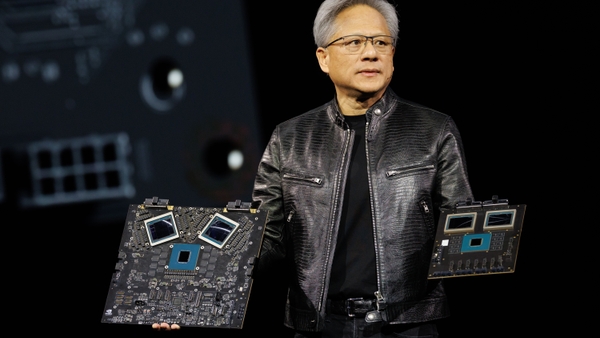
The pressure is centered exactly where 2025’s upside was concentrated. NVIDIA (NVDA), still the flagship AI name and the largest public company by market value, is trading around $186–187, down about 2% after a more than 5% advance last week and after agreeing to buy AI-chip startup Groq’s assets for roughly $20 billion, its biggest acquisition to date. Tesla (TSLA) is off more than 2%, snapping part of last week’s run to new highs. Palantir (PLTR), Meta Platforms (META), Oracle (ORCL) and Advanced Micro Devices (AMD) are also under pressure as the Technology Select Sector ETF (XLK) drops around 0.6–0.7%.
Inside the “Magnificent Seven”, only Amazon (AMZN) is holding close to unchanged. Apple (AAPL), Microsoft (MSFT), Alphabet (GOOGL, GOOG) and META are modestly negative while NVDA and TSLA absorb the heaviest selling. After a year in which AI-linked capital expenditure is estimated around $400 billion and projected to exceed $500 billion next year, valuations in these names now discount a long runway of earnings and free-cash-flow growth. Today’s move is not a macro panic; it is investors extracting some profits from the most crowded winners of 2025.
Autos Diverge: GM Stock Outpaces TSLA, F, STLA In 2025 Performance Tables
In autos, 2025 is ending with a clear surprise. General Motors (GM) has quietly become the top-performing major US-listed automaker. The stock is up more than 55% this year and recently pushed to record territory above $80 a share. The December move alone is nearly 13%, extending a streak of five consecutive monthly gains, the strongest run since GM emerged from bankruptcy. Management’s long-standing argument that GM traded below its earnings power is finally reflected in the multiple.
By contrast, TSLA remains a high-beta name that has delivered huge returns over several years, but today’s ~2–2.5% drop highlights how sensitive the stock is to any reassessment of growth assumptions. Even after the pullback, TSLA still embeds aggressive expectations around full self-driving, energy storage and volume expansion. When a legacy manufacturer like GM delivers a better year-to-date performance with a lower valuation and consistent earnings, some institutional money naturally rotates toward the cheaper cash-flow stream. On a risk-reward basis, GM screens as Buy, while TSLA is sliding toward Hold/Trim rather than a fresh high-conviction buy at current levels.
AI Infrastructure Re-Rating: DBRG Rockets On SoftBank’s $4 Billion Data-Center Deal
The clearest single-stock outperformance comes from DigitalBridge Group (DBRG). After closing last week with a year-to-date gain of about 23%, the stock exploded in premarket trade, at one point up more than 50%, and is still higher by around 10% intraday near $15.27–15.28. The catalyst is SoftBank Group (9984.T) agreeing to acquire DBRG for approximately $4 billion, valuing the equity at $16 per share, a 15% premium to the December 26 close.
DigitalBridge manages roughly $108 billion in assets across platforms including AIMS, AtlasEdge, DataBank, Switch, Vantage Data Centers and Yondr. For SoftBank, the acquisition fits into a broader strategy that includes the $500 billion “Stargate” project to build massive AI-grade data centers alongside OpenAI, Oracle and Gulf partners. For equity investors, it reinforces a clear message: power-dense digital infrastructure with secure long-term hyperscaler contracts is strategic, and strategic assets can command double-digit deal premiums even late in the cycle. With DBRG now trading just below the $16 offer, the upside is dominated by merger-spread math rather than fundamentals. That puts DBRG itself in Hold territory, while the wider AI-infrastructure complex—data centers, power, cooling, grid—remains a Buy theme for 2026.
Stock-Specific Movers: CPNG, PRAX, NVO, OLPX Trade On Idiosyncratic Catalysts
Today’s tape is also full of individual stories. Coupang (CPNG) is up roughly 2.5–2.8%, extending a >6% rise on Friday as the market looks past a major cybersecurity incident. A former employee downloaded customer data; the latest reports indicate the information has since been deleted, which reduces regulatory and reputational tail risk and allows investors to refocus on growth and margins in Korea and new geographies.
Praxis Precision Medicines (PRAX) has turned into a speculative magnet. After a broker upgrade naming the company a top pick for 2026 and lifting the target from $507 to $843—a projected upside of more than 213%—the shares are pushing higher by several percentage points. In thinly traded biotech, that kind of target revision often re-anchors the entire bull case and pulls in momentum capital.
On the downside, Novo Nordisk (NVO) is weaker by around 1.5–1.6% after reports that the company cut Wegovy obesity-drug prices by up to 50% in parts of China and on JD.com ahead of a March patent expiry. Even with GLP-1s dominating the global drug narrative, regional pricing pressure reminds investors that not every market will deliver US-style margins.
Meanwhile Olaplex (OLPX) is up about 5%. The stock is still down roughly 22% for the year but has bounced about 20% in the last month. With no fresh fundamental news, the move looks like short-covering and year-end positioning rather than a structural re-rating.
Metals Unwind: Gold, Silver, NEM, CDE, HL, AG, SLV Hit After CME Margin Hikes
The most violent moves are in precious metals and their equity proxies. Gold futures (GC=F), which finished Friday near $4,585 an ounce after a year-to-date gain of around 70%, are now trading closer to $4,356–4,415, down about 3–4.3%. Silver (SI=F) spiked beyond $80 an ounce overnight to set a new all-time high after a 150–185% surge this year, then snapped lower into the $71–75 range, a decline of roughly 6–7% from the peak.
The technical backdrop is stretched. Silver is more than 70% above its 200-day moving average; historically, whenever silver trades more than 60% above that trend line, forward returns over the next 20–40 sessions have been negative in most cases. The current adjustment is being accelerated by CME Group raising margin requirements: silver performance bonds increased from $22,000 to $25,000 per contract (+14%), gold margins rose from $20,000 to $22,000 (+10%), and platinum from $6,500 to $8,000 (+23%). Highly leveraged longs are being forced to de-risk at the same time that speculative positioning is crowded.
Mining equities are reacting with leverage to the downside. Newmont (NEM), which had soared more than 160% this year in tandem with the gold spike, is down close to 6% and sits near the bottom of the S&P 500. Silver-focused names Coeur Mining (CDE), Hecla Mining (HL) and First Majestic Silver (AG) are shedding roughly 4–6%. The iShares Silver Trust (SLV) is weaker by more than 8% after being one of 2025’s best-performing macro vehicles.
Given the combination of parabolic gains, extreme distance from moving averages and fresh margin hikes, this looks like a blow-off phase rather than a healthy pause. Metals and high-beta miners shift to Sell / Take Profits tactically. The long-term debasement and central-bank-buying narrative is intact, but the entry point is now poor after a vertical move.
Industrial And Energy Commodities: HG, CL=F, BZ=F, GSCI Paint A Different Picture
While investors unwind precious-metal exposure, cyclical commodities tell a more nuanced story. Copper on the London Metal Exchange has traded above $12,400 per metric ton and is ahead by more than 40% in 2025, putting it on course for its best year since 2009. The metal’s role in data centers, electric vehicles and power-grid upgrades means each dollar of AI-related capex reinforces the structural demand case.
In energy, West Texas Intermediate (CL=F) is trading around $58.09 a barrel, up roughly 2.4% on the session, and Brent (BZ=F) sits above $61.50, higher by about 2.1–2.2%. The S&P GSCI Spot Index edges up to around 551.89, a gain of about 0.27%. The fuel for the move is geopolitical and supply-driven. Peace talks between Ukraine and Russia, hosted in the US, failed to produce a resolution; sanctions continue to keep several hundred thousand barrels per day of Russian crude constrained, even as China and India buy at steep discounts.
At the same time, output from Kazakhstan’s Tengiz field—where Chevron (CVX) is the lead operator—has fallen about 6% this month after Ukrainian drones damaged a Black Sea export terminal. Rhetoric from Iran’s leadership adds another layer of risk premium, while US-Venezuela tensions complicate expectations for additional supply. Yet despite these supports, crude is still heading for its fifth consecutive monthly decline, showing that global growth worries and non-OPEC supply are capping any runaway rally. Against this backdrop, high-quality energy producers and integrated majors screen as a Cautious Buy, with the emphasis on balance sheets and dividends rather than aggressive volume growth.
Rates, Dollar And Volatility: UST10Y, DXY, VIX Confirm Orderly De-Risking
The equity and metals weakness is not being driven by a rate spike. The US 10-year Treasury yield (UST10Y) trades around 4.11–4.13%, about 2 basis points below Friday’s close under 4.14%. The primary macro event this week is Wednesday’s release of the Federal Reserve’s December meeting minutes, which should clarify how deep internal divisions are and how committed the committee is to holding rates in January. Fed-funds futures imply roughly an 80% probability that rates remain unchanged next month, while expectations for March are more evenly split between a hold and the first cut.
The US Dollar Index (DXY), depending on the basket referenced, is roughly 95.7–98.0, down about 7–10% year to date after April’s tariff shock. Major banks now project an additional 10% trade-weighted decline by the end of 2026, effectively calling time on a dollar bull cycle that lasted most of the past decade.
The Cboe Volatility Index (VIX) sits around 14.77–14.83, about 8.6–9% higher on the session after registering a low not seen in more than a year last week. That level still corresponds to relatively calm conditions; the move is consistent with a controlled reduction in gross exposure rather than an outright risk-off stampede.
Housing, Consumers And Stress Pockets: Pending Sales, Power Bills, Foreclosures
Real-economy data show pockets of resilience alongside growing stress. Pending home sales rose 3.3% in November versus expectations of a 0.9% increase, the biggest monthly gain since February 2023. Compared with a year earlier, contract signings are up 2.6%, and every US region recorded growth, with the West leading on a 9.2% month-over-month rise. Falling mortgage rates from peak levels and more moderate home-price appreciation are finally coaxing buyers back into the market.
At the same time, households are being squeezed elsewhere. Electricity bills jumped sharply in 2025 and are set to remain high in 2026, forcing many consumers to reallocate spending away from discretionary categories. Foreclosure activity—defined as default notices, scheduled auctions and bank repossessions—was 21% higher in November than a year earlier. Delaware stands out with foreclosure activity up nearly 159%, Nevada about 26%, New Jersey more than 48%, and Florida around 21%, even though national foreclosure volumes are still well below historical peaks. The overall picture is a consumer that is weakening at the margins rather than collapsing, which matters for sectors tied to lower-income and subprime borrowers.
Crypto And Mining: BTC-USD Flatlines While Mining ETF Rides The AI Data-Center Wave
Bitcoin (BTC-USD) trades around $87,300–87,500, down from an overnight pop near $90,000 and roughly flat to slightly negative for the year, a stark contrast to the enormous rally in 2020–2021. Yet equity exposure tied to the mining space has dramatically outperformed spot BTC. A prominent Bitcoin-Mining ETF has exploded about 79% in 2025 as miners pivot their business models. Instead of relying purely on block rewards and transaction fees, they are converting existing data-center sites, cooling systems and long-term power contracts into infrastructure for AI and cloud workloads.
That pivot changes the risk profile. Earnings become less dependent on Bitcoin’s day-to-day price and more sensitive to AI capex cycles and hyperscaler demand. For now, investors are rewarding that shift with higher multiples. For Trading News readers, pure BTC exposure at these levels leans Neutral / Hold, while selected miners that have genuinely transitioned into diversified data-center operators can still be treated as opportunistic Buys, provided valuations reflect the new revenue mix rather than the old speculative model.
Read More
-
PayPal Stock Price Forecast - PYPL at a Five-Year Low: Deep-Value Bet at $57 With Upside Toward $100–$120
20.01.2026 · TradingNEWS ArchiveStocks
-
XRP ETF Focus: Are XRPR at $15.56 and XRPI at $10.96 Setting Up a Rebound?
20.01.2026 · TradingNEWS ArchiveCrypto
-
Natural Gas Price Jumps Above $3.80 on Arctic Blast as Traders Target the $4.00 Line
20.01.2026 · TradingNEWS ArchiveCommodities
-
Stock Market Today - Dow Jones, S&P 500 and Nasdaq Tumble as Greenland Tariffs Trigger ‘Sell America’
20.01.2026 · TradingNEWS ArchiveMarkets
-
USD/JPY Price Forecast - USDJPY=X Eyes 160 as Japan’s Fiscal Shock Overpowers Classic Safe-Haven Flows
20.01.2026 · TradingNEWS ArchiveForex
Sector Internals: SPX Materials Lags While Energy, Utilities, Staples And Real Estate Hold Ground
Underneath the headline indices, sector leadership has changed. The S&P 500 Materials Sector Index is down roughly 1.1–1.2%, the weakest of the 11 major groups, dragged lower by gold and silver miners that are now giving back a portion of their extraordinary year-to-date gains. In contrast, defensives and cash-flow sectors show pockets of strength. The S&P 500 Utilities Sector Index is up about 0.5%, the Energy Sector Index gains around 0.6%, Real Estate advances approximately 0.3–0.4%, Consumer Staples are up about 0.2%, and Health Care is marginally positive.
This is a classic year-end factor rotation. After three years of strong index returns and a 2025 dominated by AI leaders, investors are rotating toward yield, lower volatility and companies whose cash distributions are easier to forecast. That rotation is happening at the same time as some of the most speculative trades—silver, richly valued software, long-duration AI stories—are being trimmed. For active managers, today’s tape reinforces the idea that sector and factor selection will matter more in 2026 than simple index exposure.
Positioning And Verdict: Buy, Sell Or Hold Across The Main 2025 Winners
For the major indices—SPX, DJIA, Nasdaq, Russell 2000 (RUT)—a year-to-date performance of +14–22%, combined with modestly rising volatility and an important but light macro calendar, argues for Hold rather than aggressive chasing. Dip-buying can still work, but the asymmetry is no longer as favorable at S&P ~6,900 and Dow ~48,500.
For mega-cap tech and AI—NVDA, TSLA, META, AAPL, MSFT, AMZN, GOOGL, ORCL, AMD, PLTR—today’s declines of 1–3% are noise against a huge 2025 rally. However, after a year with $400–500 billion of AI-linked capex and stretched multiples, the stance shifts to Hold / Trim, not unconditional Buy. Upside exists but with very little margin for disappointment.
For precious metals and miners—gold, silver, NEM, CDE, HL, AG, SLV—the combination of 70% gold gains, 150–185% silver gains, prices far above moving averages and fresh CME margin hikes points to an exhausted move. Near term, that complex is a Sell / Take Profits trade.
For energy—CL=F, BZ=F and well-capitalized producers—the multi-month slide in crude, persistent geopolitical risk and improving relative performance of energy equities support a Cautious Buy stance into 2026, focused on balance-sheet strength, dividends and disciplined capital allocation.
For AI infrastructure and data-center names highlighted by DBRG, the structural call remains Bullish. DigitalBridge itself moves to Hold with the price near a $16 cash takeout, but the lesson is clear: scarce compute and power capacity tied to AI and cloud workloads justifies a strategic premium. That is where the market is willing to pay up even as it trims the over-owned AI front-end names.