Stock Market Today – Indices, AI Rotation, Metals And Key Movers
US indices drift lower as 2025 rally cools for ^GSPC, ^IXIC, ^DJI, RUT
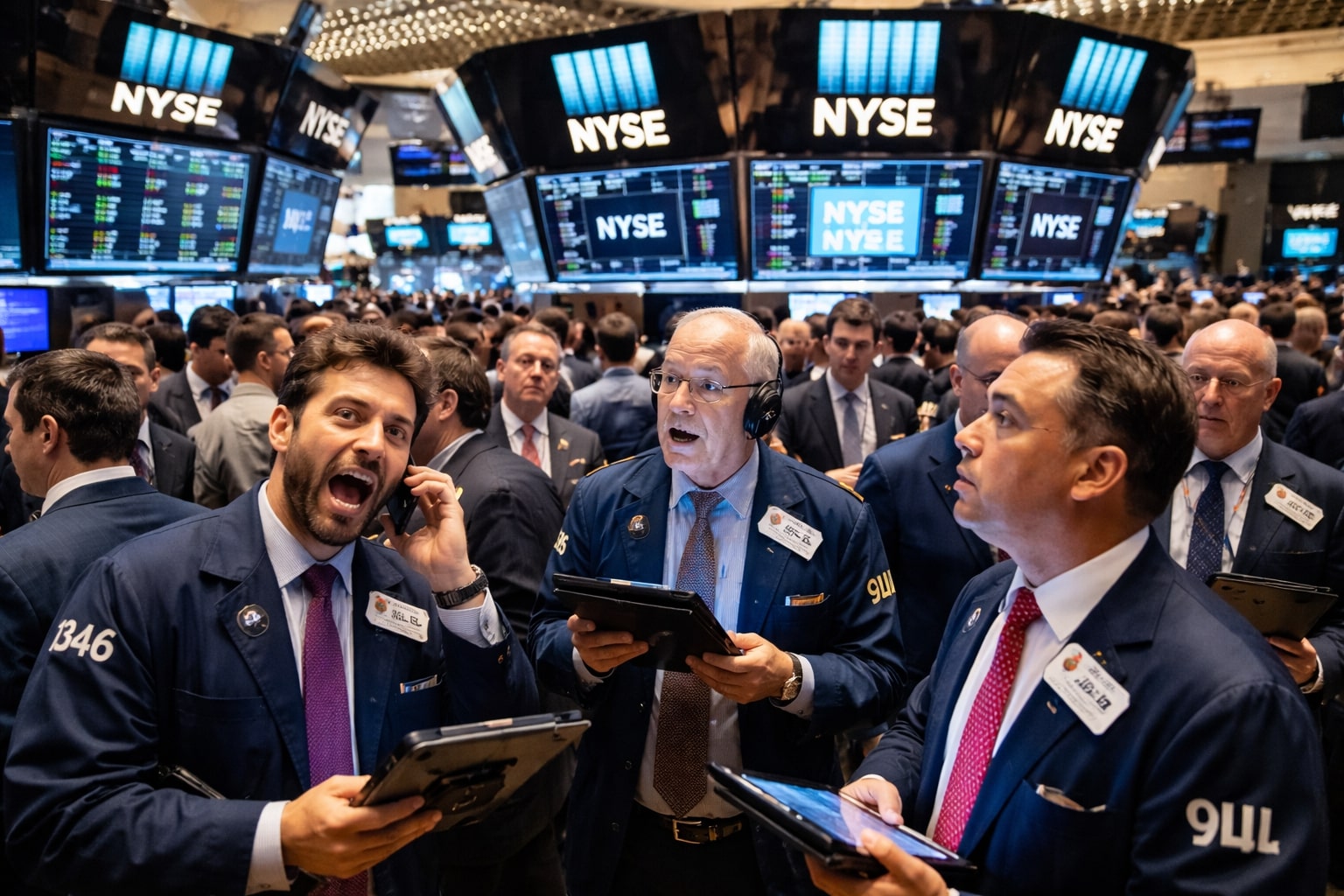
The final Tuesday of 2025 opens with Wall Street fading instead of delivering a classic year-end melt-up. The S&P 500 (^GSPC) trades around 6,896, down roughly 0.1–0.15% on the session. The Dow Jones Industrial Average (^DJI) sits near 48,358, off about 0.2%, while the Nasdaq Composite (^IXIC) is around 23,436, lower by roughly 0.15–0.2%. The Russell 2000 hovers near 2,515, down about 0.2%, confirming this is broad but controlled profit taking, not a risk-off stampede.
Even after today’s softness, 2025 is a strong year across the board. The S&P 500 is still ahead by about 17–18% year to date, the Nasdaq has gained more than 21%, and the Dow is up roughly 14%. Inside the S&P 500, Communication Services stands out with gains around 32.5%, Information Technology is up close to 25%, while Real Estate is barely positive at roughly 0.5%, making it the clear loser among the 11 sectors.
Globally, the U.S. is no longer the only game in town. A global equity basket ex-US is on track to outperform the S&P 500 by the widest margin since 2009, and Korean equities are having their best year since 1999, highlighting that 2025 has been a broad global risk rally, not just a U.S. tech story.
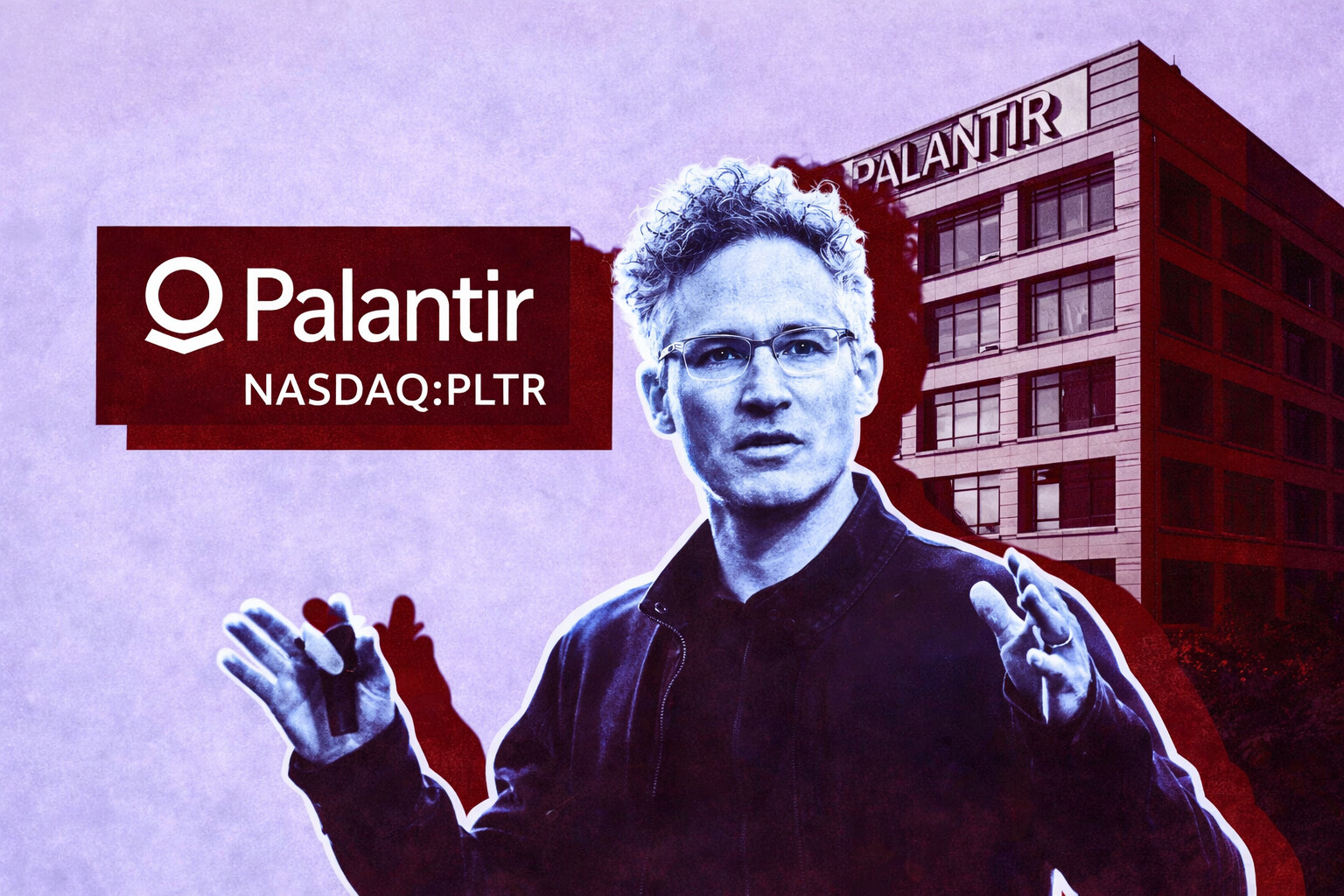
AI megacaps NVDA TSLA PLTR ORCL rotate from leadership into profit-taking
The core dynamic under the surface is rotation out of this year’s AI winners. After months of near-parabolic moves, traders are using thin holiday liquidity to crystallize gains. On Monday, Nvidia (NVDA), Tesla (TSLA) and Palantir Technologies (PLTR) dropped in a 1–3% range, while precious-metals producer Newmont (NEM) was hit for about 5.6% as part of a broader materials shake-out.
Into today’s session, the tape is less brutal but still heavy on that leadership basket. TSLA, PLTR and NVDA are roughly 0–1% lower intraday, showing pressure rather than panic, while Oracle (ORCL) manages to trade about 0.5% higher, proving that not every AI-linked software name is being sold mechanically.
Valuation explains the behavior. In the S&P 500, Western Digital (WDC) is up close to 300% in 2025, Micron Technology (MU) has advanced nearly 250%, and PLTR has rallied more than 140% this year. Those kinds of numbers naturally trigger position cuts into year-end when the VIX is still around the mid-teens and liquidity is patchy.
From a Trading News standpoint, this is a positioning reset in AI, not the end of the theme. At current levels, NVDA/TSLA/PLTR are Hold / trim candidates rather than aggressive Buys. Fresh upside will require either better-than-expected 2026 guidance or cheaper entry points after a deeper shake-out.
META doubles down on AI agents with $2B+ Manus acquisition
While hardware and infrastructure plays digest big moves, Meta Platforms (META) is pushing down the stack toward AI agents. The company is buying Singapore-based Manus for more than $2 billion, one of the larger deals in the global agentic-AI space. Manus’ core product is a platform of AI agents that can autonomously handle market research, coding, and data analysis, and Meta plans to fold those capabilities into its own products.
The market’s reaction is calm rather than euphoric. META trades roughly flat to modestly higher (around +1%) today and is up about 13% in 2025, signaling that investors are comfortable with large AI checks as long as they are tied to clear monetization paths. The deal shifts part of the AI upside from raw compute toward software layers that actually execute workflows—a logical next step after the GPU boom.
As long as META can convert these investments into higher engagement, ad yield, and new agentic services at scale, the stock remains a Buy on weakness, not just a passive index exposure. The risk is not the AI direction; it is execution and integration speed.
Metals shock: silver SI=F, gold GC=F and copper outpace the equity benchmarks
The wildest action today is in precious and industrial metals. After suffering its biggest one-day drop in over five years, March silver futures (SI=F) jump about 6.5–7.2% to roughly $75–76 per ounce, leaving year-to-date gains around 158% and keeping prices not far below the recent record above $82.65.
Gold futures (GC=F) rebound almost 1–1.5% to just under $4,400 per ounce after sliding more than 4% from their latest all-time highs in Monday’s margin-driven washout. The catalyst was higher margin requirements at the exchange level, not a sudden macro shift, and today’s bounce confirms that the structural bid in gold—central-bank buying, lower real rates, and demand for non-fiat hedges—remains intact.
Industrial metals join the party. Three-month copper on the LME trades around $12,405 per metric ton, up roughly 41% for 2025 after notching a record near $12,960. COMEX copper has climbed more than 40% this year, driven by mine disruptions, a softer dollar trend, and massive power and cabling demand from AI-heavy data-center build-outs.
On the equity side, producers finally outperform. Newmont (NEM) bounces more than 2% after yesterday’s 5.6% loss, while Freeport-McMoRan (FCX) and Hecla Mining (HL) rebound as traders re-express the metals theme through miners instead of heavily margined futures. Given gold’s roughly 70%+ YTD run and silver’s triple-digit move, our stance is Tactical Buy / Core Hold in metals and quality miners: structural tailwinds are intact, but position sizing must respect the volatility.
Energy, AI power demand and crude CL=F: quiet tape, loud structural story
Oil trades quietly compared with metals. West Texas Intermediate (CL=F) hovers around $58.3–58.5 per barrel, up roughly 0.5% today and locked inside the same broad range that has defined most of 2025. On the surface, that looks boring; underneath, demand is being reshaped by AI.
A major Wall Street bank is co-leading financing for natural-gas-fired power plants in Texas dedicated to AI data centers, in a project south of Dallas known as South Dallas One. Developer GridFree AI is designing sites capable of roughly 1.5 gigawatts of generation each, promising to deliver off-grid power for compute within about two years, bypassing slow grid-connection queues.
This is critical for positioning. Even if headline crude remains stuck around $55–65 WTI, dedicated gas-fired units for AI raise the floor under U.S. natural gas demand, midstream volumes and related infrastructure. For now, with CL=F capped below $60, oil-heavy equities stay in selective Hold territory, but gas, midstream, and power-linked infrastructure tied to AI have a structurally bullish medium-term story.
Crypto, rates and dollar: BTC-USD, 10Y yield and DXY send a mixed macro message
Bitcoin (BTC-USD) is no longer the star of the “alternative asset” complex in 2025. After printing a new all-time high just above $126,000 earlier this year, BTC now trades around $88,000, down roughly 6% year to date and about 23% off the last three-month peak, even after a recovery from late-November lows near $80,000.
Capital has clearly diversified: part of the speculative and hedge demand that historically flowed into crypto is now spread across gold at ~$4,400, silver at ~$75+, and industrial metals. That leaves BTC in a speculative Hold zone for institutional portfolios—still relevant, but no longer the only hedge against policy mistakes and monetary debasement.
The 10-year U.S. Treasury yield trades near 4.14%, a touch above Monday’s 4.11% close, while the U.S. dollar index (DXY) edges up to roughly 98.15. Those levels reflect a market that believes the Fed has room to pause after three consecutive rate cuts, but does not expect an aggressive re-tightening. The combination of a firm but not surging dollar, a 10Y anchored near 4%, and strong metals suggests investors are hedging against policy uncertainty via commodities as much as via currencies or crypto.
Fed minutes, >15% tariffs and the macro setup for ^GSPC and ^IXIC
The near-term catalyst is the December FOMC minutes due at 2:00 p.m. ET. The Fed has already cut rates at three straight meetings, signaling a shift into a data-dependent easing pause if inflation progress stalls. Fed funds futures are pricing roughly 80–85% odds of no move in January, with a split view on whether March brings another cut or an extended hold.
Overlaying monetary policy is the tariff landscape. Average U.S. tariff rates are set to end 2025 above 15%, significantly higher than at the start of the year. That level of protection reshapes supply chains, keeps pressure on import costs, and supports the case for reshoring, metals, and certain industrials, while simultaneously encouraging investors to look more seriously at non-US equity markets that have been outperforming.
For ^GSPC and ^IXIC, the mix of a 4-handle 10Y yield, high but stable tariffs, and slowing but still positive AI capex supports an index stance of core Hold. Earnings will have to grow into elevated multiples in 2026; there is less room for multiple expansion to drive returns from here. The Fed minutes will determine whether we start the new year with a renewed risk chase or a more prolonged sideways consolidation.
Single-stock standouts: TSLA PLTR BIDU NEM UAA APLD EKSO
Single names are moving aggressively in thin holiday trading. Tesla (TSLA) gains about 0.6% today after a roughly 3% decline on Monday, as the market digests softer-than-expected Q4 delivery estimates. The message is straightforward: the EV cycle is maturing, competition is intensifying, and AI/autonomy headlines do not erase classic auto cyclicality. At current levels and volatility, TSLA is a high-beta Hold, with new large entries better timed after either a deeper correction or a convincing margin surprise.
Ultragenyx (RARE) stabilizes with a small ~0.5% pre-market uptick following a 42% crash tied to weak phase-3 results for a bone-disease treatment. Fundamentally, a key asset has been repriced down; the bounce is mostly positioning. RARE is now a high-risk speculation, suitable only for investors who specialize in binary biotech stories.
Chinese AI and internet exposure gets a rare bright spot via Baidu (BIDU). The stock jumps roughly 5.4%, easily beating Alibaba (BABA) and JD.com (JD), after unveiling robotaxi tie-ups with Lyft (LYFT) and Uber (UBER) targeting London from 2026. This gives BIDU a unique autonomous-driving angle in a developed Western market. Relative to the broader China ADR complex, BIDU screens as a tactical Buy, particularly for investors who want AI plus mobility exposure outside the U.S.
Metals-linked equities respond to today’s commodity squeeze. Newmont (NEM) adds around 2–3%, retracing part of Monday’s 5.6% loss, while names like Hecla Mining (HL) and other gold-silver miners follow spot prices higher. For leveraged exposure to gold and silver without futures, the senior-miner complex remains a core Hold / Buy-the-dip area, as long as GC=F stays comfortably above the $4,200–4,300 zone.
In apparel, Under Armour (UAA, UA) climbs roughly 3% despite disclosure of an insider sale of about 1,385,850 shares at roughly $4.58. The stock is still down around 38% for 2025, so the market is treating the sale as portfolio management rather than a fresh negative signal. Given the brand’s ongoing reset, UAA sits in turnaround Hold territory, not in a high-conviction Buy bucket.
At the speculative end, Applied Digital (APLD) and Ekso Bionics (EKSO) show how tiny floats respond to AI narratives. APLD plans to spin off its cloud business and combine it with EKSO into a new GPU-focused infrastructure entity, ChronoScale Corporation. EKSO, which started the day with a market cap below $20 million, jumps over 40–50% in pre-market trade, and APLD gains roughly 3%. These moves are driven far more by relative float size and the AI label than by fundamentals; for serious institutional capital they are trading vehicles only, not core AI holdings.
Sectors and styles: comms and tech in front, real estate and small caps lag behind
Looking at the full year, sector and style data are clear. Communication Services and Information Technology top the S&P 500 performance table, up around 32.5% and approximately 25% respectively, powered by names like META, Alphabet (GOOGL) and the broader GPU and software complex. Growth has outpaced value decisively, reflecting the AI premium embedded in the market.
At the other end, Real Estate manages only about 0.5% for 2025. Stocks such as Alexandria Real Estate Equities (ARE), down close to 50%, and Iron Mountain (IRM), off around 21%, illustrate how higher rates, refinancing risk, and specific asset-type worries (office, certain storage and commercial exposures) have crushed parts of the REIT universe despite the nominal “data-center” narrative.
The Russell 2000 and other small-cap benchmarks are positive for the year, roughly 10–12% higher, but still well below prior cycle peaks. Combined with non-US outperformance and tariff rates north of 15%, this supports a 2026 rotation case where small caps, selected cyclicals, and ex-US equities finally get more attention as the mega-cap AI trade matures.
Trading News stance: Buy Sell Hold on indices, metals, crypto and key themes
For ^GSPC around 6,896 after a 17–18% YTD gain, the call is Hold. Risk-reward is balanced: valuations are not cheap, but earnings and macro data do not justify an outright bearish stance. Upside from here will rely more on earnings delivery than on further multiple expansion.
For the Nasdaq (^IXIC) near 23,436 and up more than 21% on the year—with WDC up almost 300%, MU up nearly 250%, and PLTR more than 140%—the stance is Hold / trim, particularly in the most stretched AI names such as NVDA, TSLA, PLTR. Recycling some capital into profitable second-tier software, more reasonably priced semis, and non-US tech is rational at this stage of the cycle.
For the Dow (^DJI) and value-tilted cyclicals, the view is a cautiously bullish Hold. Tariffs above 15%, resilient U.S. demand, and AI-driven real-economy investment support industrials, select financials and parts of the value complex, especially if the Fed minutes confirm a stable, lower-rate environment without a sharp growth downgrade.
For metals—gold (GC=F) near $4,400, silver (SI=F) around $75–76, and copper in the $12,400+ per ton band—plus miners like NEM, FCX, HL, the stance is Tactical Buy / Core Hold. The combination of central-bank accumulation, AI-linked power and infrastructure demand, and a still-constructive inflation/real-rate mix justifies ongoing exposure, but investors must size trades for sudden margin-driven swings.
For Bitcoin (BTC-USD) around $88,000, modestly negative on the year and almost $40,000 below the 2025 peak, the view is Speculative Hold rather than a core allocation. BTC is now sharing the “alternative” role with gold, silver and copper; unless we see fresh, durable institutional inflows via spot ETFs or a reset to much lower prices, it is a trade, not an anchor.
Bottom line for Stock Market Today: this is a rotation phase, not a breakdown. AI leaders are being clipped, metals and selective cyclicals are outperforming, ex-US markets and small caps are quietly gaining relevance, and the last major 2025 macro input—the Fed minutes—will decide whether January opens with renewed momentum or a longer consolidation. The portfolio stance that fits the tape is core Hold on the big U.S. indices, selective trimming in stretched AI megacaps, and disciplined accumulation in metals, quality cyclicals, and AI users rather than pure AI hype issuers.
That's TradingNEWS