NASDAQ:NVDA After Groq, Intel And A 25x–27x Multiple
Price, Valuation And Market Setup For NASDAQ:NVDA
Nvidia (NASDAQ:NVDA) trades around $187.96, down roughly 1.3% on the latest session, but still near a $5 trillion market value after a gain of almost 1,400% over five years. On forward numbers, the stock sits at about 25–27x earnings, while consensus expects close to 57% EPS growth in the current fiscal year and around 61% the year after. That multiple is below Advanced Micro Devices at roughly 33x 2026 earnings and far below Intel, which trades above 60x as it crawls back from depressed profitability. The market is effectively assigning a discount multiple to the company with the largest AI revenue base, the strongest free cash flow and the deepest ecosystem, which is the core of the long side of NASDAQ:NVDA here.
Groq LPU Deal: Turning An AI Challenger Into A Margin Lever For NASDAQ:NVDA
Nvidia’s $20 billion non-exclusive licensing and asset deal with Groq is the largest transaction in the company’s history and a direct move to lock down the most threatening piece of emerging inference technology. Groq’s last funding round valued the start-up at around $6.9 billion, with management targeting about $500 million in revenue; Nvidia is paying more than three times that private valuation and north of 40x near-term sales. The logic is simple: this is not a revenue add-on, it is a technology and talent capture. Groq’s Language Processing Units are built around on-chip SRAM instead of external HBM, pushing data at up to roughly 80 TB/s and eliminating complex high-bandwidth memory controllers. That architecture is engineered for ultra-low-latency inference rather than generalized training. By licensing Groq IP, absorbing key executives such as founder Jonathan Ross into an “Ultra-Low Latency” division, and keeping Groq’s cloud business outside the deal to avoid full antitrust review, Nvidia effectively pulls a rising inference rival into its orbit while keeping Groq formally independent. The strategic punchline is that Groq’s LPU design can be folded into future Nvidia products on the inference side, while preventing that same design from maturing against Nvidia as a completely standalone platform.
Integrating Groq Into Vera Rubin And CUDA To Lock AI Training And Inference For NASDAQ:NVDA
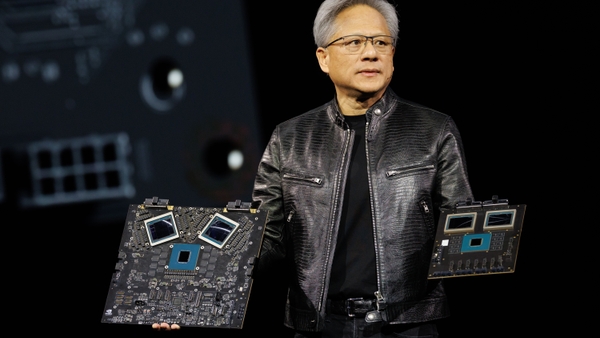
Groq’s value is magnified when you plug it into Nvidia’s roadmap. The Vera Rubin GPU line, slated for launch in the second half of 2026, already sits as the next major architecture after Blackwell. Embedding LPU logic into Vera Rubin allows Nvidia to ship a stack that handles both high-throughput training and ultra-low-latency inference from the same platform, with CUDA as the software front door. CUDA is Nvidia’s main moat: the programming model, libraries and tools that hyperscalers and enterprises already depend on. Once Groq-derived inference primitives live inside CUDA, a customer that standardizes on Nvidia hardware can handle model training and massive inference workloads without defecting to TPUs or custom ASICs. The SRAM-centric architecture also hits the P&L directly. High-bandwidth memory is one of the tightest bottlenecks and a major cost line in advanced GPUs. Reducing HBM requirements per inference job, and simplifying memory controllers, lifts gross margin potential over time. Nvidia already holds a clear gross-margin advantage over AMD; integrating Groq’s approach into Vera Rubin creates room for another leg higher in profitability as inference ramps through 2026–2028.
Free Cash Flow Machine: Why NASDAQ:NVDA Can Spend $20B Without Blinking
Three years ago, quarterly revenue at Nvidia was under $6 billion. Today the company is printing more than $22 billion of free cash flow in its strongest quarters, with trailing twelve-month FCF above $77 billion. At the end of fiscal Q3 2026 (ended October 26, 2025), Nvidia sat on $60.6 billion of cash and marketable securities against roughly $8.5 billion of total debt, implying a net cash position over $50 billion. Analysts modeling the current AI cycle project free cash flow above $200 billion per year by fiscal 2028 if the present trajectory holds. Against those numbers, a $20 billion Groq deal represents roughly one quarter’s worth of future free cash flow, not a structural stretch of the balance sheet. The transaction is fully supportable out of organic cash generation. That is the key difference between Nvidia’s M&A firepower and almost any prior semiconductor cycle: the company is buying technology from a position of extreme financial strength, not leveraging up to chase growth.
Why Buybacks Alone Don’t Move The Needle For NASDAQ:NVDA Anymore
Nvidia is already spending aggressively on share repurchases. In the most recent quarter, more than $12 billion went into buybacks. Yet the outstanding share count fell by only about 0.17%. At a market capitalization approaching $5 trillion, a one-percent reduction in float requires roughly $50 billion of buybacks at $187.96 per share. That arithmetic explains why management is leaning into Groq-style deals and will likely keep doing so. Even $100 billion per year in repurchases would mostly offset stock-based compensation and make only modest progress in shrinking the share base. The true compounding power now lies in converting free cash flow into additional strategic moats: proprietary architectures, exclusive or advantaged IP, and key engineering teams. The Groq transaction is a template for how Nvidia can do that repeatedly.
$5B Intel Stake: Strategic Alliance, Optionality And Capacity Hedge For NASDAQ:NVDA
Separate from Groq, Nvidia has taken a $5 billion equity position in Intel by purchasing about 214.7 million shares at $23.28 each in a private placement under a September agreement. U.S. antitrust regulators cleared the transaction in December, and the deal completed with Nvidia’s latest filing. For Intel, this is a critical capital infusion after years of strategic missteps, heavy foundry capex and margin compression. For Nvidia, it is an asymmetric shot on goal. Owning common equity in a historic rival gives Nvidia a financial claim on any successful Intel turnaround and, more importantly, influence and alignment if Intel’s foundry strategy eventually delivers competitive advanced nodes in the U.S. That matters because Nvidia’s dependence on a narrow set of foundries is both a business and geopolitical risk. A functioning Intel foundry with cutting-edge capacity gives NASDAQ:NVDA another lever in negotiating access, pricing and geographic diversification for future AI chips. If Intel executes, Nvidia benefits from both improved supply chain resilience and mark-to-market gains on the stake. If Intel fails, Nvidia has risked $5 billion against a free-cash-flow engine that throws off more than ten times that figure annually. The fact that the stock slipped only about 1.3% on the announcement while Intel barely moved shows that the market has not fully priced the strategic option value of this position.
Competitive Positioning: NASDAQ:NVDA Versus AMD, Intel And Custom AI Silicon
On relative valuation and growth, Nvidia remains the strongest name in the group. At roughly 25–27x forward earnings, Nvidia (NASDAQ:NVDA) trades at a discount to AMD at around 33x and far below Intel at more than 60x, despite consensus modeling Nvidia for the highest absolute earnings growth on the largest profit base. EPS is expected to rise about 57% this year and another roughly 61% next year. AMD’s projected 63% EPS growth in 2026 follows only about 20% growth in 2025, and from much lower earnings; Intel’s projected inflection is largely a rebound from extremely low margins. At the same time, Nvidia sits at the center of the AI infrastructure build-out, with CUDA entrenched as the default platform and DGX systems embedded across hyperscalers. The real strategic risk comes from custom chips rather than traditional CPU and GPU rivals. Google’s TPUs, internal accelerators at cloud giants, and national sovereign AI initiatives are all trying to reduce dependency on a single merchant vendor. Groq’s rise belonged to that wave: fast, efficient inference silicon designed to erode Nvidia’s share of inference workloads. By writing a $20 billion check and integrating Groq into Vera Rubin and CUDA, Nvidia turns one of the more credible emerging threats into a component of its own stack. That does not eliminate the TPU or custom ASIC challenge, but it resets the balance of power in inference just as workloads are shifting from training to model serving at scale.
China, H200 And The Re-Opening Of A $50B AI TAM For NASDAQ:NVDA
China remains a major swing factor for Nvidia. Export restrictions throttled shipments of the highest-end GPUs into the market earlier in the cycle, freezing a region that multiple sources estimate as a $50 billion AI accelerator opportunity. Recent approvals for H200 exports into China, with early talk of around 80,000 units in the initial phases, suggest that the channel is reopening under stricter product definitions. If Nvidia manages to ramp H200 and related products into Chinese demand without triggering new restrictions, the incremental revenue and profit contribution in 2026–2027 will be significant. The market is not fully discounting that upside because policy remains unstable. But against a backdrop where Nvidia is already delivering >$77 billion in free cash flow outside a fully normalized China business, any sustained resumption of shipments into that $50 billion TAM pushes the earnings and FCF trajectory higher than current consensus.
Capital Allocation Playbook: More Groq-Type Deals Ahead For NASDAQ:NVDA
The pattern is clear. Nvidia is generating more cash than it can productively deploy into buybacks alone at current scale. Management has already shown a willingness to write large checks to neutralize threats, capture talent and bolt on critical IP. The Groq non-exclusive licensing deal, priced at more than triple the last private valuation to secure LPU technology and senior engineers, illustrates how aggressively Nvidia will move when a strategically dangerous rival appears. With analysts projecting free cash flow above $200 billion annually by fiscal 2028, the company has room to pair ongoing buybacks with a pipeline of similar targeted transactions in AI chips, systems software, interconnects and developer tools. Monitoring Nvidia’s stock profile and insider activity is important here: if insiders continue to hold or add at higher prices while the company leans into strategic deals, it confirms that management sees long-duration value well above $187.96.
Valuation Scenarios And Price Targets For NASDAQ:NVDA
Starting from the current price near $187.96 and a forward P/E in the mid-20s, the baseline scenario assumes Nvidia delivers the roughly 57% and 61% EPS growth already modeled and the market is willing to pay 30x forward earnings for that profile. On that math, fair value lands around $227 per share, with the multiple still only modestly above the roughly 28x level ascribed to the broader “Magnificent Seven” basket. A more bullish, but realistic, scenario layered on top assumes Blackwell and Vera Rubin ship at volume, Groq-driven inference architectures improve gross margins, China H200 and H20 exports ramp within regulatory bounds, and custom accelerators only nibble at, rather than crater, Nvidia’s share. In that world, a move above $315 per share is reasonable as investors capitalize more than $200 billion in annual free cash flow at a mid-single-digit FCF yield. Current Street targets around $253 sit in the middle of those ranges, implying roughly 23% upside from $187.96 over twelve months.
Risk Map: What Can Go Wrong For NASDAQ:NVDA From Here
Key risks revolve around the durability of the AI capex cycle, the strength of the custom silicon challenge, and policy uncertainty. If hyperscalers normalize spending faster than expected in 2026–2027, AI infrastructure budgets could flatten, compressing growth and undermining the case for a 30x multiple. If TPUs or other in-house accelerators capture a larger share of inference than expected, Nvidia’s unit volumes and pricing power could come under pressure even with Groq integrated. The Groq deal itself carries execution risk: $20 billion for a company that cut its target from $2 billion to $500 million in revenue is only rational if Nvidia successfully embeds LPU ideas into mainstream products and extracts real margin and share gains. The $5 billion Intel stake hinges on Intel’s ability to stabilize its foundry roadmap; a continued deterioration there turns that position into pure financial drag. China remains a major policy wildcard: any new tightening in export rules could again choke off a large slice of the AI accelerator TAM. Finally, with NASDAQ:NVDA already priced as the core AI proxy in global equities, any disappointment on earnings, guidance or AI adoption narratives can erase hundreds of billions of market value in short windows.
Investment Stance On NASDAQ:NVDA After Groq And Intel
Taking the full picture together – a stock at about $187.96, a 25–27x forward multiple, a $20 billion Groq LPU pivot, a $5 billion Intel equity stake, more than $77 billion of trailing free cash flow, a net cash position above $50 billion, projected EPS growth of roughly 57% and 61% in back-to-back years, and a roadmap that fuses training and inference under CUDA – the risk-reward skew remains positive. At these levels, Nvidia (NASDAQ:NVDA) justifies a clear Buy rating, with a base case path toward $227 on 30x forward earnings and credible upside into the $300+ zone as Vera Rubin, Groq-enhanced inference and China shipments scale, while downside is cushioned by scale, cash and ecosystem depth. For investors able to tolerate volatility and think in 12–24 month time frames, the data still support a bullish stance on NASDAQ:NVDA rather than a cautious Hold or outright Sell.
That's TradingNEWS