US EQUITY INDEXES: RECORD LEVELS WITH VALUATIONS NEAR EXTREMES
The S&P 500 (SNPINDEX:^GSPC) trades around the 6,900–6,970 band after three straight calendar years of double-digit gains: roughly +24%, +23%, and +16%. That sequence has pushed the Shiller CAPE valuation metric to about 39, a zone reached only around the peak of the dot-com boom. At the same time, the Nasdaq Composite (NASDAQINDEX:^IXIC) sits near 23,600–23,700, while the Dow Jones Industrial Average (DJINDEX:^DJI) holds just under 49,500, with all three indices either at or just off all-time highs. Short term, this is classic late-cycle price action: extended valuations, strong tape, and high expectations priced into growth, AI, and high-beta names.
BREADTH IMPROVES AS MEGACAP TECH LEADERSHIP SOFTENS
For several years, beating the market meant concentrating in the so-called Magnificent 7. That trade is no longer one-way. The dedicated Magnificent 7 index gained about 25% last year versus roughly +16% for the S&P 500, but that outperformance was driven disproportionately by Alphabet (NASDAQ:GOOGL) and Nvidia (NASDAQ:NVDA), while several mega-caps lagged the benchmark. Leadership is rotating: flows are moving into the rest of the S&P 500, mid-caps, and Russell 2000 small caps, which just printed new record highs. The implication for this week: stock picking matters more than at any time in this cycle – passive exposure to the same seven names is no longer enough to outperform.
VALUATION RISK: SHILLER CAPE AT 39 AND WHAT IT MEANS FOR 2026
With the Shiller CAPE ratio around 39, the market is in rare territory historically. The last time valuations sat at this type of altitude, the S&P 500 ultimately gave back more than 40% from the 2000 peak over the following three years. That does not mean a 2000-style collapse is guaranteed, but it does mean forward returns are likely to be more volatile and more path-dependent. The most realistic weekly and monthly scenario is a pattern of sharp pullbacks inside a broader uptrend, not a smooth grind higher. For professional positioning, this is a trim-strength, buy-selective-weakness environment, not a place to add passive exposure at any price.
MACRO BACKDROP: LOWER RATES, TARIFF NOISE, AND AN AI BUBBLE SCARE
The bullish side of the tape is straightforward: the Federal Reserve cut rates three times in the final stretch of last year, signaling a durable shift away from the peak-tightening regime. Lower policy rates cut funding costs across the S&P 500, ease pressure on consumers, and lift discounted cash-flow valuations, especially for long-duration, growth-heavy sectors. Offsetting that, the market had to absorb President Trump’s tariff threats and negotiations, which temporarily hit multinationals like Apple (NASDAQ:AAPL) and retailers such as Target (NYSE:TGT) that rely on imported product. Another short-term wobble came when investors started to fear an AI bubble, pushing some to lock in gains in NVDA, Advanced Micro Devices (NASDAQ:AMD) and other AI beneficiaries. In both cases the market sold off, quickly reassessed earnings strength, and resumed the uptrend. That pattern – macro headline shock, fast risk-off, then rapid recovery – is exactly what you should expect again if new tariff details or AI-bubble narratives flare this week.
STOCK MARKET TODAY: BANKS DRAG THE DOW WHILE AI AND TECH HOLD THE NASDAQ
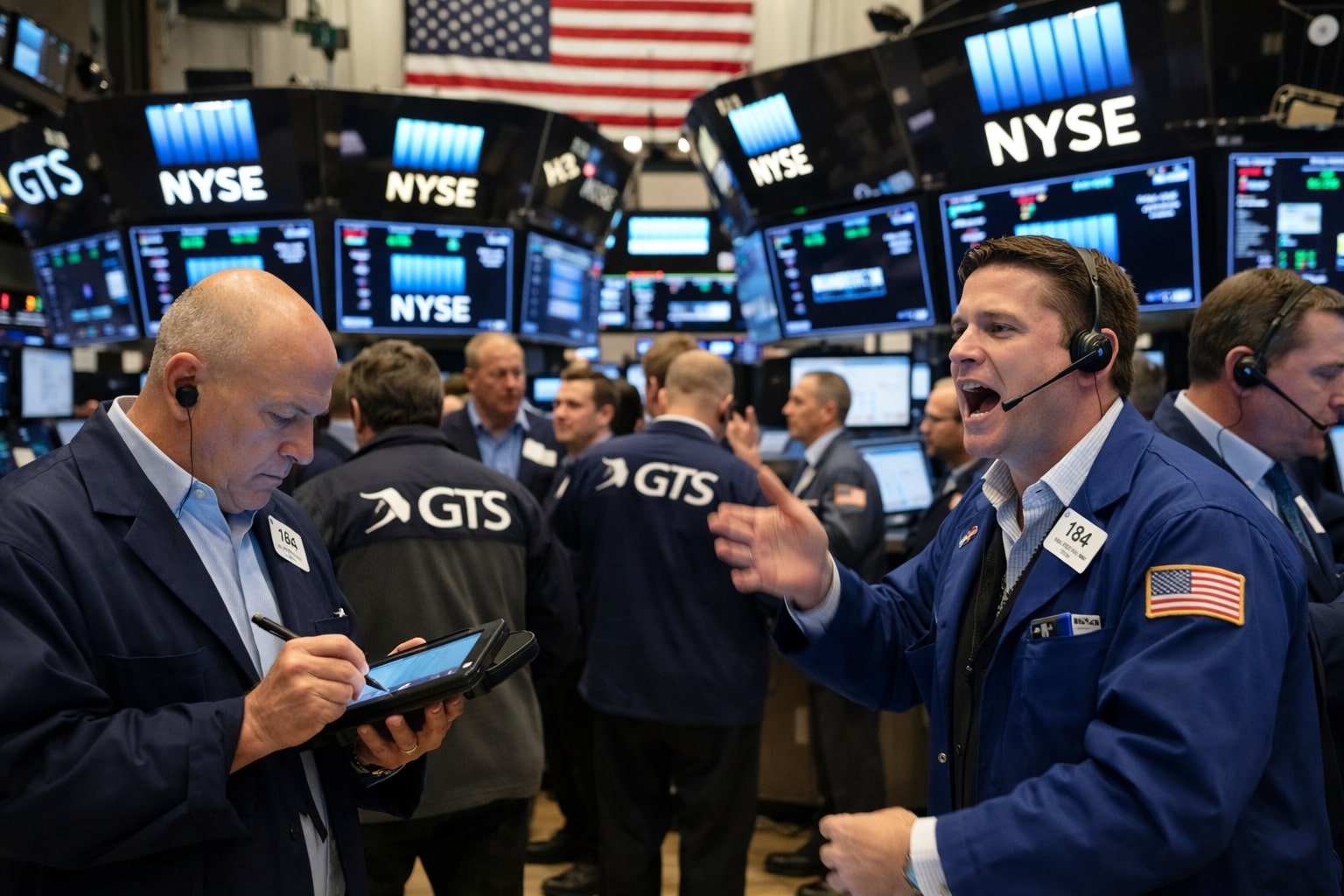
The latest daily tape shows how fragile sector leadership is under the surface. On one of the most recent sessions, the S&P 500 dipped about 0.34% to 6,920.93, the Dow dropped roughly 0.94% to 48,996.08, and the Nasdaq Composite still managed a 0.16% gain. The driver was a targeted sell-off in financials: JPMorgan Chase (NYSE:JPM) and Bank of America (NYSE:BAC) slipped as traders repositioned ahead of earnings and digested mixed labor data. At the same time, niche industrial Apogee Enterprises (NASDAQ:APOG) slid after missing revenue expectations and guiding cautiously. Despite the pressure in banks and cyclicals, NVDA eked out a small gain, confirming that AI demand remains robust enough to offset pockets of profit-taking. Crude oil also traded lower after Washington signaled tighter control over Venezuelan crude sales, weighing on energy names and reinforcing the idea that this is now a stock-specific market, not a one-factor macro trade.
POLICY NOISE AND SENTIMENT SHOCKS: DEFENSE, HOMEBUILDERS AND BLACKSTONE
Social media continues to inject intraday volatility into otherwise stable sectors. A recent Trump post targeting institutional investment in single-family homes hit Blackstone (NYSE:BX) as investors marked down the embedded value of large rental portfolios and anticipated tighter rules. Earlier comments on defense and housing similarly jostled contractors and homebuilders. None of this changes fundamental earnings power overnight, but it increases headline risk premiums and justifies tighter short-term stops in policy-sensitive sectors.
EARNINGS SEASON KICKOFF: BIG BANKS SET THE TONE FOR THE S&P 500
The next major catalyst for S&P 500 direction is the start of Q4 and full-year earnings from the large banks. Consensus expects Q4 2025 S&P 500 earnings growth of roughly 8.3%, the 10th consecutive quarter of positive EPS expansion, supported by a U.S. economy that has consistently beaten gloomier forecasts: upward-revised GDP, resilient consumer spending, and gradually cooling inflation. For this week, the focus is on whether financials confirm that narrative.
JPMORGAN (JPM): RECORD PRICE, ROBUST TRADING, MODERATING GROWTH
JPMorgan (NYSE:JPM) goes into Tuesday’s print at or near record territory around $335. In Q3, JPMorgan delivered EPS of $5.07, up 16% year-on-year, on revenue of $46.4 billion (+9%). Trading was the standout: fixed income revenue climbed 21%, equity trading surged 33%, and investment-banking fees rebounded 16%, signaling a healthier deal calendar. For Q4, the market is looking for EPS around $4.94 (+3%) and revenue near $46.2 billion (+7%). That is still solid, but growth is slowing, and with the Fed’s three rate cuts compressing the top of net-interest margins while deposit costs lag only gradually, investors will dissect the NIM line closely. Technically, immediate support sits near $320 (January low / prior breakout), with trendline support around $310 and a deeper line in the sand at $300. At these valuation and price levels, JPM screens as a Hold with a mild bullish bias: upside is still open if Q4 beats on IB and trading, but risk-reward is no longer asymmetric after a relentless run.
OTHER MONEY-CENTER BANKS: BAC, C, WFC, GS, MS INTO Q4 NUMBERS
The rest of the money-center complex – Bank of America (NYSE:BAC), Citigroup (NYSE:C), Wells Fargo (NYSE:WFC), Goldman Sachs (NYSE:GS), Morgan Stanley (NYSE:MS) – will confirm whether JPM’s strength is idiosyncratic or systemic. Q3 trends argue for cyclical resilience: rising deal activity, better trading revenue on higher volatility, and credit costs that remain well-behaved despite pockets of consumer stress. The near-term risk is guidance: if managements lean hard into margin pressure from lower rates or signal a slower loan pipeline for 2026, financials can cap the Dow even if tech keeps the Nasdaq near highs. On balance, the complex screens as selective Buy: favor diversified franchises with strong fee and trading engines (JPM, GS, MS) over pure NIM plays more exposed to the flatting curve.
DELTA AIR LINES (DAL): CYCLICAL WINNER LEVERAGED TO CHEAPER OIL AND PREMIUM DEMAND
Delta Air Lines (NYSE:DAL) has quietly become one of the strongest cyclical performers in the large-cap space. From an April low near $34.40, the stock ripped higher to about $73.10, marking fresh records. The fundamental driver is a mix of lower fuel, premium demand, and corporate travel recovery. For Q3, Delta reported +14% profit growth and +6% revenue growth, but the mix was important: main-cabin revenue dipped, while corporate revenue rose 8% and premium cabins grew 9%. That mix upgrades the quality of earnings and justifies a higher multiple. With oil prices down roughly 18% over 2025, jet fuel has become a tailwind instead of a headwind. Management guided Q4 EPS to $1.60–$1.90 (midpoint $1.75) versus Street expectations around $1.65. Technically, the stock trades above both its 50- and 200-day SMAs. First support comes in near $68.90, then $62.50 and $55.50 on deeper pullbacks. Despite a modest bearish RSI divergence, DAL remains a Buy on dips, not a fade, as long as oil stays contained and premium demand holds.
TAIWAN SEMICONDUCTOR (TSM): PILLAR OF THE AI/CHIP CYCLE AT NEW HIGHS
Taiwan Semiconductor (NYSE:TSM) is central to the AI and high-performance computing story driving the Nasdaq. Over the last six quarters, TSM has posted earnings growth between 31% and 79%, with revenue growth running 30%–54% as hyperscalers and chip designers ramp advanced node demand. December revenue numbers showed a 20.4% year-on-year jump, confirming strong exit velocity into Q4. Street expectations call for Q4 EPS of about $2.84 (+29%) and revenue around $32.8 billion (+37%). The stock recently printed a record near $333 before consolidating. It trades above both the multi-month uptrend and the 50/200-day SMAs, with first support around $310 and a more structural line near $277. Given the growth profile and its choke-point role in global foundry capacity, TSM still screens as a Buy, though not a cheap one. For this week, guidance on 2026 capex and AI-related wafers will be as important as the backward-looking beat.
AI LEADERS: NVDA AND AMD STILL CRITICAL, BUT EXPECT VOLATILITY
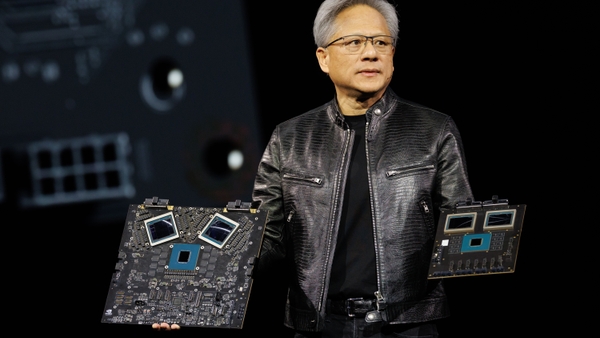
The AI complex remains the emotional center of the Nasdaq. Nvidia (NASDAQ:NVDA) continues to trade with a premium justified by data-center demand, but investors have started to whisper about “AI fatigue” and bubble risk, triggering short bursts of profit-taking. AMD (NASDAQ:AMD), trading around $203, boasts a $331 billion market cap, with gross margin near 44.3% and a 52-week range of $76.48–$267.08. These valuations imply very high expectations for GPU and accelerator share gains. In the context of a CAPE at 39, AI leaders are High-Beta Buy/Hold: structurally bullish over multi-year horizons, but vulnerable to 10%–20% corrections on any misstep or macro scare. Position sizing and time horizon are critical here.
EMERGING MARKETS: EEM OUTPERFORMS AS THE DOLLAR SOFTENS
Outside the U.S., the iShares MSCI Emerging Markets ETF (NYSEARCA:EEM) has turned from sideshow to leader. Over the last 12 months, EEM is up around 34%, outpacing the S&P 500 as the U.S. dollar weakened and investors priced in further Fed cuts. The ETF, with about $22.4 billion in AUM and a 2.1% dividend yield, has pulled in roughly $5.5 billion in net inflows versus $3 billion in outflows, signaling real institutional rotation into EM. With a 52-week range of $38.19–$57.43 and a current price near $57, EEM is pressing the top of that band. Given the macro tailwind of softer USD and improving global risk appetite, EM remains a Buy/Hold, with near-term risk centered on any surprise re-acceleration in U.S. inflation that forces the Fed to slow its easing path.
ALIBABA (BABA): SINGLE-STOCK LEVERAGE TO THE EM TRADE AND AI CLOUD
A high-conviction way to express the EM theme is Alibaba Group (NYSE:BABA), which carries about a 3.16% weight in EEM. BABA’s market cap sits around $368 billion. The stock trades near $150.93, down about 2.3% on the referenced session, with a 52-week range of $80.06–$192.67 and a modest 0.63% dividend yield. On valuation, BABA changes hands at roughly 20.9x trailing earnings with a forward P/E near 17, while the Street’s average target of $191.84 implies about 24% upside. Technically, the stock broke to new 52-week highs last September, then pulled back in a controlled fashion to retest former resistance around $150, which now acts as support. A sustained break above $160 would confirm a new leg higher. Although institutions were net sellers last year (about $29 billion sold vs $4 billion bought) after a massive rally from roughly $80 to just under $193, that looks more like profit-taking than structural abandonment. The key medium-term catalyst is AI and cloud: Alibaba controls roughly one-third of China’s AI cloud market and has committed over $50 billion over the next three years to AI and cloud infrastructure. With Chinese regulators green-lighting limited access to advanced chips such as NVIDIA’s H-series, BABA is positioned to monetize AI workloads, not just e-commerce. Net-net, BABA is a Buy for investors comfortable with China risk, and it is likely to outperform EEM if EM momentum persists.
POSITIONING DATA: FUTURES AND COMMODITY FLOWS AROUND EQUITIES
CFTC data show non-commercial positioning in S&P 500 futures still net short around –106.1K contracts vs –94.4K previously. That persistent short base can fuel short-covering spikes on any upside surprise in earnings or macro data. In commodities, gold net non-commercial length has eased slightly from about 231.2K to 227.6K contracts, while oil and FX positioning show typical tactical swings rather than structural extremes. From an equity perspective, the key takeaway is that there is still fuel on the sidelines: bears are not capitulated, which paradoxically supports the broader rally on good news.
WEEKLY INDEX OUTLOOK: NASDAQ, S&P 500, DOW AND RUSSELL 2000
Into the coming week, the setup for U.S. indices is defined by record-high prices, stretched valuation, but still-constructive earnings and liquidity.
For the S&P 500, immediate resistance is the 7,000 psychological line, with short-term support around 6,850–6,900. A clean beat and constructive guidance from JPM and peers can keep the index grinding higher, but any earnings disappointment from the banks or a surprise hawkish tone from Fed speakers will likely trigger a 3%–5% pullback.
The Nasdaq Composite is leveraged to TSM, NVDA, AMD, and the rest of the AI complex. As long as TSM confirms strong demand and AI leaders avoid guidance cuts, the Nasdaq can continue to outperform, especially if rates continue to drift lower. Expect higher volatility here: intraday moves of 1.5%–2.5% in either direction are very plausible around earnings headlines.
The Dow Jones Industrial Average is more vulnerable to the bank tape. If JPM, GS, MS and industrial cyclicals deliver solid prints, the Dow can hold near the 49,000–49,500 band and potentially break higher. Weak bank guidance would hit the Dow harder than the Nasdaq and S&P, given its sector composition.
The Russell 2000 and broader small-cap complex have started to outperform as rate-cut expectations boost high-beta domestic names. With record highs already printed, the near-term question is whether earnings and credit conditions validate the move. For now, small caps are a tactical Buy on modest pullbacks, but not a place to chase extended breakouts blindly.
STRATEGIC STANCE: BUY, SELL OR HOLD ACROSS THE BOARD
Pulling it together:
-
U.S. indices (S&P 500, Nasdaq, Dow): at a Shiller CAPE of 39 and after three consecutive double-digit up years, the broad U.S. market is a Hold with a short-term bearish tilt. Upside from here exists but is no longer cheap. Expect at least one meaningful pullback in 2026; use that to add, not chase at current levels.
-
Big banks (JPM, BAC, C, WFC, GS, MS): selective Buy, with preference for diversified fee-and-trading franchises. Valuations are not stretched, and earnings momentum plus still-solid credit quality support further upside if Q4 prints are clean.
-
Delta Air Lines (DAL): structurally a Buy on weakness. Earnings leverage to cheaper fuel and premium demand justifies a premium multiple, but wait for dips towards first support rather than paying record-high prices blindly.
-
Taiwan Semiconductor (TSM): still a Buy, but position size should respect the fact that the stock is at all-time highs and sentiment around AI is euphoric. Any guidance wobble will hurt, but the long-term foundry story is intact.
-
AI megacaps (NVDA, AMD, core AI complex): High-conviction long-term Buy, short-term trading Sell/Hold if you are over-allocated. Trim into strength, be ready to reload on 15%–25% corrections rather than trying to time the exact top.
-
Emerging markets (EEM): Buy/Hold as long as the dollar trend remains soft and Fed cuts stay on track. Valuations and earnings growth look more reasonable than U.S. megacaps.
-
Alibaba (BABA): Buy as a leveraged, stock-specific way to play EM and AI cloud together, with technical support around $150 and a clear upside roadmap if price breaks and holds above $160.
Net message for Trading News readers: the index-level trade is no longer obviously cheap, but the opportunity set inside the market is still rich. This week is about watching whether banks, airlines, and semiconductors confirm the earnings power implied by record-high prices. If they do, bulls keep control. If they blink, the first real stress test of this high-valuation regime arrives immediately.
That's TradingNEWS